英文互译镜像站

Horten H.XVIII

Last updated
H.XVIII
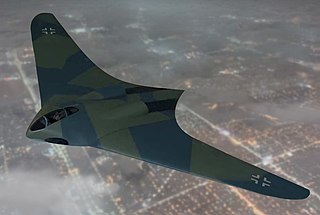
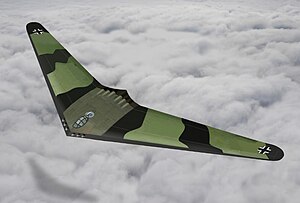
Horten H.XVIII concept art.jpg
Artist's concept of the aircraft in flight
General information
Type Long-range bomber
National origin Nazi Germany
Designer
History
Developed from Horten Ho 229

The Horten H.XVIII (18) was a proposed German World War II intercontinental bomber, designed by the Horten brothers. The unbuilt H.XVIII represented, in many respects, a scaled-up version of the Horten Ho 229, a prototype jet fighter. The H.XVIII was one of many proposed designs for the Langstreckenbomber, [1] and would have carried sufficient fuel for transatlantic flights.

Contents

Design

In recent years, software modelling has suggested that the stealth and speed of the Hortens' flying wing jet designs would have made interception, prior to bombing, difficult and unlikely. [2]

The ability of bomber crews, in an aircraft such as the Horten H.XVIII, to attack targets in North America, might have been hampered by existing and emerging Allied air defence strategies and technologies, such as:

Variants

H.XVIIIA

The A model of the H.XVIII was a long, smooth blended wing body. Its six turbojet engines were buried deep in the wing and the exhausts centered on the trailing end. Resembling the Horten Ho 229 flying wing fighter there were many odd features that distinguished this aircraft; the jettisonable landing gear and the wing made of wood and carbon based glue, are but two. The aircraft was first proposed for the Langstreckenbomber competition initiated in late 1944 and was personally reviewed by Hermann Göring: after review, the Horten brothers (with deep dissatisfaction) were forced to share design and construction of the aircraft with Junkers and Messerschmitt engineers, who wanted to add a single rudder fin as well as suggesting underwing pods to house the engines and landing gear. [2]

H.XVIIIB

The B model of the H.XVIIIB was generally the same as the A model, except the four (down from six) engines and four-wheel retractable landing gear were now housed in underwing pods, and the three-man crew housed under a bubble canopy. The aircraft was to be built in huge concrete hangars and operate off long runways with construction due to start in autumn 1945, but the end of the war came with no progress made. Defensive armament was considered unnecessary due to the expected high performance. [2]

H.XVIIIC/B-2

The C model of the H.XVIII was based on the airframe of the H.XVIIIA with a huge tail. It had an MG 151 turret set in the middle rear of the wing and with six BMW 003 turbojets slung under the wings; this was designed by Messerschmitt and Junkers engineers. It is uncertain if this overall design was directly developed by the Horten brothers or their manufacturer, as there is little surviving evidence of this proposed version. It was eventually rejected by the Horten brothers, as it was not a major improvement over the Ho XVIIIA.

Specifications (H.XVIIIA)

Data from [3]

General characteristics

Performance

Armament

See also

Related development

Aircraft of comparable role, configuration, and era

Related lists

Related Research Articles

<span class="mw-page-title-main">Horten Ho 229</span> German prototype fighter/bomber (1944)

The Horten H.IX, RLM designation Ho 229 was a German prototype fighter/bomber designed by Reimar and Walter Horten to be built by Gothaer Waggonfabrik. Developed at a late stage of the Second World War, it was one of the first flying wing aircraft to be powered by jet engines.

<span class="mw-page-title-main">Horten brothers</span> German aircraft pilots (1910s–1990s)

Walter Horten and Reimar Horten, sometimes credited as the Horten Brothers, were German aircraft pilots. Walter was a fighter pilot on the Western Front, flying a Bf 109 for Jagdgeschwader 26 in the first six months of World War II; he eventually became the unit's technical officer. Reimar was also trained as a Messerschmitt Bf 109 pilot; however, later in August 1940, he was transferred to the glider pilot school in Braunschweig. He earned his PhD in mathematics from the University of Göttingen, having resumed his studies in 1946 with help from Ludwig Prandtl. The Hortens designed the world's first jet-powered flying wing, the Horten Ho 229.

<span class="mw-page-title-main">Junkers Ju 287</span> Prototype German jet bomber

The Junkers Ju 287 was a multi-engine tactical jet bomber built in Nazi Germany in 1944. It featured a novel forward-swept wing, and the first two prototypes were among the very few jet propelled aircraft ever built with fixed landing gear.

<span class="mw-page-title-main">Henschel Hs 132</span> 1945 prototype multi-role combat aircraft by Henschel

The Henschel Hs 132 was a jet-powered dive bomber and interceptor aircraft designed and produced by the German aircraft manufacturer Henschel Flugzeugwerke AG. It was developed during the latter portion of the Second World War with the intention of being adopted by the Luftwaffe, but this did not come to fruition.

The Yakovlev Yak-26, OKB designation Yak-123, was a Soviet tactical supersonic bomber aircraft flown at the Tushino air show on 24 June 1956. The model did not enter service.

<span class="mw-page-title-main">Ilyushin Il-6</span> Soviet long range bomber by Ilyushin

The Ilyushin Il-6 was a Soviet long-range bomber developed from the Ilyushin Il-4 during 1942. Originally intended as a high-speed replacement for the Il-4, it was recast as a very long-range bomber with fuel-conserving diesel engines before production of the single prototype began in December 1942. Flight testing showed controllability issues when landing at high weights and the engines proved to be hard to start at low temperatures and were slow to respond to throttle movements. Further development was canceled in 1944.

<span class="mw-page-title-main">Heinkel He 118</span> German dive bomber

The Heinkel He 118 was a prototype German monoplane dive bomber design that lost out to the Junkers Ju 87 Stuka in the 1930s, and was never ordered by the Luftwaffe.

<span class="mw-page-title-main">Horten H.IV</span> German single-seat glider, 1944

The Horten H.IV is a German tailless flying wing glider in which the pilot was to lie in a prone position to reduce the frontal area, and hence drag. It was designed by Reimar and Walter Horten in Göttingen. Four were built between 1941 and 1943. They were flown in a number of unofficial competitions in Germany during World War II. After the war the flying examples were transported to the United Kingdom and the United States where several contest successes were achieved.
<span class="mw-page-title-main">FMA I.Ae 38</span> Type of aircraft

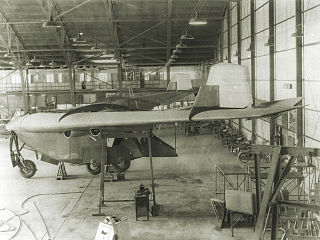
The DINFIA IA 38 was a 1960s Argentine four-engine experimental tailless transport aircraft, designed under the direction of Reimar Horten and based on the German Horten Ho VIII project and built by the DINFIA.

<span class="mw-page-title-main">Blohm & Voss P 194</span> Type of aircraft

The Blohm & Voss P 194 was a German design for a mixed-power Stuka or ground-attack aircraft and tactical bomber, during World War II.

<span class="mw-page-title-main">I.Ae. 34 Clen Antú</span> Type of aircraft

The I.Ae. 34 Clen Antú, sometimes known as the Horten XVa after its designer Reimar Horten, was a two-seat tailless glider built in Argentina. Two single-seat variants competed unsuccessfully in the 1952 World Gliding Championships.
<span class="mw-page-title-main">FMA I.Ae. 37</span> Argentine jet fighter prototype

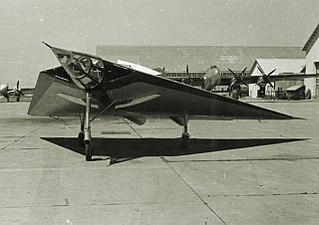
The FMA I.Ae. 37 was a prototype jet fighter developed in Argentina during the 1950s. It never flew and was cancelled in 1960.

<span class="mw-page-title-main">I.Ae. 41 Urubú</span> 1950s Argentinian flying wing glider

The I.Ae.41 Urubú was a two-seat flying wing tailless glider, built in Argentina by the Fábrica Militar de Aviones (FMA) in the 1950s.

<span class="mw-page-title-main">Horten H.III</span> German single-seat glider, 1937

The Horten H.III is a flying wing sailplane built by Walter and Reimar Horten in Germany from 1937 to 1944.

<span class="mw-page-title-main">Horten H.II</span> Type of aircraft

The Horten H.II Habicht (Hawk) was a German flying wing glider built in Germany in 1935. Four, including one flown mostly as a motorglider, were built. One of the gliders was used to test the aerodynamics of a prototype World War II Horten jet fighter-bomber.
<span class="mw-page-title-main">Horten H.V</span> Type of aircraft

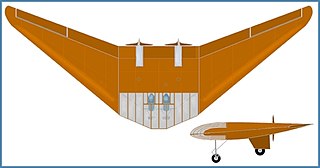
The Horten H.V was a delta-winged, tail-less, twin-engined motor-glider designed and built in the late 1930s and early 1940s by Walter and Reimar Horten in Germany. The H.V aircraft were used for various experimental duties, including: innovative structure, performance, stability and control of flying wing aircraft. The first H.V was the first aircraft to be built using an all composite material structure.

<span class="mw-page-title-main">Horten H.I</span> German single-seat glider, 1933

The Horten H.I was a German flying wing research glider built by Walter and Reimar Horten in 1933.

<span class="mw-page-title-main">Horten H.VII</span> Flying wing prototype

The Horten H.VII was a flying wing fighter-trainer aircraft designed by the Horten brothers in Nazi Germany during World War II.

The Horten H.VIII was a flying wing research aircraft designed by Reimar Horten during World War II and only partly built by the end of the war.

<span class="mw-page-title-main">Horten H.XIII</span> WWII German flying wing aircraft

The Horten H.XIII was an experimental flying wing aircraft designed by the Horten brothers during World War II.
References

Notes

  1. Sharp, D., Luftwaffe: Secret Bombers of the Third Reich. Mortons 2016.
  2. 1 2 3 Myhra, 1998. pp.[ page needed ]
  3. Horten, Reimar; Peter F. Selinger (1985). Nürflugel (in German) (1st ed.). Graz: H. Wieshaupt Verlag. pp. 165–167. ISBN   3-900310-09-2.

Bibliography

镜像站群 泛镜像站群 时间因子转换镜像 站点核心词加权 站点克隆软件