History
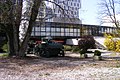
The museum was founded on 13 November 1945 as the Museum of the Liberation of Sarajevo. The museum has had several names during its life, adopting the name Museum of National Revolution of Bosnia and Herzegovina in 1949, before changing to Museum of Revolution of Bosnia and Herzegovina in 1963. It adopted the current name of Historical Museum of Bosnia and Herzegovina in 1993. [1] [2] The museum moved into its current, purpose built building at Zmaja od Bosne 5 street in 1963. [1]
Collections
The museum holds more than 400,000 historical artifacts, [8] with the largest part of the collection referring to the Second World War and the struggle for liberation from fascism. [9] Prior to 1993, the museum's sole focus was the War period, however upon changing name, the museum started to cover the country's history more broadly. [1] Now, the collection holds items covering a number of time periods, with permanent exhibitions looking at the Yugoslav Wars and a photographic history of Sarajevo. [10]
This page is based on this
Wikipedia article Text is available under the
CC BY-SA 4.0 license; additional terms may apply.
Images, videos and audio are available under their respective licenses.