Taxonomy
The genus Prionops was introduced in 1816 by the French ornithologist Louis Vieillot to accommodate a single species, "Le Geoffroy", that had been described in 1799 by the French naturalist François Levaillant based on specimens collected in Senegal. [1] [2] Levaillant did not coin a Latin name for "Le Geoffroy" but in 1809 George Shaw introduced the binomial name Lanius plumatus for Levaillant's bird. [3] This species, the white-crested helmetshrike, is the type species of the genus Prionops. [4] [5] The genus name combines the Ancient Greek πριων/priōn, πριονος/prionos meaning "a saw" with ωψ/ōps, ωπος/ōpos meaning "eye". [6]
The genus contains eight species: [7]
Description and ecology
This is an African group of species which are found in scrub or open woodland. They are similar in feeding habits to shrikes, hunting insects and other small prey from a perch on a bush or tree.
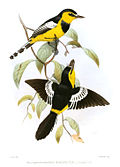
Although similar in build to the shrikes, these tend to be colourful species with the distinctive crests or other head ornaments, such as wattles, from which they get their name.
Helmetshrikes are noisy and sociable birds, some of which breed in loose colonies. They lay 2–4 eggs in neat, well-hidden nests. [8]
This page is based on this
Wikipedia article Text is available under the
CC BY-SA 4.0 license; additional terms may apply.
Images, videos and audio are available under their respective licenses.