英文互译镜像站

HD 196885

Last updated
HD 196885
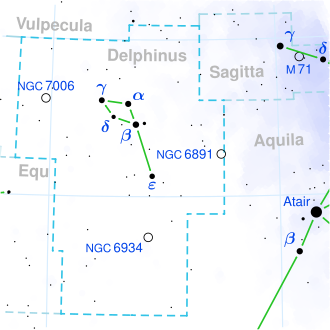
Delphinus constellation map.svg
Red circle.svg
Location of HD 196885 (circled in red)
Observation data
Epoch J2000       Equinox J2000
Constellation Delphinus
Right ascension 20h 39m 51.87484s [1]
Declination +11° 14 58.7002 [1]
Apparent magnitude  (V)6.39 [2]
Characteristics
Evolutionary stage main-sequence star
Spectral type F8V [3] + M1±1V [4]
B−V color index 0.559±0.006 [2]
Astrometry
Radial velocity (Rv)−30.13±0.09 [2] km/s
Proper motion (μ)RA: +71.915 mas/yr [1]
Dec.: +89.318 mas/yr [1]
Parallax (π)29.4076±0.0272  mas [1]
Distance 110.9 ± 0.1  ly
(34.00 ± 0.03  pc)
Absolute magnitude  (MV)3.76 [2]
Orbit [5] :7
PrimaryHD 196885 A
CompanionHD 196886 B
Period (P)69.045+0.533
−0.111
  yr
Semi-major axis (a)19.778+0.108
−0.019
  AU
Eccentricity (e)0.417+0.001
−0.004
Inclination (i)120.427°
Longitude of the node (Ω)79.150°
Periastron epoch (T)1982.886 AD
Argument of periastron (ω)
(secondary)
231.464°
Details [5]
A
Mass 1.3±0.1  M
Radius 1.35±0.10 [6]   R
Luminosity 2.611±0.007 [1]   L
Surface gravity (log g)4.46±0.02  cgs
Temperature 6,340±39  K
Metallicity [Fe/H]+0.29±0.05  dex
Rotation 15 days [7]
Rotational velocity (v sin i)7.3±1.5 [7]  km/s
Age 1.5—3.5  Gyr
B
Mass 0.45±0.01  M
Other designations
BD+10°4351, GC 28784, HD 196885, HIP 101966, HR 7907, SAO 106360, WDS J20399+1115, GCRV 12946, GSC 01092-01778, 2MASS J20395188+1114588 [8]
Database references
SIMBAD data
Exoplanet Archive data

HD 196885 is a binary star system in the northern constellation of Delphinus. It comprises a pair of stars, HD 196885 A and HD 196885 B, on a 69-year eccentric orbit. The primary star has one known planet. [5]

Contents

Stellar properties

HD 196885 A (center) and B (top left) imaged by SPHERE HD 196885 AB SPHERE.tif
HD 196885 A (center) and B (top left) imaged by SPHERE

The primary star is near the lower limit of visibility to the naked eye with an apparent visual magnitude of 6.39. [2] It is located at a distance of 110.9  light-years from the Sun. [1] It is drifting closer with a radial velocity of −30 km/s, and is expected to come to within 52.5 light-years in 836,000 years. [2]

The secondary, component B, is a red dwarf star separated by 0.6 arcseconds from the primary star that was discovered in 2006 with NaCo at VLT. [9] [4] It has a class in the range M1V to M3V [4] with 51% of the Sun's mass. [5]

The star BD+10 4351B, located 192 arcseconds away from HD 196885, was once thought to be a possible third component of the system, [10] but Gaia astrometry shows a smaller parallax, indicating that it is an unrelated background star. [11]

Planetary system

In 2004, an exoplanet, HD 196885 Ab, was announced to be orbiting the star HD 196885 A in a 386-day orbit. [12] Follow-up work published in 2008 did not confirm the original candidate but instead found evidence of a planet in a 3.63 years orbit. [7] Perturbation by the secondary star in this system may have driven the planet into a high inclination orbit. [13] The planetary existence was confirmed and parameters were refined by 2022. [5]

The HD 196885 planetary system [5] :7
Companion
(in order from star)
Mass Semimajor axis
(AU)
Orbital period
(years)
Eccentricity Inclination Radius
b 3.394+0.702
−0.264
  MJ
2.383+0.002
−0.004
3.485+0.001
−0.016
0.444+0.013
−0.005
143.041+6.572
−4.582
°

See also

References

  1. 1 2 3 4 5 6 7 Vallenari, A.; et al. (Gaia collaboration) (2023). "Gaia Data Release 3. Summary of the content and survey properties". Astronomy and Astrophysics. 674: A1. arXiv: 2208.00211 . Bibcode:2023A&A...674A...1G. doi: 10.1051/0004-6361/202243940 . S2CID   244398875. Gaia DR3 record for this source at VizieR.
  2. 1 2 3 4 5 6 Anderson, E.; Francis, Ch. (2012). "XHIP: An extended hipparcos compilation". Astronomy Letters. 38 (5): 331. arXiv: 1108.4971 . Bibcode:2012AstL...38..331A. doi:10.1134/S1063773712050015. S2CID   119257644.
  3. Gray, R. O.; et al. (2001), "The Physical Basis of Luminosity Classification in the Late A-, F-, and Early G-Type Stars. I. Precise Spectral Types for 372 Stars", The Astronomical Journal, 121 (4): 2148, Bibcode:2001AJ....121.2148G, doi:10.1086/319956, S2CID   117076031
  4. 1 2 3 Chauvin, G.; et al. (2007). "Characterization of the long-period companions of the exoplanet host stars: HD 196885, HD 1237 and HD 27442". Astronomy and Astrophysics. 475 (2): 723–727. arXiv: 0710.5918 . Bibcode:2007A&A...475..723C. doi:10.1051/0004-6361:20067046. S2CID   16950822.
  5. 1 2 3 4 5 6 Chauvin, G.; Videla, M.; et al. (July 2023). "Chasing extreme planetary architectures. I. HD 196885 Ab, a super-Jupiter dancing with two stars?". Astronomy & Astrophysics . 675: A114. arXiv: 2211.00994 . Bibcode:2023A&A...675A.114C. doi: 10.1051/0004-6361/202244502 .
  6. Ghezzi, L.; Cunha, K.; et al. (September 2010). "Stellar Parameters and Metallicities of Stars Hosting Jovian and Neptunian Mass Planets: A Possible Dependence of Planetary Mass on Metallicity". The Astrophysical Journal . 720 (2): 1290–1302. arXiv: 1007.2681 . Bibcode:2010ApJ...720.1290G. doi: 10.1088/0004-637X/720/2/1290 .
  7. 1 2 3 Correia, A. C. M.; et al. (2008). "The ELODIE survey for northern extra-solar planets. IV. HD 196885, a close binary star with a 3.7-year planet". Astronomy and Astrophysics . 479 (1): 271–275. arXiv: 0711.3343 . Bibcode:2008A&A...479..271C. doi:10.1051/0004-6361:20078908. S2CID   119261807.
  8. "HD 196885". SIMBAD . Centre de données astronomiques de Strasbourg . Retrieved 2020-08-08.
  9. Chauvin, G.; et al. (2006). "Probing long-period companions to planetary hosts. VLT and CFHT near infrared coronographic imaging surveys". Astronomy and Astrophysics. 456 (3): 1165–1172. arXiv: astro-ph/0606166 . Bibcode:2006A&A...456.1165C. doi:10.1051/0004-6361:20054709. S2CID   15611548.
  10. "HD 196885 A page". Geneva Observatory. Archived from the original on 2008-05-09. Retrieved 2008-08-19.
  11. "TYC 1096-637-1". SIMBAD . Centre de données astronomiques de Strasbourg.
  12. "The Planet Around HD 196885". California & Carnegie Planet Search Team (Internet Archive link). Archived from the original on 2004-12-27. Retrieved 2008-08-19.
  13. Satyal, S.; Hinse, T. C.; Quarles, B.; Noyola, J. P. (September 2014). "Chaotic dynamics of the planet in HD 196885 AB". Monthly Notices of the Royal Astronomical Society. 443 (2): 1310–1318. arXiv: 1401.1268 . Bibcode:2014MNRAS.443.1310S. doi: 10.1093/mnras/stu1221 . S2CID   119189415.
YES镜站站群引擎 MirrorElfR 蚂蚁超级镜像 整站镜像下载 站群镜像程序