
Dana Elaine Owens, known professionally by her stage name Queen Latifah, is an American rapper, singer, and actress. She has received various accolades, including a Grammy Award, a Primetime Emmy Award, a Golden Globe Award, three Screen Actors Guild Awards, and two NAACP Image Awards, in addition to a nomination for an Academy Award. In 2006, she became the first hip hop artist to receive a star on the Hollywood Walk of Fame.
Black feminism is a branch of feminism that focuses on the African-American woman's experiences and recognizes the intersectionality of racism and sexism. Black feminism philosophy centers on the idea that "Black women are inherently valuable, that liberation is a necessity not as an adjunct to somebody else's but because of our need as human persons for autonomy."
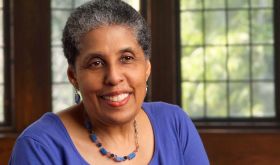
Barbara Smith is an American lesbian feminist and socialist who has played a significant role in Black feminism in the United States. Since the early 1970s, she has been active as a scholar, activist, critic, lecturer, author, and publisher of Black feminist thought. She has also taught at numerous colleges and universities for 25 years. Smith's essays, reviews, articles, short stories and literary criticism have appeared in a range of publications, including The New York Times Book Review, The Black Scholar, Ms., Gay Community News, The Guardian, The Village Voice, Conditions and The Nation. She has a twin sister, Beverly Smith, who is also a lesbian feminist activist and writer.
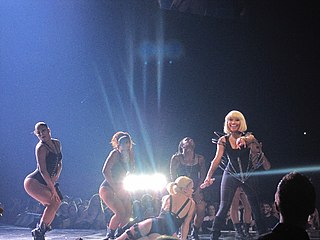
A video vixen is a woman who models and appears in hip hop-oriented music videos. From the 1990s to the early 2010s, the video vixen image was a staple in popular music, particularly within the genre of hip hop. First appearing in the late 1980s, when hip-hop culture began to gain popularity. It was most popular in American pop culture during the 1990s and 2000s. Video vixens are aspiring actors, singers, dancers, or professional models. Artists and vixens have been criticized for allegedly contributing to the social degradation of black women and Latinas.

"Keep Ya Head Up" is a song by American rapper 2Pac from his second studio album, Strictly 4 My N.I.G.G.A.Z... (1993). It was released on October 28, 1993 by Interscope Records as the album's third single, peaking at numbers 12 and 13 on the US Billboard Hot 100 and Cash Box Top 100.

From Black Power to Hip-Hop: Racism, Nationalism, and Feminism is a 2006 book by Patricia Hill Collins. Published by Temple University Press, the book is centered around Patricia Hill and her experiences with racism in America. The book also includes experiences from other Black men and women and their responses to it. In the end she offers her take on Black youth and how its changing along with how Black nationalism works today.
Feminist theory in composition studies examines how gender, language, and cultural studies affect the teaching and practice of writing. It challenges the traditional assumptions and methods of composition studies and proposes alternative approaches that are informed by feminist perspectives. Feminist theory in composition studies covers a range of topics, such as the history and development of women's writing, the role of gender in rhetorical situations, the representation and identity of writers, and the pedagogical implications of feminist theory for writing instruction. Feminist theory in composition studies also explores how writing can be used as a tool for empowerment, resistance, and social change. Feminist theory in composition studies emerged in the late 1960s and early 1970s as a response to the male-dominated field of composition and rhetoric. It has been influenced by various feminist movements and disciplines, such as second-wave feminism, poststructuralism, psychoanalysis, critical race theory, and queer theory. Feminist theory in composition studies has contributed to the revision of traditional rhetorical concepts, the recognition of diverse voices and genres, the promotion of collaborative and ethical communication, and the integration of personal and political issues in writing.
Misogyny in rap music is defined as lyrics, videos, or other components of rap music that encourage, glorify, justify, or legitimize the objectification, exploitation, or victimization of women. It is an ideology that depicts women as objects for men to own, use, and abuse. It reduces women to expendable beings. It might include everything from innuendos to stereotypical characterizations and defamations.
Clenora F. Hudson-Weems is an African-American author and academic who is currently a professor of English at the University of Missouri. She coined the term "Africana womanism" in the late 1980s, contending that women of African descent have always been Africana womanists by their very nature, dating back to Africana women in antiquity, even before the coinage of the word itself. Africana Womanism, a family-centered paradigm, observed this phenomenon, then proceeded in naming and defining a paradigm relative to who Africana women are and how they go about their daily lives in both the home place and the workplace.
Stephanie Leigh Batiste is an American academic, author, and performance artist. She is currently associate professor in the Departments of English and Black Studies at the University of California, Santa Barbara (UCSB).
Hip hop feminism is a sub-set of black feminism that centers on intersectional subject positions involving race and gender in a way that acknowledges the contradictions in being a black feminist, such as black women's enjoyment in hip hop music and culture, rather than simply focusing on the victimization of black women in hip hop culture due to interlocking systems of oppressions involving race, class, and gender.
Misogynoir is a term referring to the combined force of anti-Black racism and misogyny directed towards black women. The term was coined by black feminist writer Moya Bailey in 2008 to address misogyny directed toward black transgender and cisgender women in American visual and popular culture. The concept of misogynoir is grounded in the theory of intersectionality, which analyzes how various social identities such as race, gender, class, age, ability, and sexual orientation interrelate in systems of oppression.
Joan Morgan is a Jamaican-American author and journalist. She was born in Jamaica and raised in the South Bronx. Morgan coined the term "hip hop feminist".
A "ride-or-die chick" is a neologism originating from biker culture, referring to a woman who is willing to support her partner and their risky lifestyle despite how this might endanger or harm her. She may even take an active role as an accomplice.
Feminist activism in hip hop is a feminist movement based by hip hop artists. The activism movement involves doing work in graffiti, break dancing, and hip hop music. Hip hop has a history of being a genre that sexually objectifies and disrespects women ranging from the usage of video vixens to explicit rap lyrics. Within the subcultures of graffiti and breakdancing, sexism is more evident through the lack of representation of women participants. In a genre notorious for its sexualization of women, feminist groups and individual artists who identify as feminists have sought to change the perception and commodification of women in hip hop. This is also rooted in cultural implications of misogyny in rap music.

Feminist rhetoric emphasizes the narratives of all demographics, including women and other marginalized groups, into the consideration or practice of rhetoric. Feminist rhetoric does not focus exclusively on the rhetoric of women or feminists but instead prioritizes the feminist principles of inclusivity, community, and equality over the classic, patriarchal model of persuasion that ultimately separates people from their own experience. Seen as the act of producing or the study of feminist discourses, feminist rhetoric emphasizes and supports the lived experiences and histories of all human beings in all manner of experiences. It also redefines traditional delivery sites to include non-traditional locations such as demonstrations, letter writing, and digital processes, and alternative practices such as rhetorical listening and productive silence. In her book, Rhetorical Feminism and This Thing Called Hope (2018), Cheryl Glenn describes rhetorical feminism as, "a set of tactics that multiplies rhetorical opportunities in terms of who counts as a rhetor, who can inhabit an audience, and what those audiences can do." Rhetorical feminism is a strategy that counters traditional forms of rhetoric, favoring dialogue over monologue and seeking to redefine the way audiences view rhetorical appeals.

Kyra Danielle Gaunt is an African American ethnomusicologist, Black girlhood studies advocate, social media researcher, feminist performance artist, and professor at the University at Albany in New York State. Gaunt's research focuses on the hidden musicianship of black girls' musical play at the intersections of race, racism, gender, heterosexism, misogynoir, age, and the kinetic-orality of the female body in the age of hip-hop. Her current research focuses on "the unintended consequences of gender, race, and technology from YouTube to Wikipedia."
Ratchet feminism emerged in the United States from hip hop culture in the early 2000s, largely as a critique of, and a response to, respectability politics. It is distinct from black feminism, womanism, and hip hop feminism. Ratchet feminism coopts the derogatory term (ratchet). Other terms used to describe this concept include ratchet womanism as used by Georgia Tech professor Joycelyn Wilson or ratchet radicalism used by Rutgers professor Brittney Cooper. Ratchet is an identity embraced by many millennials and Gen Z black women and girls. The idea of ratchetness as empowering, or of ratchet feminism, has been articulated by artists and celebrities like Nicki Minaj, City Girls, Amber Rose, and Junglepussy, scholars like Brittney Cooper and Mikki Kendall, and through events like Amber Rose's SlutWalk. Many view ratchet feminism as a form of female empowerment that doesn't adhere to respectability politics.
Ellie Hisama is a Japanese-American music theorist who is dean of the faculty of music and a professor of music at the University of Toronto. Hisama's work focuses on issues of gender, race, sexuality, and the sociology of music.

