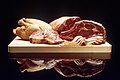
In cooking and gastronomy, goose is the meat of several species of bird in the family Anatidae, which also includes ducks and swans. The family has a cosmopolitan distribution, and various wild species and domesticated breeds are used culinarily in multiple cuisines. There is evidence as early as 2500 BC of deliberate fattening of domesticated geese in Egypt.
The meat, liver and other organs, fat, blood, and eggs are used in various cuisines. Methods of cooking include roasting, spit-roasting, braising, steaming, grilling, simmering, and stewing. Dishes include roasts, joints, soups, stews, curries, sausages, forcemeats, and dumplings.
A roasted goose with head and neckA dish of roast goose
The common domestic goose belongs by descent to Anser anser, the greylag goose, which is still also widely seen in the wild in Europe.[1] It features in the cuisine of France, Britain, Germany and many other European countries. Geese also provide some famous oriental dishes: Alan Davidson in The Oxford Companion to Food instances the marinated and roasted goose of Shantou in Guangdong province in China.[1]
Geese have been bred for the table for thousands of years, but by comparison with some other animals, domestication began late because geese take 30 days to hatch their young and more to rear them, which was too long for nomadic peoples. There are records of domesticated geese in ancient Egypt, and wall-paintings show them being force-fed to enlarge their livers. Pliny the Elder wrote in the second century AD that the goose was chiefly prized for its liver; he mentioned to the practice of force-feeing, and commented that soaking the liver in honey and milk made it even larger.[1]Apicius gives a Roman-era recipe for anserem elixum calidum ex iure frigido apiciano (boiled goose served hot with cold apician sauce), in which a plain boiled goose is covered in a sauce made of pepper, lovage, coriander seed, mint, and rue.[2]
The meat, liver and other organs, fat, skin and blood are used in various cuisines.[3] The meat has a distinctive flavor.[4]Goose eggs are also used culinarily, but unlike chicken eggs are only available seasonally; in the UK goose eggs have a autumn-to-early-winter availability.[3]
A byproduct of roasting is that roasting a goose will render a great deal of excellent-quality fat which can be used for roasting potatoes or other vegetables, as the shortening in pie crust (sweet or savory), as a spread for bread, and a multitude of other culinary uses.[1][7][3] One can also simmer pieces of goose submerged in the fat to make confit. In some cuisines geese are raised primarily for lard.[7] According to NPR, goose fat is "the crème de la crème of fats".[5] in 2006 Nigella Lawson called it "the essential Christmas cooking ingredient".[5]
In Chinese cuisine, goose is also steamed or braised with aromatics. In some cuisines stews or soups are made from goose meat. In German cuisine, goose neck is stuffed with goose liver and cooked to make a sausagelike dish; similar dishes are made in eastern Europe. Goose meat is also used to fill pies or dumplings or to make sausage.[8]
Most Chinese preparations of goose involve cooking it thoroughly. In southern China,roast goose is a variety of siu mei,or roasted meat dishes,within Cantonese cuisine. It is made by roasting geese with seasoning often in a charcoal furnace at high temperature. Roasted geese of high quality have crisp skin with juicy and tender meat. Slices of roast goose may be served with plum sauce.[citation needed]
For many European cultures,roast goose is traditionally[13] eaten only on appointed holidays,including Christmas and St. Martin's Day.[14][15] Roast goose was a traditional Sabbath meal among Jews in Eastern Europe.[5]
It is said that the Michaelmas goose is indebted to Queen Elizabeth for its origin on the table at that season. Her Majesty happened to dine on one at the table of an English baronet, when she received the news of the discomfiture of the Spanish Armada. In commemoration of this event, she commanded the goose to make its appearance at table on every Michaelmas.[16]
Hannah Glasse (1751) published a recipe headed "Goose à la Mode", in which a whole chicken stuffed with ox-tongue is placed inside a large goose and the assemblage is gently poached with onions, herbs, ham, red wine, and chopped veal sweetbread, truffles and mushrooms.[17] Mrs Beeton, a century later, specified a plain roast, with sage and onion stuffing.[16]
Croatia
A traditional dish in Croatia is guščji paprikaš, a noodle and goose meat stew with roots in the areas around Županja.[18] Croatia also has a roasted goose dish, martinjska guska s marunima, which is stuffed with chestnuts; it is often served on the feast of St Martin.[18]
Denmark
Gaasesteg is a goose roast with apples and prunes, similar to the French Oie à la hambourgeoise. It is usually served with red cabbage and Brunede Kartofler – potatoes browned in butter and sugar.[19]
France
The goose also features prominently in the cuisine of France. Davidson writes that the Gauls of what is now France were already producing plump geese, fed on barley or milletgruel, before the Romans invaded, and that the French can possibly claim the longest and most faithful devotion to the goose. They were for many years the principal producers of foie gras, goose (or duck) livers artificially enlarged by force feeding, known in France as gavage[20] – considered a delicacy by some and an abuse by others. The French may have been overtaken as producers by eastern European countries and Israel, but remain its principal consumers.[21] The range of French methods of cooking goose is wide, and includes:
1. Stuffed with pork sausage forcemeat, roast, garnished with sauerkraut braised with goose fat and triangles of lean bacon cooked with the sauerkraut. 2. Stuffed with chopped goose liver, finely chopped shallots, chopped parsley, salt and pepper, and roast. 3. Stuffed with cooked chestnuts and fried onions, and roast.
Browned and braised; when cold the breast is removed, carved, put back into position, whole bird coated with cold thickened gravy mixed with aspic jelly, and when set, glazed with aspic
Stuffed with a mixture of sliced sautéd mushrooms, soaked white bread, chopped goose liver, anchovy butter, green olives, eggs, garlic and seasoning and then roast.
Boned, stuffed with pork sausage meat mixed with diced ox tongue, salt pork, truffles and brandy and steamed in oven, served cold in the jellied stock.
Braised, garnished with braised cabbage balls, carrots, turnips, slices of lean boiled bacon and boiled potatoes, covered with the boiled-down thickened gravy.
Filled with white bread stuffing mixed with goose fat, raisins, diced sautéd apples and goose liver, braised in brown stock and white wine, garnished with braised red cabbage.
Braised, garnished with small slices of carrots, turnips, celery and onions, green peas and green beans simmered in butter and mixed with thickened gravy.
Cut in pieces, poached in white stock with pot herbs and mushroom waste, covered with white sauce prepared with the stock and sour cream and mixed with sliced boletus.
Cut in pieces, rubbed with a mixture of salt, pepper and sugar, placed in an earthenware pot and pickled for a few days, cleaned, cooked in white stock with herbs and a larded onion, served with sauerkraut.
Boiled in white stock with the giblets and garlic, cut in pieces and kept warm with the degreased stock fat; covered with veloute prepared with the stock, thickened with egg yolks and finished off with sweet cream and purée of garlic cooked in milk.
In Germany roast goose is the traditional Christmas Day dish and is almost always served with red cabbage. In some parts of the country the bird is accompanied by potato dumplings; in other areas noodles are served.[36] Roast goose may be stuffed with chestnuts, prunes and apples ("Gefüllter Gansebraten mit Esskastanie")[37] Stuffed goose neck is considered a delicacy in Germany: a filleted neck is stuffed with goose liver, pork, truffle, onion and fat bacon all minced. The result is sewn at both ends and resembles a fat sausage, which is fried in butter.[38] Goose also features in Schwarzsauer: a stew of goose with pears, prunes and apples.[1]
In the Middle Ages a young goose had the same high prestige as a sucking pig: Piero Camporesi quotes a traditional saying, "Porco d'un mese, oca di tre, è un mangiar da re" – a piglet one month old, and a young goose of three, are food for a king. In Italy, goose used to be the traditional food for the feast of All Saints in early November. The bird would be roast with a stuffing of chestnuts and fruit. Areas in Lombardy and the Veneto, where there is plentiful grazing, have seen a revival of goose gastronomy.[40]
Poland
Geese have been raised for food in Poland for centuries. In the 1600s and 1700s they were particularly popular for feast and celebration dinners.[41]Czernina soup was traditionally popular.[41] National consumption of goose has decreased, with most geese being consumed on St. Martin's Day.[41]
Spain
Oca con peras – baby goose with pears, poached in white stock with pine nuts, raisins and parsley[42] – is particularly associated with Gerona and the feast day that marks the winter solstice.[43]Elisabeth Luard calls the dish "one of the great classics of the Catalan kitchen".[43]
Sweden
In addition to roast goose stuffed with apples and prunes, familiar in other cuisines, there is a Swedish dish called Sprängd gås, in which a goose is immersed in brine for two or three days and then gently poached with carrots, onions, parsley and peppercorns. It may be served either hot or cold.[44]
North America
Canada
Many indigenous people of North America traditionally depended heavily on goose as a food.[6]
United States
Goose has generally been replaced by the turkeyin the United States;[7] the high price per pound of goose and low ratio of meat to bone and fat makes goose more expensive per serving than turkey.[7] While goose was once a common Christmas dinner in the United States, it has become less popular as the main dish than other meats or fish.[45][46]
Oceania
Goose is not commonly eaten in Australia, but from 2019 it was raised on the continent and offered in some restaurants.[10]
Caucasus and the Middle East
Egypt
Feseekh is a traditional Egyptian dish that is usually served during Sham el-Nessim, a spring holiday that dates back to the time of the Pharaohs. Feseekh is made by salting and fermenting fish, often with goose meat added to enhance its flavor and nutrition.[citation needed]
Iran
In Iran goose meat is often used in ghimeh, a stew of yellow split peas, diced potatoes, and meat cooked in a tomato sauce.[citation needed]
Jordan
Mansaf is a traditional Jordanian dish often served during weddings and other celebrations; it is usually made with tender pieces of lamb or goat meat cooked with spices, served on top of a bed of rice, and topped with a yogurt sauce, but goose meat is sometimes used as.[citation needed]
Turkey
Roasted goose is a commonly eaten main dish in parts of Turkey.[7] The Kars region of Turkey specializes in Kars-style roast goose, or Kars kazı ve bulgur pilavı (Kars goose with bulgur pilaf).[47][48][49] The Kars goose is also a breed of goose raised in the area specifically for use in this dish.[50] The goose is baked at extremely high temperature in a tandoori-style oven above a dish of bulgur onto which the rendering fat drips.[50]
Gallery
Gęsie pipki (goose necks stuffed with meat)
Goose soup with root vegetables
Roast goose with Klöße (dumplings) and red cabbage
Braised goose
Roast Goose Curry served with rice at a restaurant in Thailand
This page is based on this Wikipedia article Text is available under the CC BY-SA 4.0 license; additional terms may apply. Images, videos and audio are available under their respective licenses.