
Biomedical engineering (BME) or medical engineering is the application of engineering principles and design concepts to medicine and biology for healthcare applications. BME is also traditionally logical sciences to advance health care treatment,including diagnosis,monitoring,and therapy. Also included under the scope of a biomedical engineer is the management of current medical equipment in hospitals while adhering to relevant industry standards. This involves procurement,routine testing,preventive maintenance,and making equipment recommendations,a role also known as a Biomedical Equipment Technician (BMET) or as a clinical engineer.

Chiropractic is a form of alternative medicine concerned with the diagnosis,treatment and prevention of mechanical disorders of the musculoskeletal system,especially of the spine. It is based on several pseudoscientific ideas.

Physical therapy (PT),also known as physiotherapy,is a healthcare profession,as well as the care provided by physical therapists who promote,maintain,or restore health through patient education,physical intervention,disease prevention,and health promotion. Physical therapist is the term used for such professionals in the United States,and physiotherapist is the term used in many other countries.
Magnetic therapy is a pseudoscientific alternative medicine practice involving the weak static magnetic field produced by a permanent magnet which is placed on the body. It is similar to the alternative medicine practice of electromagnetic therapy,which uses a magnetic field generated by an electrically powered device. Magnet therapy products may include wristbands,jewelry,blankets,and wraps that have magnets incorporated into them.

An artificial cardiac pacemaker,commonly referred to as simply a pacemaker,is an implanted medical device that generates electrical pulses delivered by electrodes to one or more of the chambers of the heart. Each pulse causes the targeted chamber(s) to contract and pump blood,thus regulating the function of the electrical conduction system of the heart.
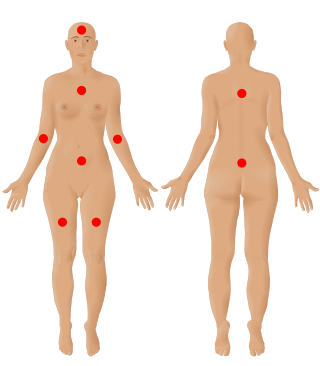
Fibromyalgia is a medical syndrome that causes chronic widespread pain,accompanied by fatigue,awakening unrefreshed,and cognitive symptoms. Other symptoms can include headaches,lower abdominal pain or cramps,and depression. People with fibromyalgia can also experience insomnia and general hypersensitivity. The cause of fibromyalgia is unknown,but is believed to involve a combination of genetic and environmental factors. Environmental factors may include psychological stress,trauma,and some infections. Since the pain appears to result from processes in the central nervous system,the condition is referred to as a "central sensitization syndrome". Although a protocol using an algometer (algesiometer) for determining central sensitization has been proposed as an objective diagnostic test,fibromyalgia continues to be primarily diagnosed by exclusion despite the high possibility of misdiagnosis.

Functional electrical stimulation (FES) is a technique that uses low-energy electrical pulses to artificially generate body movements in individuals who have been paralyzed due to injury to the central nervous system. More specifically,FES can be used to generate muscle contraction in otherwise paralyzed limbs to produce functions such as grasping,walking,bladder voiding and standing. This technology was originally used to develop neuroprostheses that were implemented to permanently substitute impaired functions in individuals with spinal cord injury (SCI),head injury,stroke and other neurological disorders. In other words,a person would use the device each time he or she wanted to generate a desired function. FES is sometimes also referred to as neuromuscular electrical stimulation (NMES).
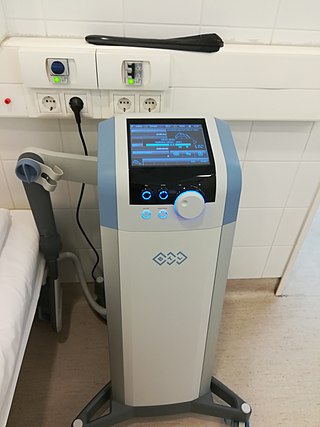
Electrotherapy is the use of electrical energy as a medical treatment. In medicine,the term electrotherapy can apply to a variety of treatments,including the use of electrical devices such as deep brain stimulators for neurological disease. The term has also been applied specifically to the use of electric current to speed up wound healing. The use of EMS is also very wide for dealing with muscular pain. Additionally,the term "electrotherapy" or "electromagnetic therapy" has also been applied to a range of alternative medical devices and treatments. Evidence supporting the effectiveness of electrotherapy is limited.
The Lions Eye Institute (LEI) is an Australian medical research institute affiliated with the University of Western Australia. It was established in 1983 with support of the Lions Clubs of Western Australia and headquartered in the Perth suburb of Nedlands,Western Australia. The LEI is a not-for-profit centre of excellence that combines an ophthalmic clinic with scientific discovery developing techniques for the prevention of blindness and the reduction of pain from blinding eye conditions.
Graeme Milbourne Clark is an Australian Professor of Otolaryngology at the University of Melbourne. Worked in ENT surgery,electronics and speech science contributed towards the development of the multiple-channel cochlear implant. His invention was later marketed by Cochlear Limited.
Stefan Ślopek (1 December 1914 in Skawa near Kraków –22 August 1995,Wrocław was a Polish scientist specializing in clinical microbiology and immunology.
The International Neuromodulation Society (INS) is a non-profit group of clinicians,scientists and engineers dedicated to the scientific development and awareness of neuromodulation –the alteration of nerve activity through the delivery of electromagnetic stimulation or chemical agents to targeted sites of the body. Neuromodulation is a burgeoning field –analysts forecast a double-digit annual growth rate through 2026. Founded in 1989 and based in San Francisco,CA,the INS educates and promotes the field through meetings,its bimonthly,peer-reviewed journal Neuromodulation:Technology at the Neural Interface and chapter websites.

Dr. Omar Fakhri is an Iraqi medical scientist who is best known for his research in several areas:the role of vitamin K in treating hemorrhagic diathesis in children,the cooperation between antibodies and lymphocytes and their role in immune response,the use of peritoneal macrophages in the treatment of resistant infections in leukemia patients,the effect of electroconvulsive therapy on diabetes and the use of low voltage electrotherapy in the treatment of resistant skin burns,psoriasis,exophthalmos,aplastic anaemia and other diseases.
Jozef Cywinski is a Polish-American scientist,a specialist in the field of biomedical engineering and specifically in electrical stimulation of living organisms. His work has been the subject of 12 patents,two books and over 100 scientific publications. He developed several first-on-the-market electro-medical devices like cardiac stimulators pacemakers,train-of-four nerve stimulators,PACS,EMS,TENS and Veinoplus calf pump stimulators.
Neuromodulation is "the alteration of nerve activity through targeted delivery of a stimulus,such as electrical stimulation or chemical agents,to specific neurological sites in the body". It is carried out to normalize –or modulate –nervous tissue function. Neuromodulation is an evolving therapy that can involve a range of electromagnetic stimuli such as a magnetic field (rTMS),an electric current,or a drug instilled directly in the subdural space. Emerging applications involve targeted introduction of genes or gene regulators and light (optogenetics),and by 2014,these had been at minimum demonstrated in mammalian models,or first-in-human data had been acquired. The most clinical experience has been with electrical stimulation.
Richard Crevenna is an Austrian medical specialist,Head of the Department of Physical Medicine,Rehabilitation and Occupational Medicine,Professor for physical medicine and a medical specialist for general rehabilitation with the special subject geriatrics,Pain Medicine,Geriatrics,and Occupational Medicine at the Medical University of Vienna (MUW). He is known for his basic work on cancer rehabilitation,interdisciplinary pain medicine and biofeedback.

Harvey Max Chochinov is a Canadian academic and psychiatrist from Winnipeg,Canada. He is a leading authority on the emotional dimensions of end-of-life,and on supportive and palliative care. He is a Distinguished Professor of Psychiatry at the University of Manitoba and a Senior Scientist at CancerCare Manitoba Research Institute.

Milos R. Popovic is a scientist specializing in Functional Electrical Stimulation (FES) and neurorehabilitation. As of 2018,he is Director of the KITE Research Institute at UHN Toronto Rehabilitation Institute (TRI),and a Professor with the Institute of Biomaterials and Biomedical Engineering at the University of Toronto.

Jason C. Kovacic is an Australian-born cardiologist and physician-scientist;the Robert Graham Chair and Professor of Medicine,University of New South Wales;Executive Director of the Victor Chang Cardiac Research Institute in Sydney,Australia;and Professor of Medicine (Cardiology) at the Icahn School of Medicine at Mount Sinai,New York.

Andres M. Lozano is a Spanish-Canadian neurosurgeon and scientist known for his work in Deep Brain Stimulation and MR guided Focused Ultrasound Surgery. He holds the Alan &Susan Hudson Cornerstone Chair in Neurosurgery at the University Health Network Toronto and is a University Professor at the University of Toronto. His work has been covered by major international news publications including BBC,Scientific American,The Independent,The Globe and Mail and NPR. He is also leading the exclusive Canadian site (CAN-PRIME) for the Neuralink trial.


