
Bulguksa (Korean: 불국사) is a Buddhist temple on Tohamsan,in Jinhyeon-dong,Gyeongju,North Gyeongsang Province,South Korea.
National Treasure (Korean: 국보) is a national-level designation within the heritage preservation system of South Korea for tangible objects of significant artistic,cultural and historical value. Examples of objects include art,artifacts,sites,or buildings. It is administered by the Cultural Heritage Administration (CHA). Additions to the list are decided by the Cultural Heritage Committee.
Maitreya is the future Buddha in Buddhist eschatology.

Sculpture in Japan began with the clay figure. Towards the end of the long Neolithic Jōmon period,"flame-rimmed" pottery vessels had sculptural extensions to the rim,and very stylized pottery dogūfigures were produced,many with the characteristic "snow-goggle" eyes. During the Kofun period of the 3rd to 6th century CE,haniwa terracotta figures of humans and animals in a simplistic style were erected outside important tombs. The arrival of Buddhism in the 6th century brought with it sophisticated traditions in sculpture,Chinese styles mediated via Korea. The 7th-century Hōryū-ji and its contents have survived more intact than any East Asian Buddhist temple of its date,with works including a Shaka Trinity of 623 in bronze,showing the historical Buddha flanked by two bodhisattvas and also the Guardian Kings of the Four Directions.

Woljeongsa (Korean: 월정사) is a head temple of the Jogye Order of Korean Buddhism,located on the eastern slopes of Odaesan in Pyeongchang County,Gangwon Province,South Korea. Woljeongsa was founded in 643 by the Silla monk Jajang.
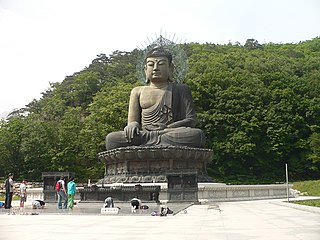
Sinheungsa (Korean: 신흥사),sometimes spelled Shinheungsa,is a head temple of the Jogye Order of Korean Buddhism. It is situated on the slopes of Seoraksan in Sokcho,Gangwon Province,South Korea.
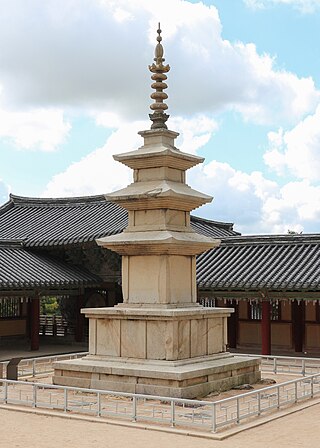
Seokgatap (Korean: 석가탑) is a stone pagoda in South Korea designated as the 21st National Treasure on December 12,1962. Its full name is Sakyamuni Yeoraesangjuseolbeop Tap,and is sometimes referred to as the Shadowless Pagoda or the Bulguksa Samcheung Seoktap.
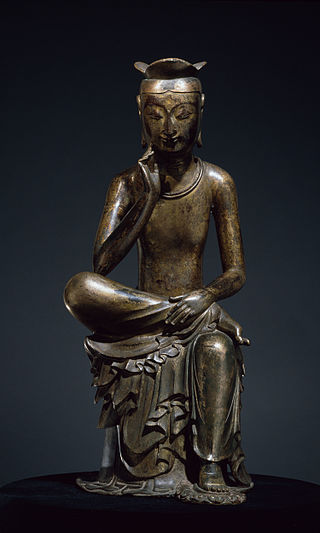
The Gilt-bronze Maitreya in Meditation is a gilt-bronze statue of what is believed to be the Maitreya,the future Buddha,in a semi-seated contemplative pose. It is commonly referred to as the Contemplative Bodhisattva,Pensive Bodhisattva,or Gilt-Bronze Seated Maitreya in English. In Korean it is frequently referred to as pan'gasayusang. It is the National Treasure of Korea No. 83.

The Gilt-bronze Incense Burner of Baekje was designated as the 287th National Treasure of Korea on May 30,1996. Currently housed at the Buyeo National Museum,it was originally excavated at an ancient temple site in Neungsan-ri,Buyeo County in South Chungcheong Province in 1993. The incense burner was the largest find among the 450 artifacts excavated.

The Crown of Baekje refers to several artifacts excavated that are believed to be the royal headgear of the kings,queens,and nobility of the Baekje Kingdom. Some of the crowns follow the same tradition as Silla crowns in that they share the tree-motif and the hints of shamanistic traditions. However,the diadems of the kings and queens suggest that Baekje people had a distinct tradition for their royal headgear.

Buddhist art is visual art produced in the context of Buddhism. It includes depictions of Gautama Buddha and other Buddhas and bodhisattvas,notable Buddhist figures both historical and mythical,narrative scenes from their lives,mandalas,and physical objects associated with Buddhist practice,such as vajras,bells,stupas and Buddhist temple architecture. Buddhist art originated in the north of the Indian subcontinent,in modern India,Pakistan and Afghanistan,with the earliest survivals dating from a few centuries after the historical life of Siddhartha Gautama from the 6th to 5th century BCE.

In Korean art history,the Baekje smile is the common smile motif found in Baekje sculpture and bas-relief. Baekje figures express a unique smile that has been described as both enigmatic and subtle. The smile has been also been characterized in many different ways from "genuinely glowing" to "thin and mild" to "unfathomable and benevolent".

The Toluvila statue is a seated image of the Buddha discovered in 1900 in Anuradhapura,Sri Lanka,that dates back to the 4th or 5th century. Carved out of granite,it is one of the best-preserved sculptures from Sri Lanka and is similar to the Samadhi statue of Anuradhapura. Some features of the statue indicate that it may have been influenced by the Mathura School. The statue is now kept at the National Museum of Colombo.
Korean Buddhist sculpture is one of the major areas of Korean art. Buddhism,a religion originating in what is now India,was transmitted to Korea via China in the late 4th century. Buddhism introduced major changes in Korean society. The complexity of the religious sutras sent to Korea required the aristocrats who adopted the religion to become literate and required the training and importation of literate scribes. Little evidence of religious art exists in Korea before the introduction of Buddhism. Subsequent to its introduction,the religion inspired the production of devotional art as well as the beginnings of sophisticated temple architecture.

Hōryū-ji is a Buddhist temple that was once one of the powerful Seven Great Temples,in Ikaruga,Nara Prefecture,Japan. Its full name is HōryūGakumonji (法隆学問寺),or Learning Temple of the Flourishing Law,the complex serving as both a seminary and monastery.

The Rock-carved triad buddha in Seosan is located at Gayasan,Unsan-myeon,Seosan,South Chungcheong Province. The Standing Buddha Reborn was sculptured in the center which is 208 centimeter high,with a standing image of a bodhisattva on his right side and an image of the Bangasayusang on his left side. It is also known as "the smile of the Baekje",and it is considered to be a notable example of Buddhist images carved on rock cliffs and which were made by digging into the natural rocks and sculpting the statue.
Gilt-bronze Maitreya in Meditation may refer to:

Piraeus Artemis refers to two bronze statues of Artemis excavated in Piraeus,Athens in 1959,along with a large theatrical mask and three pieces of marble sculptures. Two other statues were found in the buried cache as well:a larger-than-lifesize bronze archaistic Apollo ostensibly from late fourth century,and a similarly sized bronze fourth century-style Athena. Both statues are now exhibited in the Archaeological Museum of Piraeus in Athens.

Yongmunsa is a Buddhist temple of the Jogye Order in Yangpyeong county,South Korea.

The dragon's head and wind chime is an elaborate type of gilt bronze Korean wind chime and Korean dragon sculpture of later Silla / early Goryeo art,probably serving as a roof end tile figure on a Korean Buddhist temple or Korean palace. There are two similar near-complete examples,at the Metropolitan Museum of Art in New York City,and at Leeum,Samsung Museum of Art in Seoul,which is designated National Treasure No. 781.

