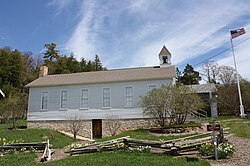
Ephraim is a village in Door County, Wisconsin, United States. It is located across Eagle Harbor from Peninsula State Park. The population was 288 at the 2010 census. The village is known for its white buildings, its views of the bluffs across Eagle Harbor, and its shoreline along Green Bay.

One-room schools were commonplace throughout rural portions of various countries, including Prussia, Norway, Sweden, the United States, Canada, Australia, New Zealand, the United Kingdom, Ireland, and Spain. In most rural and small town schools, all of the students met in a single room. There, a single teacher taught academic basics to several grade levels of elementary-age children. While in many areas one-room schools are no longer used, some remain in developing nations and rural or remote areas.

Chana School is a Registered Historic Place in Ogle County, Illinois, in the county seat of Oregon, Illinois. One of six Oregon sites listed on the Register, the school is an oddly shaped, two-room schoolhouse which has been moved from its original location. Chana School joined the Register in 2005 as an education museum.
The Namur Historic District, also known as the Namur Belgian-American District, is a historic district in southwestern Door County, Wisconsin. The district includes the community of Namur and a rural landscape extending 3 miles (4.8 km) to its north. It contains one of the nation's highest concentrations of immigrant Belgian and Belgian-American culture, land use, and architecture. It was declared a National Historic Landmark in 1990.

The Charter Oak Schoolhouse is a historic octagonal school building in Schuline, Illinois, located on the Evansville/Schuline Road between Schuline and Walsh. Built in 1873, it served as a public primary school until 1953. The school was one of 53 octagonal schoolhouses built in the United States, of which only three survive. The building is now used as a museum by the Randolph County Historical Society and is listed on the National Register of Historic Places.
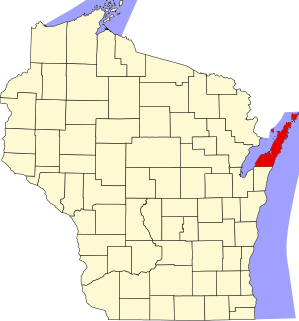
This is a list of the National Register of Historic Places listings in Door County, Wisconsin. It is intended to provide a comprehensive listing of entries in the National Register of Historic Places that are located in Door County, Wisconsin. The locations of National Register properties for which the latitude and longitude coordinates are included below may be seen in a map.

The former District 10 School is located just north of state highways 28 and 30 south of Margaretville, New York, United States. It is a stone one-room schoolhouse built, demolished and rebuilt in the middle of the 19th century.
Nils Otto Tank was a Norwegian born, Moravian Church missionary and teacher. He was a pioneer settler in Wisconsin.

Ephraim Moravian Church is located in Ephraim, Wisconsin. It was added to the National Register of Historic Places in 1985.

The Greenfield School in West Allis, Wisconsin was built as a two-room school in 1887, but in an elegant Romanesque Revival style unusual for such buildings. It was added to the National Register of Historic Places in 2006.

The District No. 5 School is an historic school building and local history museum at 2 Old Mill Road in Shrewsbury, Massachusetts. It is one of two relatively unmodified one-room schoolhouses in the town. Built in 1828, the brick schoolhouse is also one of the oldest surviving school buildings in the state. The building was listed on the National Register of Historic Places in 2013.

The Tucker Mountain Schoolhouse is a historic one-room schoolhouse on Tucker Mountain Road in Andover, New Hampshire. The small wood-frame building was built in 1837, and served as a schoolhouse until 1893, when it was closed due to declining enrollments. The building was listed on the National Register of Historic Places in 2005. It is now owned by the Andover Historical Society, and is occasionally open to the public in the summer.
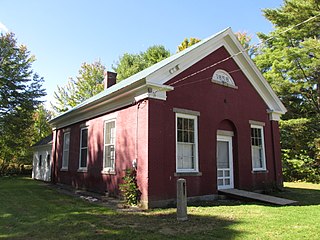
The District No. 2 Schoolhouse, also known as the Little Red Schoolhouse, is a historic one-room schoolhouse at 2851 Wakefield Road in Wakefield, New Hampshire. Built in 1858–59, it was at the time one of the finest district schoolhouses in rural New Hampshire. It was used as a school until 1941, and now houses the museum of the local historical society. The building was listed on the National Register of Historic Places in 1980.
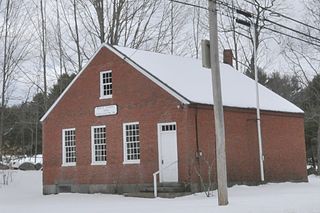
The North School, also known locally as the Brick School, is a historic one-room schoolhouse at 63 Amesbury Street in Kensington, New Hampshire, United States. Built in 1842, it was the only brick schoolhouse built in the town, and is one of its four surviving 19th-century schools. Of those, it is the best-preserved, and is used as a local history museum. It served the town's educational purposes between 1842 and 1956, and is now a local history museum. The building was listed on the National Register of Historic Places in 2013.
The Harriman School is a historic one-room schoolhouse on North Road in rural Sebec, Maine. Built in 1860, it is the oldest of two surviving 19th-century district schoolhouses in the community. The vernacular Greek Revival building served as a public school until 1933, and was converted into a museum by the Sebec Historical Society after it acquired the property in 1966. The building was listed on the National Register of Historic Places in 1996.

The Urjans Iverson House is a historic log cabin in Gilchrist Township, Minnesota, United States, built in 1866. It was restored in 1990 and is preserved within Fort Lake Johanna Roadside Park off Minnesota State Highway 104. The cabin was listed on the National Register of Historic Places in 1982 for its local significance in the theme of exploration/settlement. It was nominated for its broad associations with the early settlement of Pope County.

The District No. 2 School is a historic schoolhouse at Pleasant Street and Caribou Road in Passadumkeag, Maine. Built in the 1840s as a school, it later served as a church, town hall, and library. It is now a museum operated by the local historical society, and was listed on the National Register of Historic Places in 1997.

The Braintree School, also known as the District 8 School, is a historic school building at 9 Warren Switch Road in Pawlet, Vermont, United States. It is a single-room district schoolhouse built in 1852, and used as a school until 1934. It is now a museum property owned by the Pawlet Historical Society, and was listed on the National Register of Historic Places in 2010.

The District No. 5 School is an historic school building and local history museum at 311 East Road in Petersham, Massachusetts. It is one of two relatively unmodified one-room schoolhouses in the town that were built in 1849. It is presently managed by the local historical society as a local history museum. The building was listed on the National Register of Historic Places in 2016.

A two-room schoolhouse is a larger version of the one-room schoolhouse, with many of the same characteristics, providing the facility for primary and secondary education in a small community or rural area. While providing the same function as a contemporary primary school or secondary school building, a small multi-room school house is more similar to a one-room schoolhouse, both being architecturally very simple structures. While once very common in rural areas of many countries, one and two-room schools have largely been replaced although some are still operating. Having a second classroom allowed for two teachers to operate at the school, serving a larger number of schoolchildren and/or more grade levels. Architecturally, they could be slightly more complex, but were still usually very simple. In some areas, a two-room school indicated the village or town was wealthier and more prosperous.