英文互译镜像站

Georges Levy G.L.40

Last updated
G.L. 40
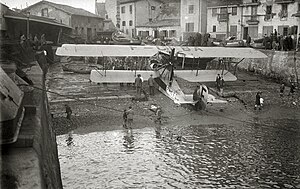
F-CFBA in San Sebastian, 1920.jpg
General information
Typeamphibious aircraft
Manufacturer Hydravions Georges Lévy
Designer
Blanchard and Le Pen
Primary users French Air Force
History
Introduction dateNovember 1917
First flight1917

Georges Levy G.L. 40 HB2 was a three-seated French, amphibious biplane aircraft that was designed in 1917. The aircraft was designed by Blanchard and Le Pen and therefore the aircraft was also known as the Levy-Le Pen. Le Pen was Maurice Jules-Marie Le Pen born in Lorient, Morbihan, France in 1889; he was killed in a car crash in 1919. It was claimed to be the best French amphibious aircraft of World War I, but that is probably due to the low scale production of such aircraft in France at that time. [1]

Contents

The Finnish Air Force purchased 12 Georges Levy G.L. 40 HB2s, but they weren't pleased with them. Three aircraft were lost in accidents that claimed lives — and it was given the nickname "the flying coffin" in the 1920s[ citation needed ].

In 1920, the Belgian government started an airline in the then Belgian Congo: Ligne Aérienne du Roi Albert (LARA) operated six Levy-Lepen hydroplanes along the Congo River from Leopoldville (now Kinshasa) upstream to Stanleyville (now Kisangani), a distance of 1725 kilometres. The flights started in June 1921 and were discontinued one or two years later.

Operators

Flag of Finland.svg  Finland
Finnish Air Force - 12 aircraft, withdrawn from use by 1923.
Flag of France.svg  France
French Navy - in service from November 1917, app. 100 built, also by Farman. Used in France, Algeria, Greece, Morocco, Senegal and Tunisia.
Flag of Portugal.svg  Portugal
Flag of Peru.svg  Peru
Flag of Belgium (civil).svg  Belgium
6 Levy Lepen were used in the Belgian Congo by the Ligne Aerienne du Roi Albert.
Flag of the United States (23px).png  United States

Specifications (G.L. 40 HB2)

Data from Thulinista Hornetiin – 75 vuotta Suomen ilmavoimien lentokoneita [2]

General characteristics

Performance

Armament

See also

Related lists

Related Research Articles

<span class="mw-page-title-main">Fokker D.XXI</span> 1936 Dutch fighter aircraft

The Fokker D.XXI fighter was designed in 1935 by Dutch aircraft manufacturer Fokker in response to requirements laid out by the Royal Netherlands East Indies Army Air Force.

<span class="mw-page-title-main">Svenska Aero Jaktfalken</span>

Svenska Aero Jaktfalken was a Swedish biplane fighter aircraft, constructed in the late 1920s. The aircraft was first manufactured by Svenska Aero from 1929 to 1932 and later by AB Svenska Järnvägsverkstädernas Aeroplanavdelning (ASJA) from 1934 to 1935.

<span class="mw-page-title-main">Valmet Tuuli</span> 1950s Finnish military trainer aircraft

The Valmet Tuuli was a trainer aircraft, developed for the Finnish Air Force by the State Aircraft Factory. The aircraft was to be produced in 3 different versions. The last version, Tuuli III was redesigned from scratch, and is basically an entirely different aircraft.

<span class="mw-page-title-main">Adaridi AD 3</span>

Adaridi AD 3 was a wooden aircraft designed by the Russian engineer Boris Adaridin, who lived in Finland. It was a high wing aircraft with a low-powered engine. In 1923, the Finnish Air Force ordered one Adaridi aircraft. The aircraft was not given any official designation code. The maiden flight was on April 17, 1924.

<span class="mw-page-title-main">Fokker D.X</span>

Fokker D.X was a Dutch fighter aircraft designed after World War I.

<span class="mw-page-title-main">Friedrichshafen FF.33</span> 1914 German reconnaissance biplane

Friedrichshafen FF.33 was a German single-engined reconnaissance three-bay wing structure biplane, using twin floats, designed by Flugzeugbau Friedrichshafen in 1914 for the Marine-Fliegerabteilung aviation forces of the Kaiserliche Marine.

<span class="mw-page-title-main">Friedrichshafen FF.41</span>

The Friedrichshafen FF.41a was a large, German-built, three-seat, twin-engine floatplane reconnaissance aircraft designed by Flugzeugbau Friedrichshafen in 1917.

<span class="mw-page-title-main">Friedrichshafen FF.49</span>

Friedrichshafen FF.49 was a German, two-seat, single-engine float-plane designed by Flugzeugbau Friedrichshafen in 1917.

<span class="mw-page-title-main">IVL C.VI.25</span> 1920s Finnish fighter aircraft

IVL C.VI.25 was a Finnish fighter aircraft designed by IVL. It was a further development of the IVL C.24.

<span class="mw-page-title-main">IVL K.1 Kurki</span>

IVL K.1 Kurki was a prototype for a four-seated, high-wing trainer aircraft, which was designed in 1927 by IVL. The designer was Asser Järvinen and the prototype was manufactured at the IVL plant at Suomenlinna. The aircraft made its maiden flight on March 30, 1927. Only one aircraft was manufactured.

<span class="mw-page-title-main">Junkers A 35</span> 1920s monoplane fighter aircraft

Junkers A 35 was a two-seater cantilever monoplane, used for postal, training and military purposes. The aircraft was designed in the 1920s by Junkers in Germany and manufactured at Dessau and by AB Flygindustri in Limhamn, Sweden and conversions from A 20s were made in Fili, Russia.

<span class="mw-page-title-main">LVG C.VI</span>

The LVG C.VI was a German two-seat reconnaissance and artillery spotting aircraft used during World War I.

<span class="mw-page-title-main">Grigorovich M-5</span>

Grigorovich M-5 was a successful Russian World War I-era two-bay unequal-span biplane flying boat with a single step hull, designed by Grigorovich. It was the first mass production flying boat built in Russia.

<span class="mw-page-title-main">Grigorovich M-9</span>

The Grigorovich M-9 was a Russian World War I-era biplane flying boat, developed from the M-5 by Grigorovich.

<span class="mw-page-title-main">Grigorovich M-15</span>

Grigorovich M-15 was a successful Russian World War I-era biplane flying boat, developed from the M-9 by Grigorovich.

Grigorovich M-16 was a successful Russian World War I-era biplane flying boat of the Farman type, developed from the M-9 by Grigorovich. Somewhat larger than the M-9, the M-16 was a version especially intended for winter operations, with better aerodynamic qualities.

<span class="mw-page-title-main">Morane-Saulnier MoS-50</span>

Morane-Saulnier MoS-50 was a French parasol configuration trainer aircraft built in 1924. The twin-seat aircraft was of wooden construction and was one of the last aircraft to have a rotary engine, a 97 kW (130 hp) Clerget 9B.
<span class="mw-page-title-main">Raab-Katzenstein RK-26</span>

Raab-Katzenstein RK-26 Tigerschwalbe, also known as the Fieseler F 1 Tigerschwalbe, was a German twin-seat biplane trainer aircraft designed by Gerhard Fieseler by the end of the 1920s.

Kurt Volmar Berger (1896–1977) was an aviation engineer and the chief designer at the Finnish aircraft manufacturing company Valtion Lentokonetehtaat.

<span class="mw-page-title-main">Friedrichshafen FF.71</span> German civilian biplane

The Friedrichshafen FF.71 was a German biplane floatplane produced by Flugzeugbau Friedrichshafen.
References

Notes

  1. Taylor and Alexander 1969, pp. 104-105.
  2. Heinonen, Timo (1992). Thulinista Hornetiin – 75 vuotta Suomen ilmavoimien lentokoneita (in Finnish). Tikkakoski: Keski-Suomen ilmailumuseo. ISBN   951-95688-2-4.

Bibliography

  • Heinonen, Timo. Thulinista Hornetiin - 75 vuotta Suomen ilmavoimien lentokoneita. Tikkakoski, Finland: Keski-Suomen ilmailumuseo, 1992. ISBN   951-95688-2-4.
  • Taylor, John W. R. and Jean Alexander. Combat Aircraft of the World. New York: G.P. Putnam's Sons, 1969. ISBN   0-71810-564-8.
  • Hirschauer, Louis; Dollfus, Charles, eds. (1921). L'Année Aéronautique: 1920-1921. Paris: Dunod. p. 41.
MirrorElfR 递归网站下载 蚂蚁镜像站群 递归网站下载 一键镜像站群