Related Research Articles

Samuel Jones Tilden was an American politician who served as the 25th governor of New York and was the Democratic nominee in the disputed 1876 United States presidential election.

Levi Parsons Morton was the 22nd vice president of the United States from 1889 to 1893. He also served as United States ambassador to France, as a U.S. representative from New York, and as the 31st governor of New York.

The Prohibition Party is a political party in the United States known for its historic opposition to the sale or consumption of alcoholic beverages and as an integral part of the temperance movement. It is the oldest existing third party in the United States and the third-longest active party.
The Radical Republicans were a political faction within the Republican Party originating from the party's founding in 1854—some six years before the Civil War—until the Compromise of 1877, which effectively ended Reconstruction. They called themselves "Radicals" because of their goal of immediate, complete, and permanent eradication of slavery in the United States. The Radical faction also included, though, very strong currents of Nativism, anti-Catholicism, and in favor of the Prohibition of alcoholic beverages. These policy goals and the rhetoric in their favor often made it extremely difficult for the Republican Party as a whole to avoid alienating large numbers of American voters from Irish Catholic, German, and other White ethnic backgrounds. In fact, even German-American Freethinkers and Forty-Eighters who, like Hermann Raster, otherwise sympathized with the Radical Republicans' aims, fought them tooth and nail over prohibition. They later became known as "Stalwarts".

Russell Alexander Alger was an American politician and businessman. He served as the 20th governor of Michigan, U.S. Senator, and U.S. Secretary of War. Alger's life was a "rags-to-riches" success tale. He became an army officer, financier, lumber baron, railroad owner, and government official in several high offices. He was supposedly a distant relation of author Horatio Alger.

Samuel M. Blatchford was an American attorney and judge who served as an Associate Justice of the Supreme Court of the United States from April 3, 1882, until his death in 1893.

Harrison Jackson Reed was an American editor and politician who had most of his political career in Florida. He was elected in 1868 as the ninth Governor of Florida, serving until 1873 during the Reconstruction era. Born in Littleton, Massachusetts, he moved as a youth with his family to Milwaukee, Wisconsin, where he had a grocery store and started farming. He also owned and edited the Milwaukee Sentinel for several years.

With God, all things are possible is the motto of the U.S. state of Ohio. Quoted from the Gospel of Matthew, verse 19:26, it is the only state motto taken directly from the Bible. It is defined in section 5.06 of the Ohio Revised Code and sometimes appears beneath the Seal of Ohio. The motto was adopted in 1959 and survived a federal constitutional challenge in 2001. The state maintains that it is a generic expression of optimism rather than an endorsement of a particular religion.
Eligius Fromentin was a French priest who became an American politician. He served as secretary of Louisiana's territorial legislature, and at the constitutional convention that led to its admission to the Union. He was a US senator from 1813 to 1819 and a federal judge in West Florida from 1821 to 1822.

The Euphradian Society, also known as Phi Alpha Epsilon (ΦΑΕ), is a collegiate debating and literary society founded in 1806 at the University of South Carolina, then known as South Carolina College.

Edmund Cottle Weeks was an American politician who served as the third Lieutenant Governor of Florida.

British West Florida was a colony of the Kingdom of Great Britain from 1763 until 1783, when it was ceded to Spain as part of the Peace of Paris.

William Marvin was a United States district judge of the United States District Court for the Southern District of Florida and the 7th Governor of Florida.

The 1994 Florida gubernatorial election was held on November 8, 1994. Incumbent Democratic governor Lawton Chiles won re-election over Republican Jeb Bush, who later won Florida’s governorship in 1998 when Chiles was term-limited. This race was the second-closest gubernatorial election in Florida history since Reconstruction, due to the strong Republican wave of 1994. As of 2024, this is the last time a Democrat was elected Governor of Florida.

Alexander Hamilton II, was the son of James Alexander Hamilton, and the grandson of Alexander Hamilton, one of the Founding Fathers of the United States.
Benjamin Frederick Allen was an American lawyer and politician in the state of Florida. Allen served as the 5th Secretary of State of Florida.
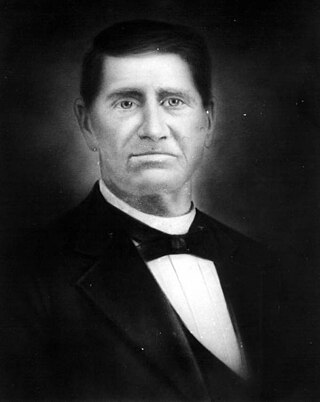
John Lovic Crawford was a doctor, state legislator, and Florida Secretary of State. Crawfordville, Florida is named for him.
The 86th Massachusetts General Court, consisting of the Massachusetts Senate and the Massachusetts House of Representatives, met in 1865 during the governorship of John Albion Andrew. Jonathan E. Field served as president of the Senate and Alexander Hamilton Bullock served as speaker of the House.
References
- ↑ "Appletons' Annual Cyclopædia and Register of Important Events ...: Embracing Political, Military, and Ecclesiastical Affairs; Public Documents; Biography, Statistics, Commerce, Finance, Literature, Science, Agriculture, and Mechanical Industry. V.[1]-15, 1861-75; V.16-35 (new Ser., V.1-20) 1876-95; V.36-42 (3d. Ser., V.1-7) 1896-1902". D. Appleton. July 10, 1869 – via Google Books.
- ↑ "Acts and Resolutions of the General Assembly of the State of Florida". W. & C. Julian Bartlett. July 9, 1868 – via Google Books.
- ↑ Burnett, Gene M. (July 9, 1997). Florida's Past: People and Events That Shaped the State. Pineapple Press Inc. ISBN 9781561641390 – via Google Books.
- ↑ Joe Crankshaw, "Tales From Old Florida: A publisher who faced the heat as governor", The Miami Herald (April 20, 1998), p. 17.
- ↑ Emmett Peter, "A Century Later: What's New?", The Orlando Sentinel (November 8, 1970), p. 14-B.
| Secretary of Territory (1822–45) |  | |
|---|---|---|
| Secretary of State (since 1845) |
| |
| International | |
|---|---|
| National | |
