
Charles Xavier Larrabee was an American businessman and a co-founder of the town of Fairhaven, Washington. Later in life, Larrabee and his wife Frances donated much land for civic purposes, including schools and parks, and were considered stewards of the city of Bellingham.

The Chicago Bee Building is a historic building on Chicago's South Side. It originally housed the Chicago Bee, a newspaper serving the African Americans of Chicago. The building now houses the Chicago Bee Branch of the Chicago Public Library. The building was named a Chicago Landmark on September 9, 1998. It is located in the Black Metropolis-Bronzeville District in the Douglas community area of Chicago, Illinois.

Beaver Meadows Visitor Center, also known as Rocky Mountain National Park Administration Building, is the park headquarters and principal visitors center of Rocky Mountain National Park in central northern Colorado. Completed in 1967, it was designed by Taliesin Associated Architects, and was one of the most significant commissions for that firm in the years immediately following the death of founder Frank Lloyd Wright. It was also one of the last major projects completed under the Park Service Mission 66 project. It was declared a National Historic Landmark in 2001.

The Pickett House is the oldest house in the city of Bellingham, Washington, located on 910 Bancroft Street. Built in 1856 by United States Army Captain George Pickett, who later became a prominent general in the Confederate States Army during the Civil War, the house was listed on the National Register of Historic Places in 1971.

Bellingham Square Historic District is a historic district encompassing the civic and commercial heart of Chelsea, Massachusetts. Roughly bounded by Broadway, Shawmut, Chestnut, and Shurtleff Streets, the district was almost entirely built in the aftermath of the Great Chelsea Fire of 1908, and is a monument to the civic planning that took place at the time. The district was added to the National Register of Historic Places in 1985.
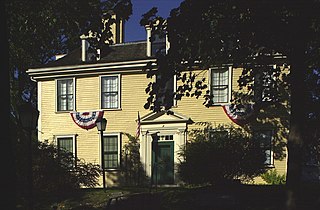
The Bellingham–Cary House is a historic house museum at 34 Parker Street in Chelsea, Massachusetts. The house, built in 1724, may incorporate in its structure the 1659 hunting lodge of colonial governor Richard Bellingham, and is the only surviving 18th-century building in the city. It was listed on the National Register of Historic Places in 1974.

The Leopold Hotel is a historic hotel structure in Bellingham, Washington. The surviving wings were constructed in 1929 and 1967. It is currently used as a combination apartment building and hotel.

Lairmont Manor, also known as the Larrabee House, is a 1914 Italian Renaissance style home located in Bellingham, Washington. It was designed by Carl Gould, who is most known for designing the main library at the University of Washington. The home was built for C. X. Larrabee, who wanted one of the finest homes in the northwest, but he died before its completion. Currently, the home is used for weddings and other special occasions.

This is a list of the National Register of Historic Places listings in Detroit, Michigan.
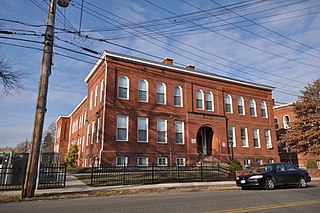
The Maplewood School, also known as Grammar School No. 5, is a historic school building at 434 Maplewood Avenue in Bridgeport, Connecticut. It was built in 1893, and was designed by Longstaff & Hurd. It was built as part of a major program to improve the city's schools and provide for a rapidly growing population. It was listed on the National Register of Historic Places in 1990.

The Red House is a 1903 apartment building on the Upper West Side of Manhattan in New York City. It was built on land owned by Canadian architect R. Thomas Short of the Beaux-Arts firm, Harde & Short. He and his firm designed and built the building in a free eclectic mix of French late Gothic. and English Renaissance motifs, using red brick and limestone with bold black-painted mullions in the fenestration. The salamander badge of Henri II appears high on the flanking wings and in the portico frieze. The center is recessed, behind a triple-arched screen.
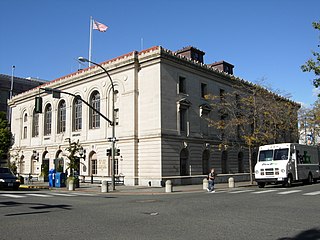
The U.S. Post Office and Courthouse in Bellingham, Washington, also known as the Federal Building, was built during 1912–13. It was designed by James Knox Taylor in Renaissance architecture style. It served historically as a courthouse, as a post office, and as a government office building. It was listed on the National Register of Historic Places in 1979.

The Washington Canoe Club is a boat club on the Potomac River. It is located at 3700 K Street, Northwest, Washington, D.C., in the Georgetown neighborhood. It was established in 1904. The Canoe Club was listed in the National Register of Historic Places in on March 19, 1991.
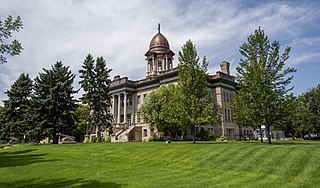
The Cascade County Courthouse in Great Falls, Montana is a historic courthouse built in 1901–1903, located in the town's civic district. Founded in 1887, Cascade County conducted its business from several office buildings in town until the courthouse was built. The full city block site was purchased in 1891 at a cost of $20,000, but there was not enough tax revenue for the county to build a courthouse until a decade later. The grey sandstone used in construction was quarried within six miles of the building. A stone dome had been planned, but a copper dome was built instead. It is crowned by a 14-foot statue of Justice. The dome was used during World War II as a lookout for Japanese aircraft.
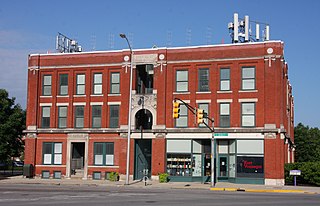
The Emelie was built in 1902 by German immigrant Frederick Schmid and named for his wife. The building was saved and restored by Browning Day Mullins Dierdorf Architects to serve as the company's corporate headquarters from 1987 to 2003. It is three stories, constructed of red brick and gray limestone. The building also includes a garden level. It is built in the German Renaissance Revival Architecture style. It has fine decorative detailing, totaling 35,000 square feet (3,300 m2). It has also served as an apartment building and commercial space.
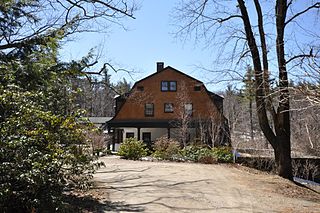
The Markham House is an historic summer house on Snow Hill Road in Dublin, New Hampshire. Built in 1898, it is one of two houses in the town to be designed by the prominent Boston architectural firm Shepley, Rutan and Coolidge, and is a prominent local example of Shingle style architecture. The house was listed on the National Register of Historic Places in 1983.

The C.H. Baker Double House, also known as the Indiana Apartments, The Manor, and The Manor House, is an historic building located in Des Moines, Iowa, United States. Built from 1901 to 1902, it is a two-story structure that features balloon frame construction with brick veneer. It was designed in the Colonial Revival style by the Des Moines architectural firm of Smith & Gutterson. Its significance is attributed to its location on the Sixth Avenue streetcar route "to capitalize on the appeal of public transportation." It was one of the first multiple-family rental properties along the avenue, and it was built for upper-middle class occupancy. It was part of the movement toward denser residential use in this area of the city. The house was listed on the National Register of Historic Places in 1996.

The Apperson Iowa Motor Car Company Building, also known as the Garage Building for Rawson Brothers, is a historic building located in Des Moines, Iowa, United States. It is significant for its association with the prominent Des Moines architectural firm that designed it, Proudfoot, Bird & Rawson. Completed in 1921, it was designed and built within the period of time the firm was at its most prolific (1910-1925). It is also significant for its association with the rise of the Automobile Industry in the city. Auto dealerships and distributorships leased the building from 1921 to 1951. Architect Harry D. Rawson and his brothers owned the building from 1921 to 1938. The two-story structure is located on a midblock lot in the midst of what was the automobile sales, service, and manufacturing district on the western edge of the downtown area. The first floor housed a showroom in the front with offices on a mezzanine. The back of the first floor and the second floor was used for assembling and servicing automobiles. The building was listed on the National Register of Historic Places in 2016.

H. N. Black was an American architect who designed many buildings in the Western United States, including Washington, Idaho and Montana, some of which are listed on the National Register of Historic Places.

The Marina Park Historic District encompasses the finest collection of high-style late 19th-century residential architecture in the city of Bridgeport, Connecticut. Extending along Park Avenue between Seaside Park and Atlantic Avenue, this area was home to Bridgeport's industrial and civic leaders, and was developed by city booster P.T. Barnum. The district was listed on the National Register of Historic Places in 1982.


