
Northwest is the northwestern quadrant of Washington, D.C., the capital of the United States, and is located north of the National Mall and west of North Capitol Street. It is the largest of the four quadrants of the city, and it includes the central business district, the Federal Triangle, and the museums along the northern side of the National Mall, as well as many of the District's historic neighborhoods.

Connecticut Avenue is a major thoroughfare in the Northwest quadrant of Washington, D.C., and suburban Montgomery County, Maryland. It is one of the diagonal avenues radiating from the White House, and the segment south of Florida Avenue was one of the original streets in Pierre (Peter) Charles L'Enfant's plan for Washington. A five-mile segment north of Rock Creek was built in the 1890s by a real-estate developer.

Sheridan Circle is a traffic circle and park in the Sheridan-Kalorama neighborhood of Washington, D.C. The traffic circle, one of two in the neighborhood, is the intersection of 23rd Street NW, Massachusetts Avenue NW, and R Street NW. The buildings along this stretch of Massachusetts Avenue NW are part of Embassy Row, which runs from Scott Circle to Observatory Circle. Sheridan Circle is a contributing property to the Massachusetts Avenue Historic District and the Sheridan-Kalorama Historic District, both listed on the National Register of Historic Places (NRHP). In addition, the equestrian statue of General Philip Sheridan is 1 of 18 Civil War Monuments in Washington, D.C., that were collectively listed on the NRHP.

Charles Evans Hughes House is a historic house at 2223 R Street, NW in the Sheridan-Kalorama neighborhood of Washington, D.C. Built in 1907, it was from 1930 to 1948 the home of Charles Evans Hughes (1862–1948), a prominent Republican politician and from 1930 to 1941 the Chief Justice of the United States. It was declared a National Historic Landmark in 1972 and is a contributing property to the Sheridan-Kalorama Historic District. It presently serves as the official residence of the Ambassador of Myanmar to the United States.

The following outline is provided as an overview of and topical guide to the District of Columbia:

General Philip Sheridan is a bronze sculpture that honors Civil War general Philip Sheridan. The monument was sculpted by Gutzon Borglum, best known for his design of Mount Rushmore. Dedicated in 1908, dignitaries in attendance at the unveiling ceremony included President Theodore Roosevelt, members of the President's cabinet, high-ranking military officers and veterans from the Civil War and Spanish–American War. The equestrian statue is located in the center of Sheridan Circle in the Sheridan-Kalorama neighborhood of Washington, D.C. The bronze statue, surrounded by a plaza and park, is one of eighteen Civil War monuments in Washington, D.C., which were collectively listed on the National Register of Historic Places in 1978. The sculpture and surrounding park are owned and maintained by the National Park Service, a federal agency of the Interior Department.
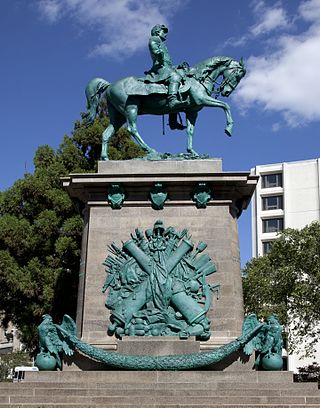
Major General George B. McClellan is an equestrian statue in Washington, D.C. that honors politician and Civil War general George B. McClellan. The monument is sited on a prominent location in the Kalorama Triangle neighborhood due to efforts made by area residents. The statue was sculpted by American artist Frederick William MacMonnies, a graduate of the École des Beaux-Arts whose best known work is a statue of Nathan Hale in New York City. MacMonnies was chosen to design the statue following a lengthy competition organized by a statue commission, led by then Secretary of War William Howard Taft. The monument was dedicated in 1907, with prominent attendees at the ceremony including President Theodore Roosevelt, New York City mayor George B. McClellan Jr., politicians, generals and thousands of military personnel.

The French ambassador's residence in Washington, D.C. is located at 2221 Kalorama Road, N.W., in the Kalorama neighborhood of Northwest Washington, D.C.
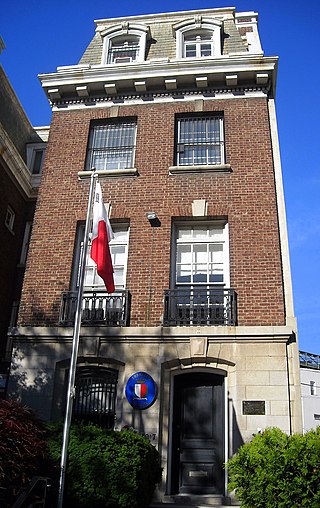
The Embassy of Malta in Washington, D.C., is the Republic of Malta's diplomatic mission to the United States. It is located at 2017 Connecticut Avenue, N.W. in Washington, D.C.'s Kalorama Triangle neighbourhood. The embassy also serves as the High Commission of Malta to Mexico and the Bahamas.

James G. Hill (1841–1913) was an American architect who, during the period 1876 to 1883, headed the Office of the Supervising Architect of the United States Department of the Treasury, which oversaw major Federal buildings.
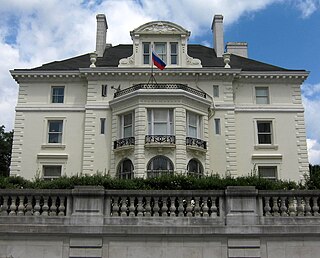
The Lothrop Mansion, also known as the Alvin Mason Lothrop House, is an historic home, located at 2001 Connecticut Avenue, Northwest, Washington, D.C., in the Kalorama Triangle neighborhood.

Anthony Holmead Archeological Site, at Mitchell Park, is a historic site located at 1801 23rd Street, Northwest, Washington, D.C., in the Sheridan-Kalorama neighborhood.

Banneker Recreation Center is an historic structure located in the Columbia Heights neighborhood of Washington, D.C. The building was built in 1934 and was named for Benjamin Banneker, a free African American who assisted in the survey of boundaries of the original District of Columba in 1791. It was known as a premier African American recreation center in the city. It was listed on the District of Columbia Inventory of Historic Sites in 1985 and it was listed on the National Register of Historic Places in 1986. The structure currently houses the Banneker Community Center, a unit of the District of Columbia Department of Parks and Recreation.
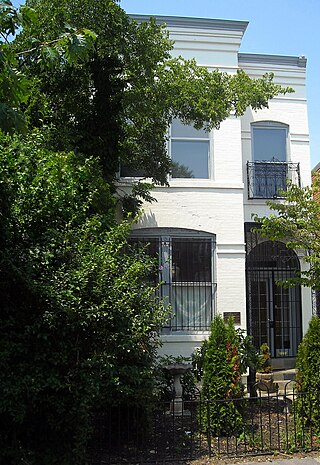
The Evans-Tibbs House is an historic house in the Shaw neighborhood of Washington, D.C. It has been listed on the District of Columbia Inventory of Historic Sites since 1985 and it was listed on the National Register of Historic Places in 1987. It is a contributing property in the Greater U Street Historic District.

The Kalorama Triangle Historic District is a mostly residential neighborhood and a historic district in the northwest quadrant of Washington, D.C. The entire Kalorama Triangle neighborhood was listed on the District of Columbia Inventory of Historic Sites (DCIHS) and National Register of Historic Places (NRHP) in 1987. In addition to individually listed landmarks in the neighborhood, the district is home to roughly 350 contributing properties. The neighborhood is roughly bounded by Connecticut Avenue to the west, Columbia Road to the east, and Calvert Street on the north.
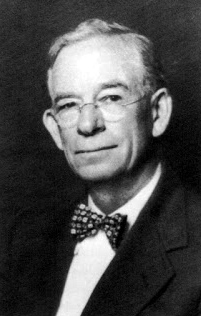
Arthur B. Heaton was an American architect from Washington, D.C. During his 50-year career Heaton designed over 1,000 commissions, including many notable buildings listed on the National Register of Historic Places (NRHP). He was the first supervising architect of the Washington National Cathedral and one of several local architects responsible for designing many of the buildings in the Burleith, Cleveland Park, Kalorama Triangle, and Woodley Park neighborhoods.
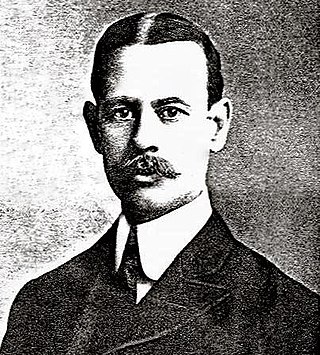
George S. Cooper was an American architect and builder from Washington, D.C. During his 40-year career, he was responsible for designing around 850 properties, including homes, commercial buildings and apartment buildings, several of which are listed on the National Register of Historic Places (NRHP). The 1903 book History of the City of Washington states: "It may be thought that Mr. Cooper's forte lies in the designing of apartment houses, since the handsomest in the city are a result of his genius..." and "No young man has played a more important part in the active growth and great development of Greater Washington than George S. Cooper..."

Appleton Prentiss Clark Jr. was an American architect from Washington, D.C. During his 60-year career, Clark was responsible for designing hundreds of buildings in the Washington area, including homes, hotels, churches, apartments and commercial properties. He is considered one of the city's most prominent and influential architects from the late 19th and early 20th centuries. Many of his designs are now listed on the National Register of Historic Places (NRHP).

The Sheridan-Kalorama Historic District is a neighborhood and historic district located in the northwest quadrant of Washington, D.C. The boundaries of the historic district include Rock Creek Park to the north and west, P Street to the south, and 22nd Street and Florida Avenue to the east. On the southwestern edge of the neighborhood is a stretch of Embassy Row on Massachusetts Avenue. The other neighborhood and historic district that lies to the east of Sheridan-Kalorama is Kalorama Triangle Historic District. The two neighborhoods are divided by Connecticut Avenue. For many years both neighborhoods were geographically connected before the stretch of Connecticut Avenue was installed toward the Taft Bridge. Oftentimes, both neighborhoods are simply called "Kalorama" or "Kalorama Heights".

2101 Connecticut Avenue is a housing co-op and former apartment building sited on a prominent place in the Kalorama Triangle Historic District in Washington, D.C. The neighborhood where the building stands was mostly developed in the 1890s to early 20th-century. Many large apartment buildings had already been built in the area by the time 2101 Connecticut Avenue was constructed in 1928. It was the last of the grand and luxurious apartment buildings constructed in Kalorama Triangle. The architects for the building were George T. Santmyers and Joseph Abel, the latter doing most of the work.


