Related Research Articles
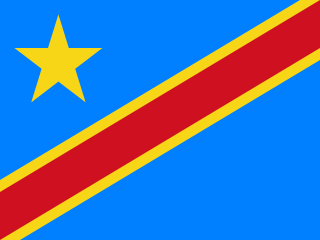
DR Congo, officially the Democratic Republic of the Congo, also known as the DRC, Congo-Kinshasa or simply Congo, is a country in Central Africa. By land area, DR Congo is the second-largest country in Africa and the 11th-largest in the world. With a population of around 109 million, the Democratic Republic of the Congo is the most populous Francophone country in the world. The national capital and largest city is Kinshasa, which is also the economic center. The country is bordered by the Republic of the Congo, Central African Republic, South Sudan, Uganda, Rwanda, Burundi, Tanzania, Zambia, Angola, the Cabinda exclave of Angola, and the South Atlantic Ocean.
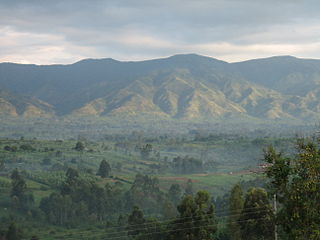
North Kivu is a province bordering Lake Kivu in the eastern Democratic Republic of the Congo. The capital city is Goma. Spanning approximately 59,483 square kilometers with a population estimate of 8,147,400 as of 2020, it is bordered by Ituri Province to the north, Tshopo Province to the northwest, Maniema Province to the southwest, and South Kivu Province to the south, as well as Uganda and Rwanda to the east.

The United Nations Organization Stabilization Mission in the Democratic Republic of the Congo, or MONUSCO, is a United Nations peacekeeping force in the Democratic Republic of the Congo (DRC). At the request of the DRC's government, it is withdrawing completely from the country by the end of 2024.

Goma is the capital and largest city of the North Kivu Province in the eastern region of the Democratic Republic of the Congo. It is located on the northern shore of Lake Kivu and shares borders with Bukumu Chiefdom to the north, Rwanda to the east and Masisi Territory to the west. The city lies in the Albertine Rift, the western branch of the East African Rift, and is only 13–18 km (8.1–11.2 mi) south of the active volcano Mount Nyiragongo. With an approximate area of 75.72 km2 (29.24 sq mi), the city has an estimated population of nearly 2 million people according to the 2022 census.

Vital Kamerhe Lwa Kanyiginyi Nkingi is a Congolese politician, currently serving as Deputy Prime Minister of Economy and the leader of the Union for the Congolese Nation (UNC) party. He served as the President of the National Assembly of the Democratic Republic of the Congo from 2006 to 2009. After resigning from that office, he went into the opposition and founded the UNC. He ran in the 2011 presidential election. He supported Félix Tshisekedi as a coalition partner in the 2018 presidential election, and became chief of staff when Tshisekedi took office.
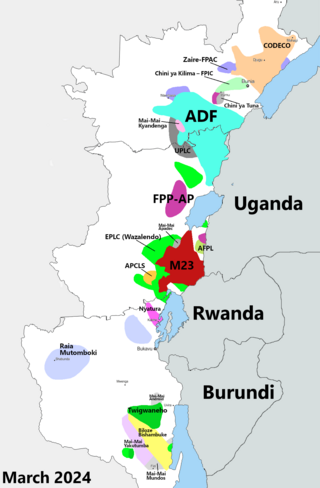
The Kivu conflict is an umbrella term for a series of protracted armed conflicts in the North Kivu and South Kivu provinces in the eastern Democratic Republic of the Congo which have occurred since the end of the Second Congo War. Including neighboring Ituri province, there are more than 120 different armed groups active in the eastern Democratic Republic of Congo. Currently, some of the most active rebel groups include the Allied Democratic Forces, the Cooperative for the Development of the Congo, the March 23 Movement, and many local Mai Mai militias. In addition to rebel groups and the governmental FARDC troops, a number of national and international organizations have intervened militarily in the conflict, including the United Nations force known as MONUSCO, and an East African Community regional force.

On 15 April 2008, Hewa Bora Airways Flight 122, a McDonnell Douglas DC-9-51 plane crashed into a residential and market area of Goma of the Democratic Republic of the Congo immediately south of Goma International Airport.
Bosco Ntaganda is a convicted war criminal and the former military chief of staff of the National Congress for the Defense of the People (CNDP), an armed militia group operating in the North Kivu province of the Democratic Republic of the Congo (DRC). He is a former member of the Rwandan Patriotic Army and allegedly a former Deputy Chief of the General Staff of the Patriotic Forces for the Liberation of Congo (FPLC), the military wing of the Union of Congolese Patriots.

The National Congress for the Defence of the People is a political armed militia established by Laurent Nkunda in the Kivu region of the Democratic Republic of the Congo in December 2006. The CNDP was engaged in the Kivu conflict, an armed conflict against the military of the Democratic Republic of the Congo. In January 2009, the CNDP split and Nkunda was arrested by the Rwanda government. The remaining CNDP splinter faction, led by Bosco Ntaganda, was planned to be integrated into the national army.
Laurent Nkunda is a former General in the Armed Forces of the Democratic Republic of Congo (DRC) and is the former warlord operating in the province of North-Kivu, and a officer of the Tutsi-dominated government of neighbouring Rwanda. Nkunda, who is himself a Congolese born Tutsi, commanded the former DRC troops of the 81st and 83rd Brigades of the DRC Army. He speaks English, French, Swahili, Kinyarwanda, Lingala and Kinande. On January 22, 2009, he was put under house arrest in Gisenyi when he was called for a meeting to plan a joint operation between the Congolese and Rwandan militaries.
The Congolese Rally for Democracy, also known as the Rally for Congolese Democracy, is a political party and a former rebel group that operated in the eastern region of the Democratic Republic of the Congo (DRC). It was supported by the government of Rwanda, and was a major armed faction in the Second Congo War (1998-2003). It became a social liberal political party in 2003.
Kanyabayonga is a town straddling the Lubero and Rutshuru territories of North Kivu province in eastern Democratic Republic of the Congo (DRC). Administratively, the part which is in Lubero is the commune of Kanyabayonga and, the part in Rutshuru belongs to the Kanyabayonga groupement (grouping) which extends well south of the town and is within the Bwito chiefdom. The region as a whole has seen much armed conflict since 1993.
The Congolese Rally for Democracy–Goma was a faction of the Congolese Rally for Democracy, a rebel movement based in Goma, Democratic Republic of the Congo (DRC) during the Second Congo War (1998–2003). After the war, some members of the group continued sporadic fighting in North Kivu. The movement also entered mainstream politics, participating in democratic elections with little success.

The M23 rebellion was an armed conflict in North Kivu, Democratic Republic of the Congo (DRC), that occurred between the March 23 Movement and government forces between 4 April 2012 and 7 November 2013. It ended when a peace agreement was made among eleven African nations, and the M23 troops surrendered in Uganda. The rebellion was part of continued fighting in the region after the formal end of the Second Congo War in 2003. The conflict reignited in late 2021 after rebel "general" Sultani Makenga and 100 rebel fighters attacked the border town of Bunagana but failed. A few months later, with a much larger force, the rebels of the M23 movement renewed their attack and captured Bunagana.

The March 23 Movement, often abbreviated as M23 and also known as the Congolese Revolutionary Army, is a Congolese rebel military group. Based in eastern areas of the Democratic Republic of the Congo (DRC), it operates mainly in the province of North Kivu, which borders both Uganda and Rwanda. The M23 rebellion of 2012 to 2013 against the DRC government led to the displacement of large numbers of people. On 20 November 2012, M23 took control of Goma, a provincial capital with a population of a million people, but it was requested to evacuate it by the International Conference on the Great Lakes Region because the DRC government had finally agreed to negotiate. In late 2012, Congolese troops, along with UN troops, retook control of Goma, and M23 announced a ceasefire and said that it wanted to resume peace talks.
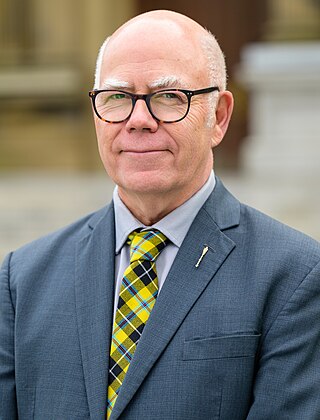
David Charles Coon is a Canadian conservationist and politician who has served as leader of the Green Party of New Brunswick since 2012 and as a Member of the Legislative Assembly of New Brunswick for Fredericton South since 2014.
Karl Richard Toft was a Canadian convicted sex predator and pederast who committed an estimated 200 sexual assaults while working as a guard at the New Brunswick Training School in Kingsclear, New Brunswick. He was regarded as one of Canada's worst sex offenders. Toft was convicted of 34 sex-related charges and sentenced in December 1992 to 13 years in prison. In 1994, Toft appealed the sentence but lost. He served 11 years of his sentence and was freed. He was represented by Daniel Watters, who maintained that two-thirds of the allegations were untrue.

Black Canadians in New Brunswick refers to Black Canadians from the province of New Brunswick, notably of those whose ancestors, much like those of Black Nova Scotians, originated from the Colonial United States as slaves or freemen and arrived in New Brunswick during the 18th and early 19th centuries. As of the 2021 Canadian census, 12,155 Black people live in New Brunswick, making them the largest visible minority group in the province. The first recorded Black person in present-day New Brunswick was a Black man from New England who was forcibly taken during a French raid in the late 17th century.
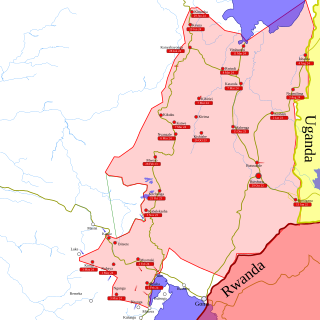
In late March 2022, the March 23 Movement (M23), supported by Rwanda, launched an offensive in North Kivu against the Armed Forces of the Democratic Republic of the Congo (FARDC) and MONUSCO. The fighting displaced hundreds of thousands of civilians and caused renewed tensions between the Democratic Republic of the Congo and Rwanda.

Beginning in 2022, tensions heightened between the Democratic Republic of the Congo (DRC) and Rwanda, marking a significant breakdown in relations between the two countries. Amid this, Rwandan forces have crossed into the DRC multiple times, usually fighting alongside Congolese rebels.
References
- 1 2 DeLong, Nathan (3 June 2024). "Fredericton activist freed after five months in captivity in Congo". Telegraph-Journal . Retrieved 4 June 2024.
- ↑ Mwenengabo, Frederick Wangabo. "A Brief on how Canada Better Can Address The Issues of: Conflict, Peace, Gender Based Violence, Security, Justice, Respect for Human Rights and Economic Development in Somalia, South Sudan and Democratic Republic of Congo (DRC). Particular Attention on DRC" (PDF). House of Commons of Canada . p. 1. Retrieved 6 June 2024.
- ↑ Bowie, Adam (24 November 2015). "Vigil calls on locals to 'open their hearts'". The Daily Gleaner . ProQuest 1735555181 . Retrieved 4 June 2024.
- 1 2 "Fredrick Mwenengabo". Canadian Museum of Immigration at Pier 21 . Retrieved 4 June 2024.
- 1 2 3 Jones, Lindsay (19 April 2024). "New Brunswick man kidnapped in Congo, held for more than four months". The Globe and Mail . Retrieved 4 June 2024.
- ↑ "Retiring school bus driver gets fond farewell". The Daily Gleaner . 23 June 2015. ProQuest 1690305424 . Retrieved 4 June 2024.
- ↑ "Fredericton man ends 48 day hunger strike". CBC News . 21 April 2012. Retrieved 4 June 2024.
- ↑ Silberman, Alexandre (30 March 2024). "Family calls on Canadian government to help Fredericton man kidnapped in Congo". CBC News . Retrieved 4 June 2024.
- ↑ Jones, Lindsay (2 June 2024). "New Brunswick man back home after kidnapping in Congo says he won't stop fighting for peace". The Globe and Mail . Retrieved 4 June 2024.
- ↑ Villeneuve, Alix (4 June 2024). "Cinq mois après avoir été enlevé en Afrique, il est libéré et rentre au N.-B". Radio-Canada (in Canadian French). Retrieved 4 June 2024.