
St. Croix County is a county in the U.S. state of Wisconsin. As of the 2020 census, the population was 93,536. Its county seat is Hudson. The county was created in 1840 and organized in 1849. St. Croix County is part of the Minneapolis-St. Paul-Bloomington, MN-WI Metropolitan Statistical Area. Between 2000 and 2010, it was the fastest-growing county in Wisconsin.

Lafayette County, sometimes spelled La Fayette County, is a county located in the U.S. state of Wisconsin. It was part of the Wisconsin Territory at the time of its founding. As of the 2020 census, the population was 16,611. Its county seat is Darlington. The county was named in honor of the Marquis de Lafayette, the French general who rendered assistance to the Continental Army in the American Revolutionary War. The courthouse scenes from the 2009 film Public Enemies were filmed at the Lafayette County Courthouse in Darlington.
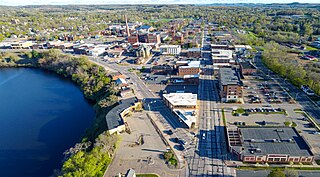
Menomonie is a city in and the county seat of Dunn County in the western part of the U.S. state of Wisconsin. The city's population was 16,843 as of the 2020 census.

The Territory of Iowa was an organized incorporated territory of the United States that existed from July 4, 1838, until December 28, 1846, when the southeastern portion of the territory was admitted to the Union as the state of Iowa. The remainder of the territory would have no organized territorial government until the Minnesota Territory was organized on March 3, 1849.

The Territory of Wisconsin was an organized and incorporated territory of the United States that existed from July 3, 1836, until May 29, 1848, when an eastern portion of the territory was admitted to the Union as the State of Wisconsin. Belmont was initially chosen as the capital of the territory. In 1837, the territorial legislature met in Burlington, just north of the Skunk River on the Mississippi, which became part of the Iowa Territory in 1838. In that year, 1838, the territorial capital of Wisconsin was moved to Madison.

John Scott Horner was a U.S. politician, Secretary and acting Governor of Michigan Territory, 1835–1836 and Secretary of Wisconsin Territory, 1836–1837.
Horatio Nelson Wells was an American lawyer, Democratic politician, and Wisconsin pioneer. He was the 2nd mayor of Milwaukee, Wisconsin, and the 2nd attorney general of the Wisconsin Territory. He also served as the last president of the Council of the Wisconsin Territory.

Ben C. Eastman was an American lawyer, Democratic politician, and Wisconsin pioneer. He served two terms in the U.S. House of Representatives, representing Wisconsin's 2nd congressional district from 1851 to 1855. He previously served as secretary of the Council of the Wisconsin Territory during the 4th Wisconsin Territorial Assembly.

William Stephen Hamilton, a son of Alexander Hamilton and Elizabeth Schuyler Hamilton, was an American politician and miner who lived much of his life in the U.S. state of Illinois and the Wisconsin Territory. Hamilton was born in New York, where he attended the United States Military Academy before he resigned and moved to Illinois in 1817. In Illinois, he lived in Springfield and Peoria and eventually migrated to the lead-mining region of southern Wisconsin and established Hamilton's Diggings at present-day Wiota, Wisconsin. Hamilton served in various political offices and as a commander in two Midwest Indian Wars. In 1849, he moved to California during the California Gold Rush. He died in Sacramento, most likely of cholera, in October 1850.
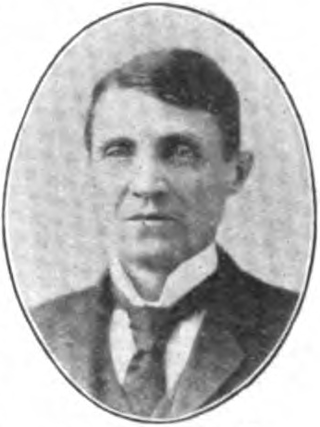
Albert R. Hall was an American farmer, businessman, and Republican politician. He served seven terms in the Minnesota House of Representatives, representing Hennepin County, and was speaker from 1872 until 1874. He later moved to Dunn County, Wisconsin, and served six terms in the Wisconsin State Assembly (1891–1903). In historical documents, his name is sometimes abbreviated as A. R. Hall.
William Banks Slaughter was an American politician.
Wisconsin's 17th Senate district is one of 33 districts in the Wisconsin Senate. Located in southwest Wisconsin, the district comprises all of Crawford, Grant, Green, Lafayette, and Iowa counties, as well as parts of southwest Dane County. It includes the cities of Boscobel, Brodhead, Cuba City, Darlington, Dodgeville, Lancaster, Mineral Point, Monroe, Oregon, Platteville, Prairie du Chien, and Shullsburg.
Francis Dunn may refer to:
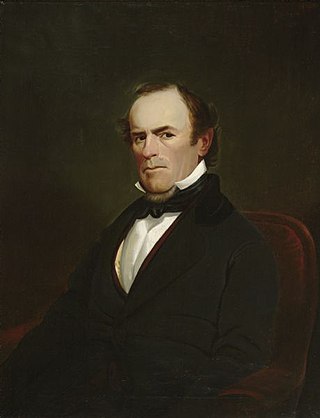
Levi Sterling was an American farmer, politician, and Wisconsin pioneer. He was one of the first American settlers at what is now Iowa County, Wisconsin. He served five years in the Wisconsin Legislature and—before Wisconsin achieved statehood—he served three years in the Wisconsin Territorial Assembly. During the American Civil War, he served as a Union Army cavalry officer.

John Wilford Blackstone Jr. was an American farmer, lawyer, politician, and judge. A Republican, he represented Lafayette County for one term each in the Wisconsin State Senate and Assembly. He also served two four-year terms as County Judge for Lafayette County.
William Henry Armstrong was an American lawyer, farmer, and Republican politician. He was a member of the Wisconsin State Assembly, representing Lafayette County during the 1873 session.
John Francis Meade was a farmer, land speculator and politician from Green Bay, Wisconsin who served a single one-year term as a Democratic member of the Wisconsin State Assembly from Brown County during the 1849 session and held various other public offices in the Territory and State of Wisconsin.
The Third Legislative Assembly of the Wisconsin Territory convened from December 7, 1840, to February 19, 1841, and from December 6, 1841, to February 19, 1842, in regular session.
James H. Persons was an American farmer, Republican politician, and Wisconsin pioneer. He was a member of the Wisconsin State Assembly, representing Pierce County during the 1873 and 1874 sessions.
Samuel Cole IV was an American mechanic, politician, and Wisconsin pioneer. He served four years in each house of the Wisconsin Legislature, representing Lafayette County. He was a member of the Wisconsin Senate in 1861, 1862, 1865, and 1866, and was a member of the State Assembly in 1851, 1860, 1864, and 1868.

