History
Legendary 15th century Arab explorer Ahmad ibn Mājid wrote of El-Darad and several other notable landmarks and ports of the northern Somali coast, including Berbera, the Sa'ad ad-Din islands (aka the Zeila Archipelago near Zeila), Alula, Ruguda, Maydh, Heis, Siyara and El-Sheikh. [1]
In the 19th century, El-Darad was a seasonal coastal trading settlement with a fort made of adobe (earth) and stone masonry, which was surrounded by Somali Aqal and Areesh (traditional nomadic and coastal dwellings respectively [2] ). The fort was erected in circa 1826 and was owned by Muhammad Diban, a Habr Je'lo (Adan Madobe) pirate and slave trader based in El-Darad who garrisoned the fort with slaves armed with matchlock rifles. [3] Muhammad Diban also had cordial relations with Sharmarke Ali Saleh – governor and ruler of Zeila, Berbera and Tadjoura – who provided Muhammad with five cannons after Sharmarke lost control of Berbera in 1852. [4]
The town today is inhabited by the Faahiye Xassan Sub-division of the Aadan Madoobe and the Ahmed Farah Sub-division of the Nuux Maxamed who both belong to the Habr Je'lo Clan family.
This page is based on this
Wikipedia article Text is available under the
CC BY-SA 4.0 license; additional terms may apply.
Images, videos and audio are available under their respective licenses.


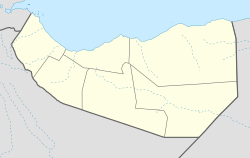
 Somaliland


