Related Research Articles
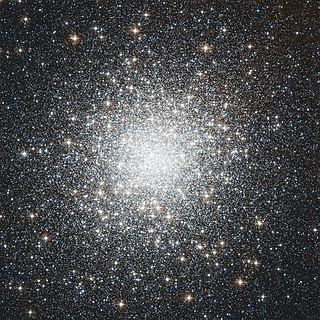
A globular cluster is a spheroidal conglomeration of stars that is bound together by gravity, with a higher concentration of stars towards their centers. They can contain anywhere from tens of thousands to many millions of member stars, all orbiting in a stable, compact formation. Globular clusters are similar in form to dwarf spheroidal galaxies, and the distinction between the two is not always clear. Their name is derived from Latin globulus. Globular clusters are occasionally known simply as "globulars".
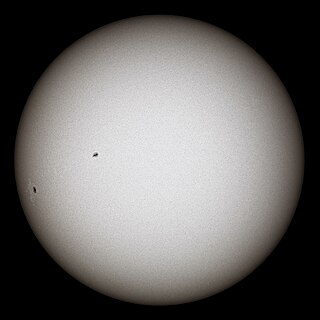
A star is a luminous spheroid of plasma held together by self-gravity. The nearest star to Earth is the Sun. Many other stars are visible to the naked eye at night; their immense distances from Earth make them appear as fixed points of light. The most prominent stars have been categorised into constellations and asterisms, and many of the brightest stars have proper names. Astronomers have assembled star catalogues that identify the known stars and provide standardized stellar designations. The observable universe contains an estimated 1022 to 1024 stars. Only about 4,000 of these stars are visible to the naked eye—all within the Milky Way galaxy.

Crater is a small constellation in the southern celestial hemisphere. Its name is the latinization of the Greek krater, a type of cup used to water down wine. One of the 48 constellations listed by the second-century astronomer Ptolemy, it depicts a cup that has been associated with the god Apollo and is perched on the back of Hydra the water snake.
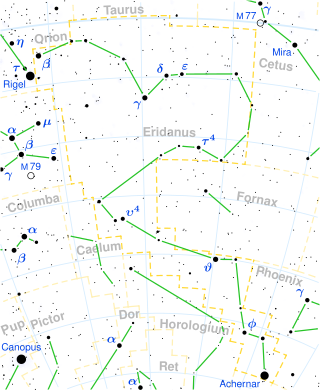
40 Eridani is a triple star system in the constellation of Eridanus, abbreviated 40 Eri. It has the Bayer designation Omicron2 Eridani, which is Latinized from ο2 Eridani and abbreviated Omicron2 Eri or ο2 Eri. Based on parallax measurements taken by the Gaia mission, it is about 16.3 light-years from the Sun.
Van Maanen 2, or van Maanen's Star, is the closest known solitary white dwarf to the Solar System. It is a dense, compact stellar remnant no longer generating energy and has equivalent to about 68% of the Sun's mass but only 1% of its radius. At a distance of 14.1 light-years it is the third closest of its type of star after Sirius B and Procyon B, in that order. Discovered in 1917 by Dutch–American astronomer Adriaan van Maanen, Van Maanen 2 was the third white dwarf identified, after 40 Eridani B and Sirius B, and the first solitary example.

Gliese 436 is a red dwarf located 31.9 light-years away in the zodiac constellation of Leo. It has an apparent visual magnitude of 10.67, which is much too faint to be seen with the naked eye. However, it can be viewed with even a modest telescope of 2.4 in (6 cm) aperture. In 2004, the existence of an extrasolar planet, Gliese 436 b, was verified as orbiting the star. This planet was later discovered to transit its host star.
Doris Daou is a Lebanese-born Canadian-American astronomer who was formerly the Director for Education and Public Outreach of the NASA Lunar Science Institute and the associate director of the NASA Solar System Exploration Research Virtual Institute (SSERVI), and is currently the program contact for NASA's "Small Innovative Missions for Planetary Exploration (SIMPLEx)".
Rebecca Oppenheimer is an American astrophysicist and one of four curator/professors in the Department of Astrophysics at the American Museum of Natural History (AMNH) on Manhattan's Upper West Side. Oppenheimer is a comparative exoplanetary scientist. She investigates planets orbiting stars other than the Sun. Her optics laboratory is the birthplace of a number of new astronomical instruments designed to tackle the problem of directly seeing and taking spectra of nearby solar systems with exoplanets and studying their composition, with the ultimate goal of finding life outside the solar system.
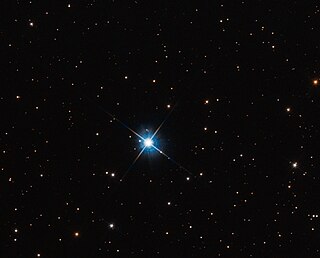
Gliese 440, also known as LP 145-141 or LAWD 37, is an isolated white dwarf located 15.1 light-years from the Solar System in the constellation Musca. It is the fourth closest known white dwarf to the Sun, after Sirius B, Procyon B, and van Maanen's star.

Nicholas B. Suntzeff is an American astronomer and cosmologist. He is a University Distinguished Professor and holds the Mitchell/Heep/Munnerlyn Chair of Observational Astronomy in the Department of Physics & Astronomy at Texas A&M University where he is Director of the Astronomy Program. He is an observational astronomer specializing in cosmology, supernovae, stellar populations, and astronomical instrumentation. With Brian Schmidt he founded the High-z Supernova Search Team, which was honored with the Nobel Prize in Physics in 2011 to Schmidt and Adam Riess.

RX Andromedae is a variable star in the constellation of Andromeda. Although it is classified as a dwarf nova of the Z Camelopardalis (UGZ) type, it has shown low-luminosity periods typical of VY Sculptoris stars. However, for most of the time it varies from an apparent visual magnitude of 15.1 at minimum brightness to a magnitude of 10.2 at maximum brightness, with a period of approximately 13 days.
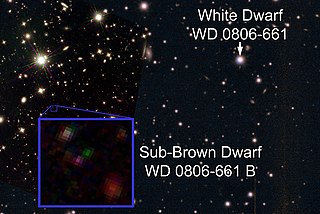
WD 0806−661, formally named Maru, is a DQ white dwarf with an extremely cold Y-type substellar companion, located in the constellation Volans at 62.7 light-years from Earth. The companion was discovered in 2011, and is the only known Y-type companion to a star or stellar remnant. At the time of its discovery WD 0806-661 B had the largest actual and apparent separation of any known planetary-mass object, as well as being the coldest directly imaged substellar object then known.

Debra Meloy Elmegreen is an American astronomer. She was the first woman to graduate from Princeton University with a degree in astrophysics, and she was the first female post-doctoral researcher at the Carnegie Observatories.

Laura Ferrarese is a researcher in space science at the National Research Council of Canada. Her primary work has been performed using data from the Hubble Space Telescope and the Canada-France-Hawaii Telescope.

SU Ursae Majoris, or SU UMa, is a close binary star in the northern circumpolar constellation of Ursa Major. It is a periodic cataclysmic variable that varies in magnitude from a peak of 10.8 down to a base of 14.96. The distance to this system, as determined from its annual parallax shift of 4.53 mas, is 719 light-years. It is moving further from the Earth with a heliocentric radial velocity of +27 km/s.

Kevin France is an astrophysicist and assistant professor in the Department of Astrophysical and Planetary Sciences at the University of Colorado. His research focuses on exoplanets and their host stars, protoplanetary disks, and the development of instrumentation for space-borne astronomy missions.

BZ Ursae Majoris is a dwarf nova star system in the northern circumpolar constellation of Ursa Major. It consists of a white dwarf primary in a close orbit with a red dwarf. The latter star is donating mass, which is accumulating in an accretion disk orbiting the white dwarf. The system is located at a distance of approximately 505 light years from the Sun based on parallax measurements.
Ata Sarajedini is an astrophysicist, professional astronomer, academic, author, and podcaster. He is the Bjorn Lamborn Endowed Chair and Professor in Astrophysics at Florida Atlantic University.
References
- ↑ Dorminey, Bruce (29 January 2014). "Nearest Dying White Dwarfs Likely Still Harbor Planets". Forbes . Retrieved 7 November 2016.
- 1 2 3 4 "Académie Des Sciences Du Liban". asduliban.org. Retrieved 2016-11-07.
- 1 2 "Edward M. Sion - Associate Member (2010) | Department of Physics and Astronomy". physics.ku.edu. 2014-01-10. Retrieved 2016-11-07.
- ↑ "Edward M. Sion". www.astronomy.villanova.edu. Retrieved 2016-11-07.
- ↑ McCook, George P.; Sion, Edward M. (1984). A Catalogue of Spectroscopically Identified White Dwarfs. Villanova Press.
- ↑ McCook, George. "White Dwarf Catalog". www.astronomy.villanova.edu. Retrieved 2016-11-07.
- ↑ Sion, E. M.; Greenstein, J. L.; Landstreet, J. D.; Liebert, James; Shipman, H. L.; Wegner, G. A. (1983). "A proposed new white dwarf spectral classification system". The Astrophysical Journal. 269: 253. Bibcode:1983ApJ...269..253S. doi: 10.1086/161036 .
- ↑ Corbally, Christopher J.; Gray, Richard O.; Burgasse, Adam J. (2009). Stellar Spectral Classification. Princeton University Press. ISBN 9780691125114.
- ↑ Sion, Edward M. (15 July 1984). "Implications of the absolute magnitude distribution functions of DA and non-DA white dwarfs". Astrophysical Journal. 282: 612–614. Bibcode:1984ApJ...282..612S. doi:10.1086/162240.
- ↑ "HubbleSite - NewsCenter - Hubble Probes the Workings of a Stellar Hydrogen Bomb (05/22/1995) - Release Text". hubblesite.org. Retrieved 2016-11-07.
- ↑ "IOPscience - search results". iopscience.iop.org. Retrieved 2016-11-19.
- ↑ "Astronomy & Astrophysics (A&A)". www.aanda.org. Retrieved 2016-11-19.
- ↑ "JSTOR: Search Results". www.jstor.org. Retrieved 2016-11-19.
- ↑ "Searching journal content for sion, e in author". Oxford Journals. Oxford University Press.[ dead link ]
- ↑ "Edward Sion". Big Think. 2010-03-08. Retrieved 2016-11-19.
- ↑ Dorminey, Bruce (30 June 2014). "Odds Against Earth Being Hit By Lethal Supernova". Forbes .
- ↑ Bruce Dorminey (February 22, 2024). "Advanced Aliens Could Still Thrive Around Stellar White Dwarfs". Forbes. Forbes. Retrieved June 24, 2024.
- ↑ "Villanova University Faculty Recognized Among World's Top 2% Scientists". Villanova University. Villanova University. April 24, 2024. Retrieved June 24, 2024.
- ↑ "The Outstanding Faculty Research Award". www1.villanova.edu. Retrieved 2016-11-07.
- ↑ "International Astronomical Union | IAU". www.iau.org. Retrieved 2016-11-07.
- ↑ "The Outstanding Faculty Mentor Teaching Award | Villanova University". www1.villanova.edu. Retrieved 2024-04-16.
- ↑ kelinich (2014-02-22). "Committee on Science & the Arts | The Franklin Institute". fi.edu. Retrieved 2024-04-16.
| International | |
|---|---|
| National | |
| Academics | |
| Other | |
