Edward M. Lee was an American Union brevet brigadier general during the period of the American Civil War. He received his appointment as brevet brigadier general dated to March 13, 1865. [1] He is also known as an early supporter for women's suffrage. [2]
In 1867, as a member of the Connecticut legislature, Lee introduced a women's suffrage amendment. [3] After the war, Ulysses S. Grant appointed John Allen Campbell as the first governor of Wyoming and Edward M. Lee as the state's first secretary, the second-highest ranking territorial officer. [4] The suffrage bill that Lee helped introduce also granted married women control of their separate property, permitted married women to work in trade or businesses and control their own earnings, stated that a mortgage was not binding to a wife unless she freely and voluntarily signed it, and granted equal pay for equally qualified women teachers. [5] Regarding Wyoming becoming the first territory or state to enshrine in law that women should be given the right to vote, Lee wrote: "Once, during the session, amid the greatest hilarity, and after the presentation of various funny amendments and in the full expectation of a gubernatorial veto, an act was passed Enfranchising the Women of Wyoming. The bill, however, was approved, became a law, and the youngest territory placed in the van of progress... How strange that a movement destined to purify the muddy pool of politics... should have originated in a joke... All honor to them, say we, to Wyoming's first legislature!" Susan B. Anthony proclaimed, "Wyoming is the first place on God's green earth which could consistently claim to be the land of the Free!" [6] Edward M. Lee had championed this cause for years, arguing that it was unfair for his mother to be denied a privilege now granted to African-American males. [7]

The Nineteenth Amendment to the United States Constitution prohibits the United States and its states from denying the right to vote to citizens of the United States on the basis of sex, in effect recognizing the right of women to a vote. The amendment was the culmination of a decades-long movement for women's suffrage in the United States, at both the state and national levels, and was part of the worldwide movement towards women's suffrage and part of the wider women's rights movement. The first women's suffrage amendment was introduced in Congress in 1878. However, a suffrage amendment did not pass the House of Representatives until May 21, 1919, which was quickly followed by the Senate, on June 4, 1919. It was then submitted to the states for ratification, achieving the requisite 36 ratifications to secure adoption, and thereby go into effect, on August 18, 1920. The Nineteenth Amendment's adoption was certified on August 26, 1920.

Women's suffrage is the right of women to vote in elections. Beginning in the start of the 18th century, some people sought to change voting laws to allow women to vote. Liberal political parties would go on to grant women the right to vote, increasing the number of those parties' potential constituencies. National and international organizations formed to coordinate efforts towards women voting, especially the International Woman Suffrage Alliance.
Universal suffrage gives the right to vote to all adult citizens, regardless of wealth, income, gender, social status, race, ethnicity, or political stance, subject only to certain exceptions as in the case of children, felons, and for a time, women. In its original 19th-century usage by reformers in Britain, universal suffrage was understood to mean only universal manhood suffrage; the vote was extended to women later, during the women's suffrage movement that began in New Zealand in the 19th century.

Voting rights in the United States, specifically the enfranchisement and disenfranchisement of different groups, has been a moral and political issue throughout United States history.

Esther Hobart Morris was the first woman justice of the peace in the United States. She began her tenure as justice in South Pass City, Wyoming, on February 14, 1870, serving a term of nearly 9 months. The Sweetwater County Board of County Commissioners appointed Morris as justice of the peace after the previous justice, R.S. Barr, resigned in protest of Wyoming Territory's passage of the women's suffrage amendment in December 1869.

Carrie Chapman Catt was an American women's suffrage leader who campaigned for the Nineteenth Amendment to the United States Constitution, which gave U.S. women the right to vote in 1920. Catt served as president of the National American Woman Suffrage Association from 1900 to 1904 and 1915 to 1920. She founded the League of Women Voters in 1920 and the International Woman Suffrage Alliance in 1904, which was later named International Alliance of Women. She "led an army of voteless women in 1919 to pressure Congress to pass the constitutional amendment giving them the right to vote and convinced state legislatures to ratify it in 1920" and "was one of the best-known women in the United States in the first half of the twentieth century and was on all lists of famous American women."

Women's legal right to vote was established in the United States over the course of more than half a century, first in various states and localities, sometimes on a limited basis, and then nationally in 1920 with the passing of the 19th Amendment.
The Wyoming State Legislature is the legislative branch of the U.S. State of Wyoming. It is a bicameral state legislature, consisting of a 60-member Wyoming House of Representatives, and a 30-member Wyoming Senate. The legislature meets at the Wyoming State Capitol in Cheyenne. There are no term limits for either chamber.

John Allen Campbell was a politician and officer in the United States Army, as well as the first Governor of the Wyoming Territory.

Women's suffrage in Utah was first granted in 1870, in the pre-federal period, decades before statehood. Among all U.S. states, only Wyoming granted suffrage to women earlier than Utah. Because Utah held two elections before Wyoming, Utah women were the first women to cast ballots in the United States after the start of the suffrage movement. However, in 1887 the Edmunds–Tucker Act was passed by Congress in an effort to curtail Mormon influence in the territorial government, disallowing the enfranchisement of the women residents within Utah Territory.

Pauline Marie O'Neill was an American suffragist and legislator. In addition to her personal accomplishments, she is remembered as the widow of William Owen "Buckey" O'Neill.

Women's suffrage in Canada occurred at different times in different jurisdictions and at different times to different demographics of women. Women's right to vote began in the three prairie provinces. In 1916, suffrage was earned by women in Manitoba, Saskatchewan, and Alberta. The federal government granted limited war-time suffrage to some women in 1917 and followed with full suffrage in 1918, at least, granting it on same basis as men, that is, certain races and status were excluded from voting in federal elections prior to 1960.
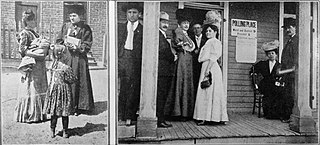
On November 7, 1893, a referendum on women's suffrage was held in Colorado that secured women's voting rights. Subsequently, Colorado became the first American state to enact women's suffrage by popular referendum. The act granted women the right to vote "in the same manner in all respects as male persons are."
This timeline highlights milestones in women's suffrage in the United States, particularly the right of women to vote in elections at federal and state levels.

Women's suffrage was established in the United States on a full or partial basis by various towns, counties, states and territories during the latter decades of the 19th century and early part of the 20th century. As women received the right to vote in some places, they began running for public office and gaining positions as school board members, county clerks, state legislators, judges, and, in the case of Jeannette Rankin, as a member of Congress.
This is a timeline of voting rights in the United States. The timeline highlights milestones when groups of people in the United States gained voting rights, and also documents aspects of disenfranchisement in the country.

Wyoming was the first place in the world to give all women the ability to vote, although other jurisdictions had already given limited suffrage to women who met various property qualifications. A U.S. territory in 1869, Wyoming's first territorial legislature voted to give women the right to vote and to hold public office. A legislature made entirely of men passed the woman's suffrage bill in 1869 entitled "An to Grant to the Women of Wyoming Territory the Right of Suffrage, and to Hold Office.” The territory retained its woman suffrage law even when that law could have jeopardized the Wyoming Territory's application for statehood. In 1890, Wyoming became the first U.S. state allowing its woman citizens to vote.
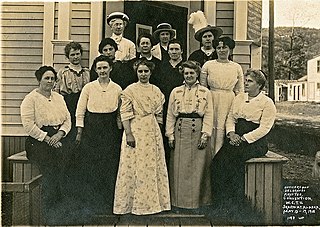
Women's suffrage in Alaska was won fairly easily for white women in 1913. Prior to becoming a territory, white women were able to vote in school board elections. Women's suffrage work took place in the Alaska chapters of the Women's Christian Temperance Union (WCTU). After Alaska was admitted as a territory, the first Territorial Legislature passed a women's suffrage bill in 1913 and was signed into law on March 21. This law only applied to white women since Alaska Natives were not considered citizens of the United States. Alaska Natives continued to fight for the right to vote, along with other civil rights throughout the twentieth and twenty-first century.

This is a timeline of women's suffrage in Colorado. Women's suffrage efforts started in the late 1860s. During the state constitutional convention for Colorado, women received a small win when they were granted the right to vote in school board elections. In 1877, the first women's suffrage referendum was defeated. In 1893, another referendum was successful. After winning the right to vote, Colorado women continued to fight for a federal women's suffrage amendment. While most women were able to vote, it wasn't until 1970 that Native Americans living on reservations were enfranchised.

Women's suffrage in North Dakota began when North Dakota was still part of the Dakota Territory. During this time activists worked for women's suffrage, and in 1879, women gained the right to vote at school meetings. This was formalized in 1883 when the legislature passed a law where women would use separate ballots for their votes on school-related issues. When North Dakota was writing its state constitution, efforts were made to include equal suffrage for women, but women were only able to retain their right to vote for school issues. An abortive effort to provide equal suffrage happened in 1893, when the state legislature passed equal suffrage for women. However, the bill was "lost," never signed and eventually expunged from the record. Suffragists continued to hold conventions, raise awareness, and form organizations. The arrival of Sylvia Pankhurst in February of 1912 stimulated the creation of more groups, including the statewide Votes for Women League. In 1914, there was a voter referendum on women's suffrage, but it did not pass. In 1917, limited suffrage bills for municipal and presidential suffrage were signed into law. On December 1, 1919, North Dakota became the twentieth state to ratify the Nineteenth Amendment.
 | This article about a person of the American Civil War is a stub. You can help Wikipedia by expanding it. |
