
Bloomberg Wall Street Week (WSW), is an investment news and information TV program airing Friday nights on the Bloomberg Television. The original weekly show hosted by Louis Rukeyser aired each Friday evening on PBS in the United States from November 20, 1970, to 2005. The program features a host and guest experts participating in discussions related to the financial markets.

Apopka is a city in Orange County, Florida. The city's population was 54,873 at the 2020 census. It is part of the Orlando–Kissimmee–Sanford Metropolitan Statistical Area. Apopka comes from Seminole word Ahapopka for "potato-eating place".
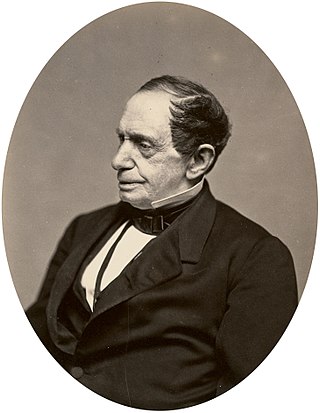
Johns Hopkins was an American merchant, investor, and philanthropist. Born on a plantation, he left his home to start a career at the age of 17, and settled in Baltimore, Maryland, where he remained for most of his life.
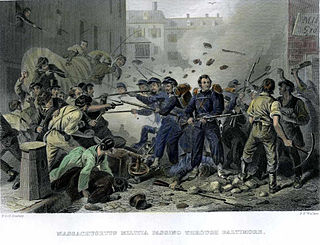
The Baltimore riot of 1861 was a civil conflict on Friday, April 19, 1861, on Pratt Street, Baltimore, Maryland. It occurred between antiwar "Copperhead" Democrats and other Confederate sympathizers on one side, and on the other, members of Massachusetts and Pennsylvania state militia regiments en route to the national capital at Washington who had been called up for federal service. The fighting began at the President Street Station, spreading throughout President Street and subsequently to Howard Street, where it ended at the Camden Street Station. The riot produced the first deaths of Union volunteers by hostile action, although caused by civilians, in the American Civil War. Civilians among the attackers also were killed.

The Peabody Institute of the Johns Hopkins University is a private music and dance conservatory and preparatory school in Baltimore, Maryland. Founded in 1857 and affiliated with Johns Hopkins in 1977, Peabody is the oldest conservatory in the United States and one of the world's most highly-regarded performing arts schools.
Hecht's, also known as Hecht Brothers, Hecht Bros. and The Hecht Company, was a large chain of department stores that operated mainly in the mid-Atlantic and southern region of the United States. The firm originated in Baltimore, Maryland.

John Work Garrett was an American merchant turned banker who became president of the Baltimore and Ohio Railroad (B&O) in 1858 and led the railroad for nearly three decades. The B&O became one of the most important American railroads by the time Garrett died, and Garret would also become a noted philanthropist. He provided crucial support for the Union cause during the Civil War, expanded the railroad to reach Chicago, Illinois, and competed with the Pennsylvania Railroad for access to New York City.
Julius Westheimer was a financial advisor from Baltimore, Maryland. He is best known for his radio and television work, having dispensed financial advice on WBAL Radio, WYPR, WMAR, WBAL-TV and PBS' Wall $treet Week, and in columns in the Baltimore Sun, Baltimore Evening Sun, and Daily Record newspapers.
Harlan D. Mills was professor of computer science at the Florida Institute of Technology and founder of Software Engineering Technology, Inc. of Vero Beach, Florida. Mills' contributions to software engineering have had a profound and enduring effect on education and industrial practice. Since earning his Ph.D. in Mathematics at Iowa State University in 1952, Mills led a distinguished career.

T. Rowe Price Group, Inc. is an American publicly owned global investment management firm that offers funds, subadvisory services, separate account management, and retirement plans and services for individuals, institutions, and financial intermediaries. The firm has assets under management of more than $1.51 trillion and annual revenues of $6.48 billion as of 2023, placing it 537 on the Fortune 1000 list of the largest U.S. companies. Headquartered at 100 East Pratt Street in Baltimore, Maryland, it has 7,868 employees across 17 international offices serving clients in 55 countries.

Louis Richard Rukeyser was an American financial journalist, columnist, and commentator, through print, radio, and television.

Jos. A. Bank is an American retailer of men's furnishings specializing in suits. Established in 1905, by Charles Bank and Joseph Alfred Bank, it operates over 180 retail locations and three distribution centers. The company is headquartered in Fremont, California. Its parent company, Tailored Brands, also owns K&G Fashion Superstores, Men's Wearhouse, and Moores Clothing for Men in Canada.
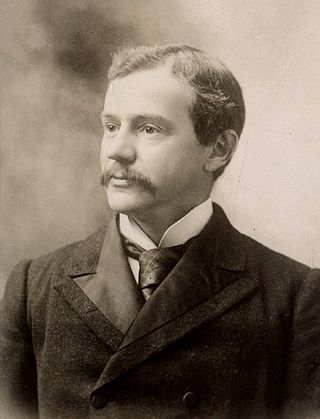
Howard Atwood Kelly was an American gynecologist. He obtained his B.A. degree and M.D. degree from the University of Pennsylvania. He, William Osler, William Halsted, and William Welch together are known as the "Big Four", the founding professors at the Johns Hopkins Hospital in Baltimore, Maryland. He is credited with establishing gynecology as a specialty by developing new surgical approaches to gynecological diseases and pathological research. He also developed several medical innovations, including the improved cystoscope, Kelly's clamp, Kelly's speculum, and Kelly's forceps. Because Kelly was a famous prohibitionist and Fundamentalist Christian, many of his contemporaries expressed skepticism towards his medical professionalism.
Mayo A. Shattuck III is an American businessman and philanthropist. He served as non-executive chairman of Chicago-based Exelon Corporation (2012-2022). He is currently Chairman of Gap INC., Board member of Capital One Financial and HUT8, and Chairman of the Board of Johns Hopkins Medical and Johns Hopkins Health System. Shattuck is involved in a number of philanthropic efforts, including those at the Johns Hopkins University, First Tee, and the University of Maryland Baltimore County and is a notable advocate for nuclear power.

Philip Evan Thomas was the first president of the Baltimore and Ohio Railroad (B&O) from 1827 to 1836. He has been referred to as "The Father of American Railways". The Thomas Viaduct bridge in Relay, Maryland, was named after him.

Maryland's leading industries by employment are health care, social assistance, state and local government, retail trade, and professional and technical services. Maryland's Gross State Product (GSP) was $295.4 billion in 2010. The Government sector produced $52.1 billion and accounted for 18 percent of Maryland's GSP in 2009. Federal government, including military and civilian, accounted for slightly more than half at just over $27 billion, while state and local government combined for nearly $25 billion. The Fort George G. Meade military installation, which includes employees of the National Security Agency, is the state's biggest employer at 44,540. The largest private sector industry is real estate with $48.4 billion, or 17 percent of economic activity. Large private employers in Maryland include Black & Decker, Legg Mason, Lockheed Martin, Marriott International, ZeniMax Media, McCormick & Company, Perdue Farms, General Motors, IBM, Northrop Grumman, and Verizon.
Jim Speros is an American businessman and former American football player and coach from Great Falls, Virginia,, best known for his ownership of teams in the southern American expansion phase of the Canadian Football League and United Football League.

Jeffrey Alfred Legum is an American philanthropist, investor and former automobile dealer.

Aris Melissaratos is a Romanian-born Greek-American engineer, industrialist, aerospace executive, investor, philanthropist, university administrator, author and former government official in Maryland. He served as Secretary of Business and Economic Development of Maryland from 2003 to 2007, in the administration of Governor Robert Ehrlich.
Patrick G. Maggitti has been provost of Villanova University since 2015. He is the university's first provost.


