Description
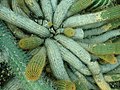
Echinopsis thelegona grows as a shrub with few branches. The tips of the prostrate to creeping shoots are slightly raised or erect. The cylindrical, dark green shoots have a diameter of 7 to 8 cm (2.8 to 3.1 in) and are up to 2 m (7 ft) long. There are about 12 low ribs, which are resolved into conspicuous hexagonal cusps. The areoles on the tips of the humps are circular. Light yellow thorns emerge from them, which turn gray with age and often have a darker tip. The individual central spine protrudes and is 2 to 4 cm (0.8 to 1.6 in) long. The six to seven needle-like marginal spines are spread out and are 1 to 2 cm (0.4 to 0.8 in) long. The lowest marginal spines are the longest.
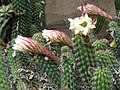
The funnel-shaped, white flowers open at night. They are up to 20 cm (8 in) long and have a diameter of 15 cm (6 in). Its flower tube is covered with reddish bristles and hairs. The spherical to egg-shaped, yellowish to reddish fruits are tuberous and tear open. They have a diameter of up to 5 cm (2.0 in). [3]
Blooming plant
Spines
Crested plant
Plant
This page is based on this
Wikipedia article Text is available under the
CC BY-SA 4.0 license; additional terms may apply.
Images, videos and audio are available under their respective licenses.