A concerto is, from the late Baroque era, mostly understood as an instrumental composition, written for one or more soloists accompanied by an orchestra or other ensemble. The typical three-movement structure, a slow movement preceded and followed by fast movements, became a standard from the early 18th century.

Trevor David Pinnock is a British harpsichordist and conductor.
Hendrik "Henk" Bouman is a Dutch harpsichordist, fortepianist, conductor and composer of music written in the baroque and classical idioms of the 17th and 18th century.

Naxos comprises numerous companies, divisions, imprints, and labels specializing in classical music but also audiobooks and other genres. The premier label is Naxos Records which focuses on classical music. Naxos Musical Group encompasses about 17 labels including Naxos Records, Naxos Audiobooks, and Naxos Books (ebooks). There are about an additional 50 labels that are independent of the Naxos Musical Group with a wide range of offerings.
A Baroque orchestra is an ensemble for mixed instruments that existed during the Baroque era of Western Classical music, commonly identified as 1600–1750. Baroque orchestras are typically much smaller, in terms of the number of performers, than their Romantic-era counterparts. Baroque orchestras originated in France where Jean-Baptiste Lully added the newly re-designed hautbois (oboe) and transverse flutes to his orchestra, Les Vingt-quatre Violons du Roi. As well as violins and woodwinds, baroque orchestras often contained basso continuo instruments such as the theorbo, the lute, the harpsichord and the pipe organ.
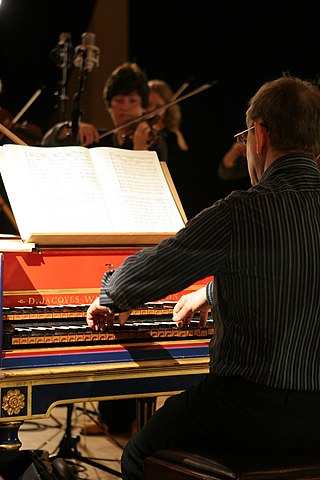
A harpsichordist is a person who plays the harpsichord. Harpsichordists may play as soloists, as accompanists, as chamber musicians, or as members of an orchestra, or some combination of these roles. Solo harpsichordists may play unaccompanied sonatas for harpsichord or concertos accompanied by orchestra. Accompanist harpsichordists might accompany singers or instrumentalists, either playing works written for a voice and harpsichord or an orchestral reduction of the orchestra parts. Chamber musician harpsichordists could play in small groups of instrumentalists, such as a quartet or quintet. Baroque-style orchestras and opera pit orchestras typically have a harpsichordist to play the chords in the basso continuo part.
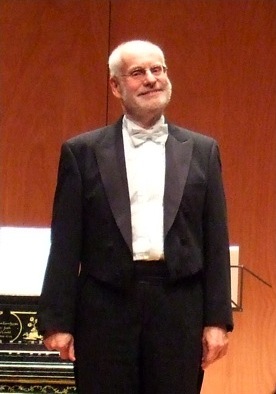
Antonius Gerhardus Michael Koopman, known professionally as Ton Koopman, is a Dutch conductor, organist, harpsichordist, and musicologist, primarily known for being the founder and director of the Amsterdam Baroque Orchestra & Choir.
Harold Meltzer is an American composer. Harold is inspired by a wide variety of stimuli, from architectural spaces to postmodern fairy tales and messages inscribed in fortune cookies. In Fanfare Magazine, Robert Carl commented that he "seems to write pieces of scrupulous craft and exceptional freshness, which makes each seem like an important contribution." The first recording devoted to his music, released in 2010 by Naxos on its American Classics label, was named one of the CDs of the year in The New York Times and in Fanfare; new all-Meltzer recordings will issue from Open G Records (2017), Bridge Records (2018), and BMOP/Sound (2019). A Pulitzer Prize Finalist in 2009 for his sextet Brion, Meltzer has been awarded the Rome Prize, the Barlow Prize;, a Guggenheim Fellowship, and both the Arts and Letters Award in Music and the Charles Ives Fellowship from the American Academy of Arts and Letters.

Suzie LeBlanc is a Canadian soprano and early music specialist. She taught at McGill University from 2016 to 2020 and became the Artistic and Executive Director of Early Music Vancouver in 2021. She was named a member of the Order of Canada in 2014 for her contributions to music and Acadian culture.
A triple concerto is a concerto with three soloists. Such concertos have been composed from the Baroque period, including works by Corelli, Vivaldi, Bach and Telemann, to the 21st century, such as two works by Dmitri Smirnov. The most famous example is Beethoven's Triple Concerto for violin, cello and piano. His combination of solo instruments, a piano trio, was often used also in later works.
Monica Huggett is a British conductor and leading baroque violinist.
Gary Cooper is an English conductor and classical keyboardist who specialises in the harpsichord and fortepiano. He is known as an interpreter of the keyboard music of Bach and Mozart, and as a conductor of historically informed performances of music from the Renaissance, Baroque, Classical and Romantic periods.
ATMA Classique is an independent classical record label based in Montreal, and welcomes artists from Quebec, across Canada, and around the world.
Robert Stephen Hill is an American harpsichordist and fortepianist. From 1990 to 2018 he was "Professor of Historical Keyboard Instruments, Performance Practice and Chamber Music" at the Hochschule für Musik Freiburg, Germany, and he now serves as the “Eugene D. Eaton Jr. Chair in Baroque Music Performance” and teaches harpsichord at the University of Colorado Boulder College of Music, in the United States.
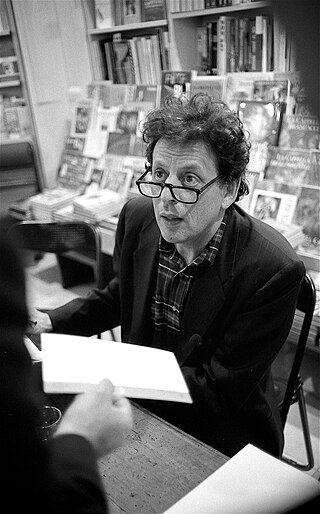
The Concerto for Harpsichord and Orchestra was completed by Philip Glass in spring of 2002. It was commissioned for the Northwest Chamber Orchestra by Charles and Diana Carey and published by Dunvagen Music. Glass wrote the concerto with the Baroque tradition in mind; however, in order to approach the work in a modern idiom, he calls for a contemporary chamber orchestra to accompany the harpsichord. The concerto was premiered in September 2002 in Seattle, with David Schrader as soloist performing with the Northwest Chamber Orchestra. It is approximately 20 minutes in length. The concerto was included in Glass' Concerto Project, a collection in four volumes.
Jérémie Rhorer is a French conductor and the founding artistic director of Le Cercle de l'Harmonie, a period instrument ensemble dedicated to the music of the 18th and 19th centuries. Rhorer is also a well-respected composer, having won the Prix Pierre Cardin.
Byron Schenkman is an American harpsichordist, pianist, music director, and educator. Schenkman has recorded over 40 CDs and has won several awards and accolades. He co-founded the Seattle Baroque Orchestra, and was its artistic director. Schenkman currently directs a baroque and classical chamber music concert series, Byron Schenkman & Friends, and performs as a recitalist and concert soloist. He also performs with chamber music ensembles, and is a teacher and lecturer.
The Indianapolis Baroque Orchestra is a Baroque orchestra dedicated to performing music of the 17th and 18th centuries using period instruments and historically informed performance practices to enrich, educate, and inspire the Indiana community and beyond. The orchestra's artistic director is the Belgian Baroque flutist and conductor, Barthold Kuijken.

Claire Guimond is a Canadian flute player, founding member and former Artistic Director of Arion Baroque Orchestra.

Arion Baroque Orchestra, founded in 1981, is a Canadian baroque orchestra based in Montreal, Quebec, specializing in music of the 18th century performed on period instruments.
