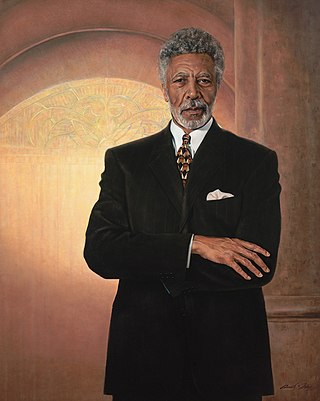
Ronald Vernie Dellums was an American politician who served as Mayor of Oakland from 2007 to 2011. He had previously served thirteen terms as a Member of the U.S. House of Representatives from California's 9th congressional district, in office from 1971 to 1998, after which he worked as a lobbyist in Washington, D.C.
Rasul v. Bush, 542 U.S. 466 (2004), was a landmark decision of the United States Supreme Court in which the Court held that foreign nationals held in the Guantanamo Bay detention camp could petition federal courts for writs of habeas corpus to review the legality of their detention. The Court's 6–3 judgment on June 28, 2004, reversed a D.C. Circuit decision which had held that the judiciary has no jurisdiction to hear any petitions from foreign nationals held in Guantanamo Bay.
Sáenz v. Roe, 526 U.S. 489 (1999), was a landmark case in which the Supreme Court of the United States discussed whether there is a constitutional right to travel from one state to another. The case was a reaffirmation of the principle that citizens select states and not the other way round.
In United States law, habeas corpus is a recourse challenging the reasons or conditions of a person's detention under color of law. The Guantanamo Bay detention camp is a United States military prison located within Guantanamo Bay Naval Base. A persistent standard of indefinite detention without trial and incidents of torture led the operations of the Guantanamo Bay detention camp to be challenged internationally as an affront to international human rights, and challenged domestically as a violation of the Due Process Clause of the Fifth and Fourteenth amendments of the United States Constitution, including the right of petition for habeas corpus. In 19 February 2002, Guantanamo detainees petitioned in federal court for a writ of habeas corpus to review the legality of their detention.
United States v. Students Challenging Regulatory Agency Procedures (SCRAP), 412 U.S. 669 (1973), was a landmark decision of the United States Supreme Court in which the Court held that the members of SCRAP—five law students from the George Washington University Law School—had standing to sue under Article III of the Constitution to challenge a nationwide railroad freight rate increase approved by the Interstate Commerce Commission (ICC). SCRAP was the first full-court consideration of the National Environmental Policy Act (NEPA). The Court also reversed the lower court decision that an injunction should be issued at the suspension stage of the ICC rate proceeding. The standing decision has retained its place as the high mark in the Court's standing jurisprudence.

Stephen Joseph Murphy III is a United States district judge of the United States District Court for the Eastern District of Michigan.
Department of Agriculture v. Moreno, 413 U.S. 528 (1973), was a United States Supreme Court case that declared a provision of the Food Stamp Act denying food stamps to households of "unrelated persons" to be a violation of the U.S. Constitution. The Court held that provision to be irrelevant to the stated purpose of the statute and in violation of the Due Process Clause of the Fifth Amendment.
Mitchell v. Donovan, 398 U.S. 427 (1970), was a United States Supreme Court case.
Gunn v. University Committee to End the War in Viet Nam, 399 U.S. 383 (1970), is a United States Supreme Court case in which the Court that since the District Court has issued neither an injunction nor an order granting or denying one, Supreme Court has no jurisdiction under 28 U.S.C. § 1253, which provides for review of orders granting or denying interlocutory or permanent injunctions.
Salazar v. Buono, 559 U.S. 700 (2010), was a decision by the Supreme Court of the United States regarding the establishment clause of the First Amendment to the United States Constitution. The case concerned the legality of the Mojave Memorial Cross, a Latin cross which was placed atop a prominent rock outcropping by the Veterans of Foreign Wars foundation in 1934 to honor war dead. The location is known as "Sunrise Rock" in the Mojave National Preserve in San Bernardino County in southeastern California. The Supreme Court ruled that the cross may stay, but also sent the case back to a lower court, making the issue currently unresolved.

American Booksellers Foundation for Free Expression v. Strickland, 560 F.3d 443, is a decision of the Sixth Circuit Court of Appeals involving a constitutional challenge—both facially and as-applied to internet communications—to an Ohio statute prohibiting the dissemination or display to juveniles of certain sexually-explicit materials or performances. The Sixth Circuit panel declined to resolve the constitutional issue but, instead, certified two questions to the Ohio Supreme Court regarding the interpretation of the statute. The Ohio Supreme Court answered both questions affirmatively and placed a narrowing construction on the statute. Since the Ohio Supreme Court's decision, the Sixth Circuit has not reheard the case.
Citizens for Equal Protection v. Bruning, 455 F.3d 859, was a federal lawsuit filed in the United States District Court for the District of Nebraska and decided on appeal by the United States Court of Appeals for the Eighth Circuit. It challenged the federal constitutionality of Nebraska Initiative Measure 416, a 2000 ballot initiative that amended the Nebraska Constitution to prohibit the recognition of same-sex marriages, civil unions, and other same-sex relationships.

Able v. United States, 88 F.3d 1280, 155 F.3d 628, is a case from the United States Court of Appeals for the Second Circuit that upheld the Don't ask, don't tell law against various constitutional challenges. Both Able I and Able II overruled district court decisions striking down "Don't ask, don't tell" as unconstitutional.
Hedges v. Obama was a lawsuit filed in January 2012 against the Obama administration and members of the U.S. Congress by a group including former New York Times reporter Christopher Hedges, challenging the National Defense Authorization Act for Fiscal Year 2012 (NDAA). The legislation permitted the U.S. government to indefinitely detain people "who are part of or substantially support Al Qaeda, the Taliban or associated forces engaged in hostilities against the United States". The plaintiffs contended that Section 1021(b)(2) of the law allows for detention of citizens and permanent residents taken into custody in the U.S. on "suspicion of providing substantial support" to groups engaged in hostilities against the U.S. such as al-Qaeda and the Taliban respectively that the NDAA arms the U.S. military with the ability to imprison indefinitely journalists, activists and human-rights workers based on vague allegations.
Schlesinger v. Reservists Committee to Stop the War, 418 U.S. 208 (1974), was a decision by the United States Supreme Court which ruled that citizens do not have the right to challenge the constitutionality of members of Congress holding reserve commissions in the armed forces.
Florence v. Shurtleff, Civil No. 2:05CV000485, was a case in which the U.S. District Court for the District of Utah issued an order stating that individuals could not be prosecuted for posting adult content that was constitutionally protected on general access websites, nor could they be civilly liable for failing to prevent access to adult content, so long as the material is identifiable by filtering software. The order was the result of a 2005 lawsuit, The King's English v. Shurtleff, brought by Utah bookstores, artists, Internet Service Providers and the other organizations challenging the constitutionality of certain portions of a Utah law intended to protect minors from adult content.

Blumenthal v. Trump, 949 F.3d 14, was a U.S. constitutional law and federal civil procedure lawsuit heard by Circuit Judges Henderson, Tatel, and Griffith, of the United States Court of Appeals for the District of Columbia Circuit. The case was on appeal from the United States District Court for the District of Columbia, where District Judge Emmet G. Sullivan granted in part and denied in part the President's motion to dismiss for lack of standing, denied the President's motion to dismiss for failure to state claim, and certified interlocutory appeal.
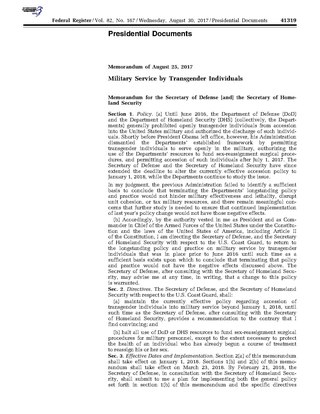
The Presidential Memorandum on Military Service by Transgender Individuals, officially the Presidential Memorandum for the Secretary of Defense and the Secretary of Homeland Security, is the 27th presidential memorandum signed by U.S. President Donald Trump on August 25, 2017. The intent was to prevent transgender people from serving in the U.S. military, on the basis that they would be a financial burden due to sex reassignment procedures and associated costs. It did not exclude transgenders indiscriminately. Federal courts delayed the implementation of this rule by issuing four injunctions. On January 22, 2019, however, the U.S. Supreme Court allowed the Trump administration's ban to take effect.
Wolf v. Vidal, 591 U.S. ___ (2020), was a case that was filed to challenge the Trump Administration's rescission of Deferred Action for Childhood Arrivals (DACA). Plaintiffs in the case are DACA recipients who argue that the rescission decision is unlawful under the Administrative Procedure Act and the Fifth Amendment. On February 13, 2018, Judge Garaufis in the Eastern District of New York addressed the question of whether the government offered a legally adequate reason for ending the DACA program. The court found that Defendants did not provide a legally adequate reason for ending the DACA program and that the decision to end DACA was arbitrary and capricious. Defendants have appealed the decision to the Second Circuit Court of Appeals.
Acree v. Republic of Iraq, 370 F.3d 41, was a case before the United States Court of Appeals for the District of Columbia. U.S. military personnel who had been tortured by Iraq during the 1991 Gulf War sued for damages, arguing that the Foreign Sovereign Immunities Act (FSIA) made state sponsors of terror liable. Iraq never contested the lawsuit, but the U.S. federal government intervened. The Court of Appeals ultimately decided against the plaintiffs, saying that the FSIA did not create new causes of action against foreign states. The U.S. Supreme Court declined to hear the plaintiffs' appeal.

