Major works
Brock, Deborah. 1998. Making Work, Making Trouble: Prostitution as a Social Problem. Toronto: University of Toronto Press.
Making work making trouble looks at how prostitution was made to be a social problem and a moral panic. Brock wonders why sex work is seen as a problem and for whom is it a problem. Chapter two focuses on how the murder of a young boy started a moral panic and the media made prostitution seem as though it was a big social problem. The government then got into it and started to shut places down and arrest people. Prostitution was used as a scapegoat for the young boy's death. Chapter three focuses on the problems with how to regulate street prostitution because of the definitions of who is a prostitute, what is a public place, what is solicitation, etc. The media and different groups start to make a big deal out of a small issues and soon everybody wants more police and more jails which leads to more criminal records which forces women to sell their bodies because they cannot get another job. Basically moral and discriminatory bias is punishing the most disadvantaged women - those who work the streets- while doing nothing to understand why they are there in the first place. Chapter four looks at the creation of the special committee on pornography and Prostitution (The Fraser Committee), its mandates, its goals and its recommendations. Chapter five looks at bill C-49 which attempted to restrict the communication for the purpose of prostitution. Restricting the communication for the purpose of prostitution did not work to get the sex workers of the street even though there were a huge number of arrest. Chapter five also looks at how the rights of the upper and the middle class take priority over the rights of the sex workers in the way that the middle and upper class feel threatened and uncomfortable with the prostitutes but the rights of the prostitutes are not taken into account. Chapter six looks at the report of the Committee on Sexual offences against children and Youth (The Badgley Report) and its recommendations. Its purpose was to "enquire into the incidence and prevalence in Canada of sexual offences against children and youth and to recommend improvements in laws for the protection of young persons from sexual abuse and exploitation"(Brock, 1998, p. 102). Chapter seven focuses on how the Badgley report built on a social problem of youth prostitution and victimization but it did not look at why the youth engaged in prostitution in the first place. The media and therefore the public saw youth prostitution as a new social problem but it has been happening for years. Chapter seven also looks at the legislation put in place to "protect" youth in prostitution and other resources that attempt to help youth prostitutes and/or runaways. Finally Chapter eight explains that criminalizing prostitution is not going to make it stop. Proving safe places for prostitution to take place would better serve everybody affected. Many prostitutes are murdered each year by their customers and many youth turn to survival sex, a form of prostitution. Women in the sex trade need more tools and support to protect themselves. The legislation and moral panic will not stop the sex trade despite what lawmakers may think.
Brock, Deborah. 2000. "Victim, Nuisance, Fallen Woman, Outlaw, Worker?: Making the Identity, Prostitute in Canadian Criminal Law." In D. Chunn and D. Lacombe (Ed.) Law as a Gendering Practice. Ontario.: Oxford University Press.
In this chapter Deborah Brock looks at how some people see prostitution as women who are victimized by patriarchy, others see prostitution as women who will not be confined by the moral rules of sexuality. Other people see prostitutes as workers, some of which work is less favorable conditions than others but they are still workers. She examines how prostitution is often seen as symbolic of patriarchal oppression however many women use their bodies as a source of income. Sex workers are not able to participate in the discussions about the issues that directly affect them. They do not have a voice in the legislation being put forth to regulate their jobs and they do not have a say in the solutions that could decrease prostitution. She examines how laws have been in place to govern sex work since 1839 and is either seen as a public nuisance or a morality problem. The law continues to distinguish between good women and bad women and sex workers are often the scapegoat for other incidents or problems in the area.
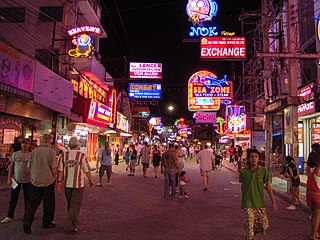
Prostitution in Thailand is not itself illegal, but public solicitation for prostitution is prohibited if it is carried out "openly and shamelessly" or "causes nuisance to the public". Due to police corruption and an economic reliance on prostitution dating back to the Vietnam War, it remains a significant presence in the country. It results from poverty, low levels of education and a lack of employment in rural areas. Prostitutes mostly come from the northeastern (Isan) region of Thailand, from ethnic minorities or from neighbouring countries, especially Cambodia, Myanmar, and Laos. In 2019, the Joint United Nations Programme on HIV/AIDS (UNAIDS) estimated the total population of sex workers in Thailand to be 43,000.

Male prostitution is a form of sex work consisting of the act or practice of men providing sexual services in return for payment. Although clients can be of any gender, the vast majority are older males looking to fulfill their sexual needs. Male prostitutes have been far less studied than female prostitutes by researchers. Even so, male prostitution has an extensive history including regulation through homosexuality, conceptual developments on sexuality, and the HIV/AIDS epidemic impact. In the last century, male sex work has seen various advancements such as popularizing new sexual acts, methods of exchange, and carving out a spot in cinema.
COYOTE is an American sex workers' rights organization. Its name is a backronym for Call Off Your Old Tired Ethics, a reflection of the fact that sex work tends to be stigmatized primarily because of society-imposed standards of ethics. COYOTE's goals include the decriminalization of prostitution, pimping and pandering, as well as the elimination of social stigma concerning sex work as an occupation. Its work is considered part of the larger sex worker movement for legal and human rights.

In Great Britain, the act of engaging in sex or exchanging various sexual services for money is legal, but a number of related activities, including soliciting in a public place, kerb crawling, owning or managing a brothel, and pimping, are illegal. In Northern Ireland, which previously had similar laws, paying for sex became illegal from 1 June 2015.
Ronald Weitzer is an American sociologist specializing in criminology and a professor at George Washington University, known for his publications on police-minority relations and on the sex industry.
John school is a form of educational intervention that caters to the clients of prostitutes, who are colloquially known as "johns" in North America. Societal norms deemed the behavior of clients and their engagement in sex work as atypical, so john schools work to address this. John schools originated in San Francisco due to community frustrations about the great occurrence of street prostitution in their areas and the lack of effective policies to combat the sex industry. Schools similar to the San Francisco one were established throughout the country and in multiple nations. John schools are usually a diversion program for people - almost exclusively men - arrested for soliciting the services of a prostitute, or another related offense. This often acts as an alternative to criminal prosecutions. However, in some jurisdictions, courts may sentence men to attend a john school program as a condition of probation. John schools often last a few months and usually have weekly sessions. Their focus is often on the experiences and harms of prostitution, such as the violence associated with prostitution, the sexually transmitted disease risks of prostitution, and the effects of prostitution on families and communities. Whether the john school is a diversion program or a sentencing condition, the client will often pay a fee to enroll. The fee frequently covers the cost of the program and sometimes contributes to programs to aid prostitutes, or community projects within red light districts. Generally speaking, there is no definitive evidence demonstrating whether or not john schools have been able to reduce the number of people who hire prostitutes.

Prostitution is a type of sex work that involves engaging in sexual activity in exchange for payment. The definition of "sexual activity" varies, and is often defined as an activity requiring physical contact with the customer. The requirement of physical contact also creates the risk of transferring infections. Prostitution is sometimes described as sexual services, commercial sex or, colloquially, hooking. It is sometimes referred to euphemistically as "the world's oldest profession" in the English-speaking world. A person who works in the field is usually called a prostitute or sex worker, but other words, such as hooker and whore, are sometimes used pejoratively to refer to those who work in prostitution. The majority of prostitutes are female and have male clients.
Current laws passed by the Parliament of Canada in 2014 make it illegal to purchase or advertise sexual services and illegal to live on the material benefits from sex work. The law officially enacted criminal penalties for "Purchasing sexual services and communicating in any place for that purpose."
Prostitution in Poland is legal, but operating brothels or other forms of pimping or coercive prostitution and prostitution of minors are prohibited.

Sex workers' rights encompass a variety of aims being pursued globally by individuals and organizations that specifically involve the human, health, and labor rights of sex workers and their clients. The goals of these movements are diverse, but generally aim to legalize or decriminalize sex work, as well as to destigmatize it, regulate it and ensure fair treatment before legal and cultural forces on a local and international level for all persons in the sex industry.

Prostitution in Nigeria is illegal in all Northern States that uses the penal code and sharia law also known as Islamic law. In Southern Nigeria, the activities of pimps or madams, underage prostitution and the operation or ownership of brothels are penalized under sections 223, 224, and 225 of the Nigerian Criminal Code. Even though the Nigerian constitution/Nigerian law does not legalize commercial sex work, it is vague if such work is performed by an independent individual who operates on his or her own accord without the use of pimps
Prostitution in Guyana is illegal but widespread. Prostitution law is antiquated and dates from the colonial era. Law enforcement is inconsistent and sex workers report violence and abuse by the police. Many turn to prostitution for economic reasons and the lack of other job opportunities. Prostitution continues to receive greater public attention due to the high incidence of HIV/AIDS among prostitutes. Prostitution in the country is separated into three types: "uptown", servicing affluent clients, "downtown", servicing the working classes, and mining sites. UNAIDS estimate there to be 6,000 prostitutes in the country.

Prostitution laws varies widely from country to country, and between jurisdictions within a country. At one extreme, prostitution or sex work is legal in some places and regarded as a profession, while at the other extreme, it is considered a severe crime punishable by death in some other places. A variety of different legal models exist around the world, including total bans, bans that only target the customer, and laws permitting prostitution but prohibiting organized groups, an example being brothels.
Canada inherited its criminal laws from England. The first recorded laws dealing with prostitution were in Nova Scotia in 1759, although as early as August 19, 1675 the Sovereign Council of New France convicted Catherine Guichelin, one of the King's Daughters, with leading a "life scandalous and dishonest to the public", declared her a prostitute and banished her from the walls of Quebec City under threat of the whip. Following Canadian Confederation, the laws were consolidated in the Criminal Code. These dealt principally with pimping, procuring, operating brothels and soliciting. Most amendments to date have dealt with the latter, originally classified as a vagrancy offence, this was amended to soliciting in 1972, and communicating in 1985. Since the Charter of Rights and Freedoms became law, the constitutionality of Canada's prostitution laws have been challenged on a number of occasions.

Canada (AG) v Bedford, 2013 SCC 72, [2013] 3 SCR 1101 is a decision of the Supreme Court of Canada on the Canadian law of sex work. The applicants, Terri-Jean Bedford, Amy Lebovitch and Valerie Scott, argued that Canada's prostitution laws were unconstitutional. The Criminal Code included a number of provisions, such as outlawing public communication for the purposes of prostitution, operating a bawdy house or living off of the avails of prostitution, even though prostitution itself is legal.
Migrant sex work is sex work done by migrant workers. It is significant because of its role as a dominant demographic of sex work internationally. It has common features across various contexts, such as migration from rural to urban areas and from developing to industrialized nations, and the economic factors that help to determine migrant status. Migrant sex workers have also been the subject of discussions concerning the legality of sex work, its connection to sex trafficking, and the views of national governments and non-governmental organizations about the regulation of sex work and the provision of services for victims of sex trafficking.
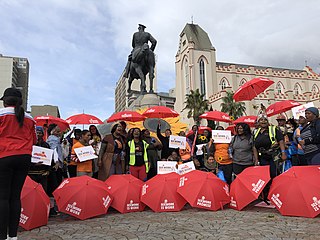
The decriminalization of sex work is the removal of criminal penalties for sex work. Sex work, the consensual provision of sexual services for money or goods, is criminalized in most countries. Decriminalization is distinct from legalization.

Anna Pappritz was a German writer and suffragist. She was one of the leaders of the German branch of the International Abolitionist Federation, which sought to abolish regulations and criminal laws directed against prostitutes, and proposed instead to eliminate prostitution through moral education of young men and women, and through providing alternative ways by which young women could earn a living. Pappritz became one of the most prominent members of the women's movement in Germany.
Clients of prostitutes or sex workers are sometimes known as johns or tricks in North America and punters in Britain and Ireland. In common parlance among sex workers as well as with others, the act of negotiating and then engaging with a client is referred to as turning a trick.
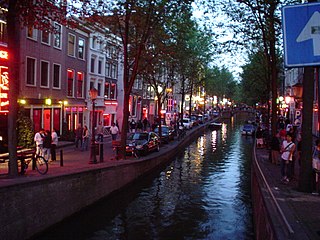
Feminist perspectives on sex markets vary widely, depending on the type of feminism being applied. The sex market is defined as the system of supply and demand which is generated by the existence of sex work as a commodity. The sex market can further be segregated into the direct sex market, which mainly applies to prostitution, and the indirect sex market, which applies to sexual businesses which provide services such as lap dancing. The final component of the sex market lies in the production and selling of pornography. With the distinctions between feminist perspectives, there are many documented instances from feminist authors of both explicit and implied feminist standpoints that provide coverage on the sex market in regards to both "autonomous" and "non-autonomous" sex trades. The quotations are added since some feminist ideologies believe the commodification of women's bodies is never autonomous and therefore subversive or misleading by terminology.

