
Lingayatism is a Hindu denomination based on Shaivism. Initially known as Veerashaivas, since the 12th-century adherents of this faith are known as Lingayats.

Basava (1131–1196), also called Basavēśvara and Basavaṇṇa, was an Indian philosopher, poet, Lingayat social reformer in the Shiva-focused bhakti movement, and a Hindu Shaivite social reformer during the reign of the Kalyani Chalukya/Kalachuri dynasty. Basava was active during the rule of both dynasties but reached the peak of his influence during the rule of King Bijjala II in Karnataka, India.

Akka Mahadevi was an early poet of Kannada literature and a prominent member of the Lingayat Shaiva sect in the 12th century. Her 430 vachanas, and the two short writings called Mantrogopya and the Yogangatrividh are considered her known contributions to Kannada literature. The term Akka was an honorific given to her by saints such as Basavanna, Siddharama, and Allamaprabhu as an indication of her high place in the spiritual discussions held at the "Anubhava Mantapa". She is regarded to be a major female figure in Kannada literature and in the history of Karnataka. She considered the god Shiva as her husband.

Karnataka Theological College(founded in 1847) is an ecumenical seminary catering to the Kannada-speaking students wishing to pursue the priestly vocation. KTC is located in Mangalore of Karnataka in South India, and is affiliated to the nation's first University, the Senate of Serampore College.

Allamaprabhu was a 12th-century mystic-saint and Vachana poet of the Kannada language, propagating the unitary consciousness of Self and Shiva. Allamaprabhu is one of the celebrated poets and the patron saint of the Lingayata movement that reshaped medieval Karnataka society and popular Kannada literature. He is included among the "Trinity of Lingayathism", along with Basavanna, the founder of the movement, and Akka Mahadevi, the most prominent woman poet.

Anubhava Mantapa, established by Basavanna in the 12th century C.E., is a religious complex located in Tipranth, Basavakalyan, in the Bidar district of Karnataka. It is the first religious parliament in the world, whose name is literally translated as "experience pavilion", and was an academy of mystics, saints and philosophers of the lingayat faith in the 12th century. It was the source of essentially all religious and philosophical thought pertaining to the lingayat, and was presided over by the mystic Allama Prabhu, with numerous Sharanas from all over Karnataka and other parts of India participating.

Vachana sahitya is a form of rhythmic writing in Kannada that evolved in the 11th century and flourished in the 12th century, as a part of the Sharana movement. The word "vachanas" literally means "(that which is) said". These are readily intelligible prose texts. These writings are notable for their simplicity and directness, often addressing social issues and personal devotion. They were composed in Kannada by saints of the Lingayat faith, most notably Basavanna, Akka Mahadevi, and Allama Prabhu. Vachanas critique rituals and caste discrimination, advocating a form of worship centered on Shiva, envisioned as a universal god.
D. S. Satyaranjan was a Silver Jubilee Pastor, a New Testament Scholar, and an Administrator who served as the Registrar of the Senate of Serampore College (University), the nation's first University {a University under Section 2 (f) of the University Grants Commission Act, 1956} with degree-granting authority validated by a Danish Charter and ratified by the Government of West Bengal.
M. Chidananda Murthy was a Kannada writer, researcher and historian. He was a well-known scholar in Karnataka specializing in the history of Kannada language and ancient Karnataka. He was also known for his campaign to conserve the monuments Hampi and to secure classical language status to Kannada Language. Murthy also articulated that uniform civil code and an anti-conversion law must be enacted by the Government in India.

Vijayanagara literature in Kannada is the body of literature composed in the Kannada language of South India during the ascendancy of the Vijayanagara Empire which lasted from the 14th through the 16th century. The Vijayanagara empire was established in 1336 by Harihara I and his brother Bukka Raya I. Although it lasted until 1664, its power declined after a major military defeat by the Shahi Sultanates in the battle of Talikota in 1565. The empire is named after its capital city Vijayanagara, whose ruins surround modern Hampi, now a World Heritage Site in Karnataka.
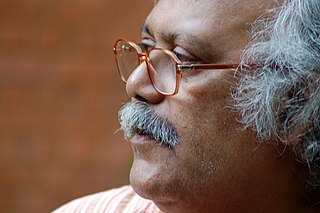
Hulkuntemath Shivamurthy Sastri Shivaprakash is a leading poet and playwright writing in Kannada. He is professor at the School of Arts and Aesthetics, Jawaharlal Nehru University, New Delhi. He heads the Cultural Centre at Berlin, known as the Tagore Centre, as Director run by Indian Council for Cultural Relations (ICCR). He has seven anthologies of poems, twelve plays, and several other books to his credit. His works have been widely translated into English, French, Italian, Spanish, German, Polish, Hindi, Malayalam, Marathi, Tamil and Telugu. His plays have been performed in Kannada, Hindi, Meitei, Rabha, Assamese, Bodo, Tamil and Malayalam. Shivaprakash is also a well-known authority on vachana literature, Bhakti movements of India, and Sufi and other mystic traditions.
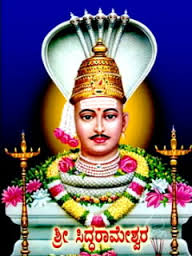
Siddheshwar also known as Siddharameshwar and Siddharama was one among the five acharya ("saint") of the Veerashaiva faith. Siddheshwar was a great contributor to Lingayat sampradaya of Hinduism. He was a great mystic and a Kannada poet who was a part of Basavanna's Lingayat revolution during the 12th century. His philosophy was one of service to mankind, the path of Shivayoga. Siddarama was instrumental in saving the vachana literature from destruction. Shri Siddharameshwar was born in Solapur City of Maharashtra.
C. D. Jathanna was the fourth Bishop - in - Karnataka Central Diocese headquartered in Bangalore with the Cathedra of the Bishop placed at St. Mark's Cathedral, Bangalore.
Robert Scheuermeier was a Swiss Christian minister and academic administrator. He was the first Principal of the Karnataka Theological College, Mangalore, a Seminary affiliated to the country's first University, the Senate of Serampore College (University), Serampore.
C. L. Furtado is CSI-Bishop Emeritus - in - Karnataka Southern of Church of South India. Furtado became the third Bishop on 25 August 1997, the date on which he was consecrated as Bishop in the diocese that is headquartered in Mangalore with the Cathedra of the Bishop placed at CSI-Shanthi Cathedral, Mangalore.
Hannibal Richard Cabral was the former principal of Karnataka Theological College, Mangalore, a seminary established in 1965 and affiliated to India's first University, the Senate of Serampore College. Cabral was appointed by the College Council as Principal in 2009.
Bishop Emeritus John S. Sadananda was the Master of Senate of Serampore College (University), the nation's first University {a University under Section 2 (f) of the University Grants Commission Act, 1956}) with degree-granting authority validated by a Danish Charter and ratified by the Government of West Bengal.
Dharmakkan Dhanaraj was an Indian Old Testament scholar who taught at the Karnataka Theological College, Mangalore, a seminary established in 1965 and affiliated to the nation's first university, the Senate of Serampore College (University).
Sydney S. Salins is a New Testament scholar who teaches at the Karnataka Theological College, Mangalore, a seminary established in 1965 and affiliated to the nation's first university, the Senate of Serampore College (University).
Daniel Rathnakara Sadananda is a New Testament Scholar who is re-elected as the General Secretary (Triennium 2017-2020) of the Church of South India Synod headquartered in Chennai as well as the Chairperson (triennium 2015-2018) of the Council of the United Theological College, Bangalore, the only autonomous College under the Senate of Serampore College (University). He also serves as the Vice President of National Council of Churches in India (2016-2020) as well Executive Secretary of the Communion of Churches in India comprising CNI, CSI, Marthoma Churches and now MCI.
