Related Research Articles

Herod I or Herod the Great was a Roman Jewish client king of the Herodian Kingdom of Judea. He is known for his colossal building projects throughout Judea. Among these works are the rebuilding of the Second Temple in Jerusalem and the expansion of its base—the Western Wall being part of it. Vital details of his life are recorded in the works of the 1st century CE Roman–Jewish historian Josephus.

Berenice of Cilicia, also known as Julia Berenice and sometimes spelled Bernice, was a Jewish client queen of the Roman Empire during the second half of the 1st century. Berenice was a member of the Herodian Dynasty that ruled the Roman province of Judaea between 39 BC and 92 AD. She was the daughter of King Herod Agrippa I and Cypros and a sister of King Herod Agrippa II.

Antipater I the Idumaean was the founder of the Herodian Dynasty and father of Herod the Great. According to Josephus, he was the son of Antipas and had formerly held that name.

Herod Archelaus was the ethnarch of Samaria, Judea, and Idumea, including the cities Caesarea and Jaffa, for nine years. He was the son of Herod the Great and Malthace the Samaritan, brother of Herod Antipas, and half-brother of Herod II. Archelaus came to power after the death of his father Herod the Great in 4 BC, and ruled over one-half of the territorial dominion of his father. Archelaus was removed by the Roman emperor Augustus when Judaea province was formed under direct Roman rule, at the time of the Census of Quirinius.

Aristobulus V of Chalcis was a son of Herod of Chalcis and his first wife Mariamne. Herod of Chalcis, ruler of Chalcis in Iturea, was a grandson of Herod the Great through his father, Aristobulus IV. Mariamne was a granddaughter of Herod the Great through her mother, Olympias; hence Aristobulus was a great-grandson of Herod the Great on both sides of his family.

The Herodian dynasty was a royal dynasty of Idumaean (Edomite) descent, ruling the Herodian Kingdom of Judea and later the Herodian Tetrarchy as a vassal state of the Roman Empire. The Herodian dynasty began with Herod the Great, who assumed the throne of Judea, with Roman support, bringing down the century-old Hasmonean Kingdom. His kingdom lasted until his death in 4 BCE, when it was divided among his sons and daughter as a tetrarchy, which lasted for about 10 years. Most of those tetrarchies, including Judea proper, were incorporated into Judaea Province from 6 CE, though limited Herodian de facto kingship continued until Agrippa I's death in 44 CE and nominal title of kingship continued until 92 CE, when the last Herodian monarch, Agrippa II, died and Rome assumed full power over his de jure domain.

Mariamne I, also called Mariamne the Hasmonean, was a Hasmonean princess and the second wife of Herod the Great. Her parents, Alexandra Maccabeus and Alexander of Judaea, were cousins who both descended from Alexander Jannaeus. She was known for her great beauty, as was her brother Aristobulus III. Herod's fear of his Hasmonean rivals led him to execute all of the prominent members of the family, including Mariamne.

Salome I was the sister of Herod the Great and the mother of Berenice by her husband Costobarus, governor of Idumea. She was a nominal queen regnant of the toparchy of Iamnia, Azotus, Phasaelis from 4 BCE.
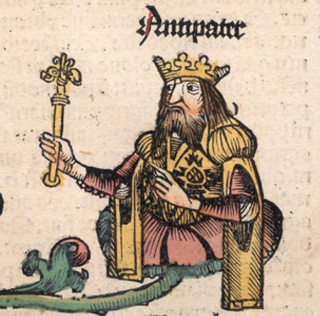
Antipater II was Herod the Great's first-born son, his only child by his first wife Doris. He was named after his paternal grandfather Antipater the Idumaean. He and his mother were exiled after Herod divorced her between 43 BC and 40 BC to marry Mariamne I. However, he was recalled following Mariamne's fall in 29 BC and in 13 BC Herod made him his first heir in his will. He retained this position even when Alexander and Aristobulus rose in the royal succession in 12 BC, and even became exclusive successor to the throne after their execution in 7 BC.
Herod II was the son of Herod the Great and Mariamne II, the daughter of Simon Boethus the High Priest, and the first husband of Herodias, daughter of Aristobulus IV and his wife Berenice. For a brief period he was his father's heir apparent, but Herod I removed him from succession in his will. Some writers call him Herod Philip I, as the Gospel of Matthew and Gospel of Mark state that Herodias was married to a "Philip". Because he was the grandson of Simon Boethus, he is sometimes also called Herod Boethus, but there is no evidence he was actually thus called during his lifetime.

Philip the Tetrarch, sometimes called Herod Philip II by modern writers, son of Herod the Great and his fifth wife, Cleopatra of Jerusalem, ruled over the northeast part of his father's kingdom between 4 BCE and 34 CE. He was a half-brother of Herod Antipas and Herod Archelaus and should not be confused with Herod II, whom some writers call Herod Philip I.
Gaius Julius Alexander II was a Herodian prince who lived in the 1st century and 2nd century in the Roman empire.
Gaius Julius Agrippa was a Cilician Prince and the first-born son of King Gaius Julius Alexander and Queen Julia Iotapa of Cetis. He had two younger siblings: a brother called Gaius Julius Alexander Berenicianus and a sister called Julia Iotapa.
Gaius Julius Alexander Berenicianus was a Cilician Prince and second-born son to King Gaius Julius Alexander and Queen Julia Iotapa of Cetis. His eldest brother was Gaius Julius Agrippa and his younger sister was Julia Iotapa.

Alexander, son of Herod was born about 35 BC; died about 7 BC. His mother was the Hasmonean princess Mariamne.
Salampsio was the eldest daughter of Herod the Great by his royal Hasmonean wife, Mariamne I.
Alexander II, also known by his Roman name Gaius Julius Alexander was a Herodian prince.

The Herodian kingdom was a client state of the Roman Republic ruled from 37 to 4 BCE by Herod the Great, who was appointed "King of the Jews" by the Roman Senate. When Herod died, the kingdom was divided among his sons into the Herodian Tetrarchy.
Pheroras, probably born in Marissa (Idumea), was the youngest son of Antipater I and his wife Cypros and younger brother of Herod the Great.

Cypros (1st-century) was a queen consort of Judea. She was married to king Herod Agrippa.
References
- 1 2 Richardson, Peter; Fisher, Amy Marie (2017-08-22). Herod: King of the Jews and Friend of the Romans. Routledge. ISBN 978-1-351-67091-3.
- 1 2 Josephus, Flavius (1999). The New Complete Works of Josephus. Kregel Academic. ISBN 978-0-8254-2924-8.
- ↑ Rosenfeld, Ben-Zion (1988). "The 'Boundary of Gezer' Inscriptions and the History of Gezer at the End of the Second Temple Period". Israel Exploration Journal. 38 (4): 235–245. ISSN 0021-2059. JSTOR 27926123.
- ↑ Hanson, K.C. (November 1989). "The Herodians and Mediterranean Kinship Part 2: Marriage and Divorce". Biblical Theology Bulletin: Journal of Bible and Culture. 19 (4): 142–151. doi:10.1177/014610798901900405. ISSN 0146-1079.
 | This biographical article about a person notable in connection with Judaism is a stub. You can help Wikipedia by expanding it. |