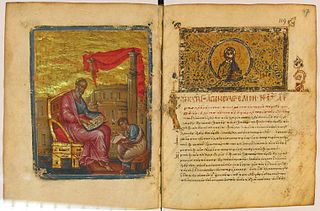
| Name | Basilensis A.N.IV.4 |
|---|---|
| Text | Acts, Pauline epistles |
| Date | 12th century |
| Script | Greek |
| Now at | Basel University Library |
| Size | 15 cm x 10 cm |
| Type | Byzantine text-type |
| Category | V |
Minuscule 2815 (in the Gregory-Aland numbering), α 253 (Soden), formerly labelled as 2ap in all catalogues, but subsequently renumbered by Aland, is a Greek minuscule manuscript of the New Testament, dated paleographically to the 12th century. [1]
Kurt Aland, was a German theologian and biblical scholar who specialized in New Testament textual criticism. He founded the Institut für neutestamentliche Textforschung in Münster and served as its first director from 1959–83. He was one of the principal editors of Nestle-Aland – Novum Testamentum Graece for the Deutsche Bibelgesellschaft and The Greek New Testament for the United Bible Societies.
A manuscript was, traditionally, any document that is written by hand -- or, once practical typewriters became available, typewritten -- as opposed to being mechanically printed or reproduced in some indirect or automated way. More recently, the term has come to be understood to further include any written, typed, or word-processed copy of an author's work, as distinguished from its rendition as a printed version of the same. Before the arrival of printing, all documents and books were manuscripts. Manuscripts are not defined by their contents, which may combine writing with mathematical calculations, maps, explanatory figures or illustrations. Manuscripts may be in book form, scrolls or in codex format. Illuminated manuscripts are enriched with pictures, border decorations, elaborately embossed initial letters or full-page illustrations. A document should be at least 75 years old to be considered a manuscript.
The New Testament is the second part of the Christian biblical canon, the first part being the Old Testament, based on the Hebrew Bible. The New Testament discusses the teachings and person of Jesus, as well as events in first-century Christianity. Christians regard both the Old and New Testaments together as sacred scripture. The New Testament has frequently accompanied the spread of Christianity around the world. It reflects and serves as a source for Christian theology and morality. Extended readings and phrases directly from the New Testament are incorporated into the various Christian liturgies. The New Testament has influenced religious, philosophical, and political movements in Christendom and left an indelible mark on literature, art, and music.
The codex contains a complete text of the Acts of the Apostles, General epistles, and Pauline epistles, 216 parchment leaves (15 by 10 cm). Written in one column per page, 27 lines per page. [1] Written on a parchment in an elegant minuscule. It contains short introduction to the books. [2]
Acts of the Apostles, often referred to simply as Acts, or formally the Book of Acts, is the fifth book of the New Testament; it tells of the founding of the Christian church and the spread of its message to the Roman Empire.
The Pauline epistles, Epistles of Paul, or Letters of Paul, are the thirteen books of the New Testament, composed of letters which are largely attributed to Paul the Apostle, although authorship of some is in dispute. Among these letters are some of the earliest extant Christian documents. They provide an insight into the beliefs and controversies of early Christianity. As part of the canon of the New Testament, they are foundational texts for both Christian theology and ethics. The Epistle to the Hebrews, although it does not bear his name, was traditionally considered Pauline for a thousand years, but from the 16th century onwards opinion steadily moved against Pauline authorship and few scholars now ascribe it to Paul, mostly because it does not read like any of his other epistles in style and content. Most scholars agree that Paul really wrote seven of the Pauline epistles, but that four of the epistles in Paul's name are pseudepigraphic ; scholars are divided on the authenticity of two of the epistles.
The Greek text of the Gospels is a representative of the Byzantine text-type. Hermann von Soden classified it as Ib1. Aland placed it in Category V. [3] [4] In Pauline epistles text is close to the codices 206, 429, 522 and 1891.
The Byzantine text-type is one of several text-types used in textual criticism to describe the textual character of Greek New Testament manuscripts. It is the form found in the largest number of surviving manuscripts, though not in the oldest. The New Testament text of the Orthodox Church, the Patriarchal Text, as well as those utilized in the lectionaries, is based on this text-type. While considerably varying, it also underlies the Textus Receptus Greek text used for most Reformation-era translations of the New Testament into vernacular languages. Modern translations mainly use Eclectic editions that conform more often to the Alexandrian text-type.
Baron Hermann von Soden was a German Biblical scholar, minister, professor of divinity, and textual theorist.
Minuscule 206, α 365 (Soden), is a Greek minuscule manuscript of the New Testament, partly on parchment, partly on paper. Palaeographically it has been assigned to the 15th century.
In 1 Corinthians 2:14 it reads πνευματος (omit του θεου) along with Minuscule 216, 255, 330, 440, 451, 823, 1827, and syrp. [5]
Minuscule 216, α 469 (Soden), is a Greek minuscule manuscript of the New Testament, on paper. It is dated by a colophon to the year 1358. It has marginalia.
Minuscule 255, α174 (Soden), is a Greek minuscule manuscript of the New Testament, on parchment. Paleographically it has been assigned to the 13th century. Formerly it was labeled by 252a and 302p. Scrivener labelled it by 249a.
Minuscule 330, δ 259 (Soden), is a Greek minuscule manuscript of the New Testament, on parchment. Palaeographically it has been assigned to the 12th century. It has marginalia. The Greek text of the codex is a representative of the Byzantine text-type.
In Hebrews 12:20 it has additional reading η βολιδι κατατοξευθησεται. [6]
The manuscript belonged to the Preaching Friars, then to Amerbach, a printer of Basle. [2]
Johann Amerbach was a celebrated printer in Basel in the 15th century. He was the first printer in Basel to use the Roman type instead of Gothic and Italian; he spared no expense in his art.
This codex was used by Desiderius Erasmus in his first edition of his Novum Testamentum (1516). In result its readings became a basis for the Textus Receptus. Erasmus grounded on this copy, and he calls it exemplar mire castigatum. His binder cut off a considerable part of the margin. [2]
It was examined by Mill, Battier, and Wettstein. [2]
NA27 cited it only in 1 Cor 11,23. [7]
The codex is located now at the Basel University Library (Cod. A.N.IV.4), at Basel. [1]
Codex Basilensis A. N. IV. 2, Minuscule 1, δ 254 and formerly designated by 1eap to distinguish it from minuscule 1rK is a Greek minuscule manuscript of the New Testament, usually dated palaeographically to the 12th century AD. It is written on 297 parchment leaves and contains the entire New Testament except the Book of Revelation.
Minuscule 2817, α 287. Formerly it was labeled as 7pK in all catalogs, but it was renumbered by Gregory, because two manuscripts had number 7. It is a Greek minuscule manuscript of the New Testament, dated palaeographically to the 12th century.
Minuscule 2816, α597, formerly labelled as 4ap in all catalogs, but subsequently renumbered by Aland, is a Greek minuscule manuscript of the New Testament, paleographically had been assigned to the 15th century.
Minuscule 1739, α 78, is a Greek minuscule manuscript of the New Testament, on 102 parchment leaves. It is dated paleographically to the 10th century.
Minuscule 103, ΟΘ28 (Soden), is a Greek minuscule manuscript of the New Testament, on parchment leaves. Palaeographically it has been assigned to the 12th century. The manuscript has complex contents.
Minuscule 131, δ 467 (Soden), is a Greek minuscule manuscript of the New Testament, on parchment leaves. Palaeographically it has been assigned to the 15th-century. It has marginalia.
Minuscule 2818, Aπρ20. Formerly it was labelled as 36aK in all catalogues, but it was renumbered by Aland, because two manuscripts had number 36. It is a Greek minuscule manuscript of the New Testament, dated palaeographically to the 12th-century.
Minuscule 323, α 157 (Soden), is a Greek minuscule manuscript of the New Testament, on parchment. Palaeographically it has been assigned to the 12th century. Formerly it was designated by 29a and 35p.
Minuscule 629, α 460, is a Latin–Greek diglot minuscule manuscript of the New Testament, on parchment. It is known as Codex Ottobonianus. Palaeographically it has been assigned to the 14th century. The manuscript is lacunose. It is known for the Comma Johanneum.
Minuscule 817, Θε52, is a Greek minuscule manuscript of the New Testament written on paper, with a commentary. It was used by Erasmus. Palaeographically it has been assigned to the 15th century.
Minuscule 891, Θε427, is a 14th-century Greek minuscule manuscript of the New Testament on paper, with a commentary. It has not survived in complete condition.
Minuscule 897, ε 361, is a 13th-century Greek minuscule manuscript of the New Testament on parchment. It has marginalia. The manuscript has not survived in complete condition.

Minuscule 922, δ 200, is a 12th-century Greek minuscule manuscript of the New Testament on parchment. It has marginalia. The manuscript has survived in complete condition.

Minuscule 1187, ε 1083, is an 11th-century Greek minuscule manuscript of the New Testament on parchment. It has marginalia. The manuscript has survived in complete condition. It is housed in the Saint Catherine's Monastery.
Minuscule 926, ε 1359, is a 13th-century Greek minuscule manuscript of the New Testament on parchment. It has marginalia. The manuscript has survived in complete condition.
Minuscule 927, δ 251, is a 12th-century Greek minuscule manuscript of the New Testament on parchment. It has marginalia. The manuscript has survived in complete condition.
Minuscule 936, ε 2098, is a 12th-century Greek minuscule manuscript of the New Testament on parchment. It has marginalia and was prepared for liturgical use. The manuscript has not survived in complete condition, it is lacunosae.
Minuscule 940, ε 1364 von Soden), is a 13th-century Greek minuscule manuscript of the New Testament on parchment. The manuscript has not survived in complete condition.
Minuscule 941, δ 369 von Soden), is a 13th or 14th-century Greek minuscule manuscript of the New Testament on parchment. The manuscript has survived in complete condition.