Related Research Articles

Sylhet Division is the northeastern division of Bangladesh. It is bordered by the Indian states of Meghalaya, Assam and Tripura to the north, east and south respectively, and by the divisions of Chittagong to the southwest and Dhaka and Mymensingh to the west.
Mohammad Ataul Gani Osmani was a Bangladeshi military officer and revolutionary. His military career spanned three decades, beginning with his service in the British Indian Army in 1939. He fought in the Burma Campaign during World War II, and after the partition of India in 1947, he joined the Pakistan Army and served in the East Bengal Regiment, retiring as a colonel in 1967. Osmani joined the Provisional Government of Bangladesh in 1971 as the commander-in-chief of the nascent Bangladesh Forces. Regarded as the founder of the Bangladesh Armed Forces, Osmani retired as the first full general from the Bangladesh Army in 1972.

Chief Justice Hamoodur Rahman, NI. HI, was a Pakistani Bengali jurist and an academic who served as the Chief Justice of Pakistan from 18 November 1968 until 31 October 1975.
Abu Sayeed Chowdhury was a jurist and the second president of Bangladesh. Besides that, he held the positions of the Chairman of the United Nations Commission on Human rights, the vice-chancellor of the University of Dhaka, the Foreign Minister of Bangladesh and the first Bangladesh High Commissioner to the UK.

East Bengal was the eastern province of the Dominion of Pakistan, which covered the territory of modern-day Bangladesh. It consisted of the eastern portion of the Bengal region, and existed from 1947 until 1955, when it was renamed as East Pakistan. East Bengal had a coastline along the Bay of Bengal to the south, and bordered India to the north, west, and east and shared a small border with Burma to the southeast. It was situated near, but did not share a border with Nepal, Tibet, the Kingdom of Bhutan and the Kingdom of Sikkim. Its capital was Dacca, now known as Dhaka.
United Bengal was a proposal to transform Bengal Province into an undivided, sovereign state at the time of the Partition of India in 1947. It sought to prevent the division of Bengal on religious grounds. The proposed state was to be called the Free State of Bengal. A confessionalist political system was mooted. The proposal was not put up for a vote. The British government proceeded to partition Bengal in accordance with the Mountbatten Plan and Radcliffe Line.
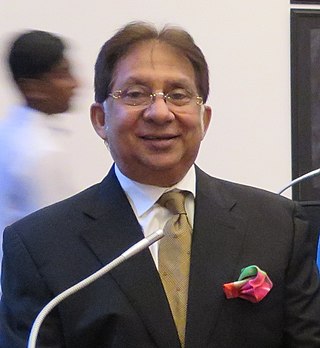
Shamsher M. Chowdhury Bir Bikrom is a Bangladeshi diplomat and served as the Foreign Secretary of Ministry of Foreign Affairs from October 2001 to March 2005. He also served as the ambassador of Bangladesh to Sri Lanka, Germany, Vietnam and United States.

Abdul Hamid Khan Bhashani, often shortened as Maulana Bhashani, was a Bengali politician. His political tenure spanned the British colonial India, Pakistan and Bangladesh periods. Maulana Bhashani was popularly known by the honorary title Mozlum Jananeta for his lifelong stance advocating for the poor. He gained nationwide mass popularity among the peasants and helped to build the East Pakistan Peasant Association. Owing to his political leaning to the left, often dubbed Islamic Socialism, he was also called 'The Red Maulana'. He is considered as one of the main pillars of Bangladeshi independence (1971).

The Constituent Assembly of Bangladesh was the first and, to date, the only constitution-making body of Bangladesh, convened in 1972 by the government of Sheikh Mujibur Rahman following the country's independence. It comprised representatives elected in the national and provincial council elections of Pakistan held in 1970.

The 1947 Sylhet referendum was held in Sylhet District of the Assam Province of British India to decide whether the district would remain in undivided Assam and therefore within the post-independence Dominion of India, or leave Assam for East Bengal and consequently join the newly created Dominion of Pakistan. The referendum's turnout was in favour of joining the Pakistani union; however, the district's Karimganj subdivision remained within the Indian state of Assam.
Salma Masud Chowdhury is a Bangladeshi justice of the High Court Division.

Abdul Matin Chaudhury, also known by his daak naam Kola Mia ; and the epithet Jinnar Daain Haat ; was a Pakistani Bengali trade unionist, journalist, politician, and a member of the Pakistan Constituent Assembly as a representative of East Bengal.
Dewan Taimur Raja Chowdhury was a Bangladeshi politician, landowner and poet. He was the former member of parliament from Sylhet-7 as a Bangladesh Nationalist Party politician.
Ajmal Ali Choudhury was a Pakistani politician and former Minister of Commerce of Pakistan. He was also a member of the 4th National Assembly of Pakistan. His close relationship with Muhammad Ali Jinnah and contributions during the 1947 Sylhet referendum led to him being known as the Sylhet's Quaid by his supporters. However, he became heavily criticised after supporting Pakistan during the Bangladesh Liberation War.
Abdul Hamid, popularly known as Minister Abdul Hamid, was a Bengali lawyer, educationist and politician. He was a former president and education minister of the Assam Legislative Council. From 1947 to 1954, he served as the education minister of East Bengal.
Abu Ahmad Abdul Hafiz, also known by his daak naam Wakil Mia, was a Bengali lawyer, teacher and politician who had a leading role in the Pakistan Movement and the reincorporation of the Sylhet district into East Bengal.

Nesaruddin Ahmad was a Bengali Islamic scholar, spiritual reformer, educationist and writer. He was the main disciple of Furfura Sharif's Mohammad Abu Bakr Siddique in eastern Bengal. Ahmad was the inaugural Pir of Sarsina, having founded the Sarsina Darbar Sharif and Darussunnat Kamil Madrasa in 1915, one of the largest Islamic institutions in South Bengal and the first major alia madrasah after Calcutta. Ahmad was among the leading Islamic leaders in colonial Barisal, and his influence extended across Bengal. The Nesarabad Upazila of Bangladesh has been named after him.

Abū Naṣr Muḥammad Waḥīd, or simply Abu Nasr Waheed, was a Bengali Islamic scholar, educationist, author and politician. He is best known for his reformations to Islamic education in Bengal, and development of Arabic language education among Bengali Muslims. Wahid also served as the Education Minister of British Assam and a member of the Assam Legislative Assembly.
Imam Hossain Choudhury was the chief justice of Dhaka High Court of East Pakistan.
References
- 1 2 3 4 5 "Justice Masud passes away". The Daily Star. 24 November 2013. Retrieved 9 September 2021.
- ↑ Shibly, Atful Hye (2011). Abdul Matin Chaudhury (1895-1948): Trusted Lieutenant of Mohammad Ali Jinnah. Juned Ahmed Choudhury. p. 137. ISBN 978-984-33-2323-1.
- ↑ The Bar List of the United Kingdom. Stevens & Sons. 1982. ISBN 9780420465207.
- ↑ "Bangladesh Election Commission". www.ecs.gov.bd. Retrieved 9 September 2021.
- ↑ Masud, Chowdhury A. T. M. (2005). Reminiscence of Few Decades and Problems of Democracy in Bangladesh. Academic Press and Publishers Library. ISBN 978-984-08-0198-5.
- ↑ "Justice ATM Masud dies". bdnews24.com. 22 November 2013. Retrieved 1 June 2023.
- ↑ "Women making their mark in Bangladesh judiciary". New Age. Retrieved 9 September 2021.
| International | |
|---|---|
| National | |
