
The Allegheny Portage Railroad was the first railroad constructed through the Allegheny Mountains in central Pennsylvania. It operated from 1834 to 1854 as the first transportation infrastructure through the gaps of the Allegheny that connected the midwest to the eastern seaboard across the barrier range of the Allegheny Front. Approximately 36 miles (58 km) long overall, both ends connected to the Pennsylvania Canal, and the system was primarily used as a portage railway, hauling river boats and barges over the divide between the Ohio and the Susquehanna Rivers. Today, the remains of the railroad are preserved within the Allegheny Portage Railroad National Historic Site operated by the National Park Service.
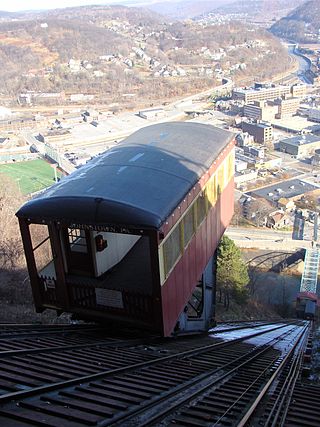
The Johnstown Inclined Plane is a 896.5-foot (273.3 m) funicular in Johnstown, Cambria County, Pennsylvania, U.S. The incline and its two stations connect the city of Johnstown, situated in a valley at the confluence of the Stonycreek and the Little Conemaugh rivers, to the borough of Westmont on Yoder Hill. The Johnstown Inclined Plane is billed as the "world's steepest vehicular inclined plane". It can carry automobiles and passengers, up or down a slope with a grade of 71.9%. The travel time between stations is 90 seconds.
A gravity railroad or gravity railway is a railroad on a slope that allows cars carrying minerals or passengers to coast down the slope by the force of gravity alone. The speed of the cars is controlled by a braking mechanism on one or more cars on the train. The cars are then hauled back up the slope using animal power, a locomotive or a stationary engine and a cable, a chain or one or more wide, flat iron bands. A much later example in California used 4 ft 8+1⁄2 instandard gauge steam engines to pull gravity cars back to the summit of Mt. Tamalpais.
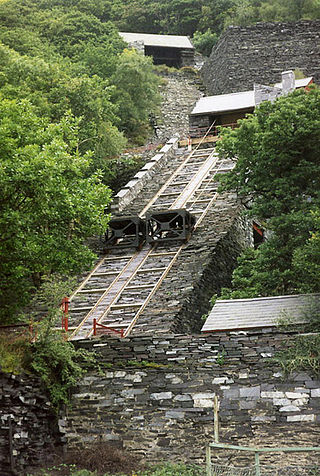
A cable railway is a railway that uses a cable, rope or chain to haul trains. It is a specific type of cable transportation.

The Monongahela Incline is a funicular on the South Side in Pittsburgh, Pennsylvania, United States, near the Smithfield Street Bridge. Designed and built by Prussian-born engineer John Endres in 1870, it is the oldest continuously operating funicular in the U.S.

The Pittsburgh Light Rail is a 26.2-mile (42.2 km) light rail system in Pittsburgh, Pennsylvania, and surrounding suburbs. It operates as a deep-level subway in Downtown Pittsburgh, but runs mostly at-grade in the suburbs south of the city. The system is largely linear in a north-south direction, with one terminus near Pittsburgh's central business district and two termini in the South Hills. The system is owned and operated by Pittsburgh Regional Transit.

The Knoxville Incline was a broad gauge inclined railway that ran between Pittsburgh's South Side and Allentown neighborhoods. The incline was built in 1890 and had a track gauge of 9 feet (2,700 mm).

The Mount Washington Transit Tunnel is a tunnel for buses and light rail trains under Mount Washington in Pittsburgh, Pennsylvania. The Mount Washington Transit Tunnel is a central component of the Pittsburgh public transit system operated by Pittsburgh Regional Transit, providing a direct connection between Downtown Pittsburgh and the South Hills suburbs. The tunnel was built for the trolley services of Pittsburgh Railways, the predecessor of the modern-day Pittsburgh Light Rail system, and has been used exclusively for public transit since its construction.
The Pittsburgh and Castle Shannon Railroad was a 3 ft 4 in narrow-gauge railroad in Allegheny County, Pennsylvania. Originally built in 1871, it may have been the first American common-carrier narrow-gauge railroad. It purchased a rail line called the Coal Hill Coal Railroad from the Pittsburgh Coal Company, and used a coal mine under Mt. Washington as a tunnel to transport coal from Castle Shannon, Pennsylvania to Pittsburgh. Passenger traffic was added soon afterwards, and the train carried passengers during the day and coal at night. The original plan was to extend the line to Finleyville, Pennsylvania, but the original narrow-gauge line ran only as far as Castle Shannon. The right of way continued as the Pittsburgh, Castle Shannon and Washington Railroad, later to become part of the Pittsburgh Southern Railroad.

The Castle Shannon Incline was a funicular railroad in Pittsburgh, Pennsylvania that was part of the Pittsburgh and Castle Shannon Railroad. It ran down the southern slope of Mount Washington, as part of the route to the suburb of Castle Shannon, 6 miles south of the incline's location. It replaced an earlier incline dating to 1825 that brought coal down from a mine in Mount Washington.
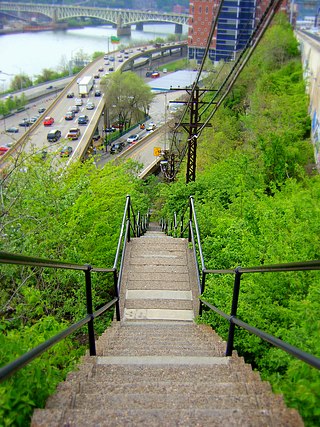
The Fort Pitt Incline was a 10 ft gauge funicular railroad in the Bluff neighborhood of Pittsburgh. Opened in 1882, the incline ran from 2nd Avenue to Bluff Street, a distance of 350 feet (107 m), and a vertical distance of 135 feet (41 m). The designer was Samuel Diescher.
Samuel Diescher was a prominent Hungarian-American civil and mechanical engineer who had his career in the United States. After being educated at universities in Karlsruhe and Zurich in Europe, he immigrated to the United States in 1866 and settled in Cincinnati, Ohio. There he supervised construction of his first inclined plane. He later moved to Pittsburgh, Pennsylvania, where he worked with John Endres on the Monongahela Incline (1870), the first passenger incline in the city.
The Pittsburgh and Castle Shannon Tunnel, also known as the Mount Washington Coal Tunnel, was a 3 ft 4 in narrow-gauge railway tunnel under Mt. Washington.

The Pittsburgh and Castle Shannon Plane was a 3 ft 4 in narrow gauge incline railway that ran from the northern end of the Pittsburgh and Castle Shannon Tunnel to Carson Street in Pittsburgh, Pennsylvania.
The Coal Hill Coal Railroad began as a coal mine on the north face of Mt. Washington, then known as "Coal Hill", begun by Jacob Beltzhoover in 1825. This mine was operated by a series of persons, finally by James M. Bailey, who extended the mine completely though the hill to the south side of the hill in 1861. The mine was then sold to the Pittsburgh Coal Company, and rails from the mine were extended an additional one half mile to a new coal mine on the south side of Saw Mill Run. The rails were extended to a third mine, for a total length of one and one half miles. In spite of this short length, the railroad had 3 locomotives and 280 coal cars. The 3 ft 4 in narrow gauge railroad delivered coal from these mines to South Pittsburgh via an inclined plane, which ran from the northern end of the mine to Carson Street in Pittsburgh, Pennsylvania. The railroad was sold by the Pittsburgh Coal Company to the Pittsburgh and Castle Shannon Railroad in 1871. After this sale, the mine was enlarged to form the Pittsburgh and Castle Shannon Tunnel, and the train tracks were extended to Castle Shannon, Pennsylvania.

The Blue Line is a Pittsburgh Light Rail line that runs between Downtown Pittsburgh via the Overbrook neighborhood to South Hills Village.

The Penn Incline, also known as the 17th Street Incline, was a funicular railroad that ran between the Strip and Hill districts in Pittsburgh, Pennsylvania. It operated from 1884 to 1953.
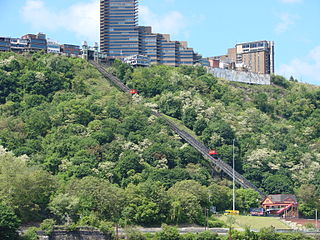
Mount Washington is a hill in Pittsburgh, on the southern banks of the Monongahela River and Ohio River.


