

Casa de la Cultura (English: "House of Culture"), or Casa de la Cultura en Puebla, [1] is a cultural center in the city of Puebla's historic centre, in the Mexican state of Puebla. [2]
Casa de la Cultura (English: "House of Culture"), or Casa de la Cultura en Puebla, [1] is a cultural center in the city of Puebla's historic centre, in the Mexican state of Puebla. [2]
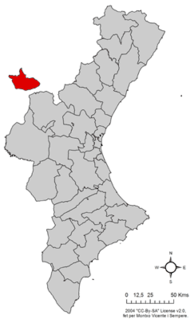
Rincón de Ademuz is a Spanish comarca constituted as an exclave of both the Valencian Community and the Valencia province located between the provinces of Cuenca and Teruel (Aragon). It is part of the Spanish-speaking area in the Valencian Community.
La Perla is a Municipality in Veracruz, Mexico. It is located in central zone of the State of Veracruz, about 75 km from state capital Xalapa. It has a surface of 199.880 km2. It is located at 18°56′N97°08′W.
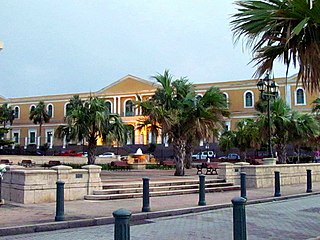
The Institute of Puerto Rican Culture, or ICP, for short, is an institution of the Government of Puerto Rico responsible for the establishment of the cultural policies required in order to study, preserve, promote, enrich, and diffuse the cultural values of Puerto Rico. Since October 1992, its headquarters have been located at the site of the old colonial Spanish Welfare House in Old San Juan. The ICP was created by order of Law Number 89, signed June 21, 1955, and it started operating in November of that year. Its first Executive Director was Dr. Ricardo Alegría.

Cuautlancingo Municipality is a town and municipality in Puebla, south-eastern Mexico. It is part of the Metropolitan area of Puebla. The town is bordered on the north by the state of Tlaxcala, Tlaxcala, east to the municipality of Tlaxcala and the city of Puebla, to the south with the municipality of San Pedro Cholula and Puebla and west by the municipality of Coronango.

Huaquechula Municipality is a municipality in Puebla in south-eastern Mexico.

Colonia San Simón Tolnáhuac is a colonia in the Cuauhtémoc borough of Mexico City, just north of the city's historic center. The colonia's borders are marked by the following streets: Eje 1 Poniente to the south, Avenida Rio Consulado to the north, Lerdo Street and Calzada Vallejo to the east and Avenida de los Insurgentes Norte to the west.

Estadio Universitario BUAP is a multi-purpose stadium located in Ciudad Universitaria in Puebla, Puebla, Mexico. It is used by the Lobos BUAP professional football team, currently playing in the Liga MX top flight of Mexican football.

The Biblioteca Palafoxiana is a library in Puebla City's historic centre, in the Mexican state of Puebla. Founded in 1646, it is recognized by the UNESCO for being the first and oldest public library in the Americas, It has more than 45,000 books and manuscripts, ranging from the 15th to the 20th century. In 2005, it was listed on UNESCO's Memory of the World Register.

Uriarte Talavera is a traditional Talavera enterprise in the city of Puebla, Mexico, which has been in existence since 1824. It was begun as a family workshop by Dimas Uriarte, but today it is run by a business group. However, the enterprise still makes Talavera pottery using 16th century methods. Much of its work still uses traditional colors and designs, and eligible for certificates of authenticity by the Mexican government, but it has also experimented with new designs and forms since the early 20th century. This has included collaborating with various plastic artists to create modern designs and even artistic pieces.
The 2012–13 Pachuca season was the 66th professional season of Mexico's top-flight football league. The season is split into two tournaments—the Torneo Apertura and the Torneo Clausura—each with identical formats and each contested by the same eighteen teams. Pachuca began their season on July 22, 2012 against Atlante, Pachuca play their homes games on Saturdays at 7:00pm local time. Pachuca did not qualify to the final phase in either the Apertura or Clausura tournament.
The 2012–13 Puebla season was the 66th professional season of Mexico's top-flight football league. The season is split into two tournaments—the Torneo Apertura and the Torneo Clausura—each with identical formats and each contested by the same eighteen teams. Puebla began their season on July 20, 2012 against Tijuana, Puebla play their homes games on Sundays at 12:00pm local time. Puebla did not qualify to the final phase in either the Apertura or Clausura tournament.

Abel Ramírez Águilar was a Mexican sculptor who won many prizes not only for traditional pieces in wood, stone and metal, but also for ice and snow sculptures in the United States, Canada, Japan and Europe. He was trained as a sculptor in Mexico and the Netherlands and has exhibited his work individually and collectively since the 1960s. He discovered snow and ice sculpting while visiting Quebec in the 1980s, first experiencing snow in his forties. The challenge intrigued him and he began sculpting this medium as an amateur. He began sculpting ice and snow professionally when he was entered in the competition associated with the 1992 Winter Olympic Games without his knowledge. Having practiced beforehand at an ice factory in Mexico City, he won the gold medal for this event, leading to invitations to other competitions for over twenty years. Ramírez lived in Mexico City.
The following is a timeline of the history of the city of Puebla, Mexico.
Angelópolis Lifestyle Center, is a high-level shopping mall located in Puebla, Mexico. It covers more than 78,000 square meters. The mall was designed by the Sordo Madaleno group and developed as a public-private partnership.
Parque Puebla is a shopping mall in the La Cienega area of Puebla City, Mexico, located between the Stadium District and the Instituto Tecnológico de Puebla near the Mexico City–Puebla tollway (150D). It was developed by Fibra Danhos at a cost of 4.5 billion pesos. Governor Rafael Moreno of the State of Puebla inaugurated the center in January 2017.

Irene Zundel, is a Mexican sculptor, painter and photographer. Her sculpture is made of different materials and has been shown around the world. Zundel lives and works in Mexico City.

The Zócalo is a park and plaza in the historic center of Puebla, a city in the Mexican state of Puebla.

Barrio de los Sapos, or Callejón de los Sapos, is a tourist attraction in the city of Puebla's historic center, in Puebla, Mexico.
 Media related to Casa de la Cultura (Puebla) at Wikimedia Commons
Coordinates: 19°2′32.6″N98°11′55.2″W / 19.042389°N 98.198667°W
 | This article about a Mexican building or structure is a stub. You can help Wikipedia by expanding it. |