
The Pancho Villa Expedition—now known officially in the United States as the Mexican Expedition, but originally referred to as the "Punitive Expedition, U.S. Army"—was a military operation conducted by the United States Army against the paramilitary forces of Mexican revolutionary Francisco "Pancho" Villa from March 14, 1916, to February 7, 1917, during the Mexican Revolution of 1910–1920.
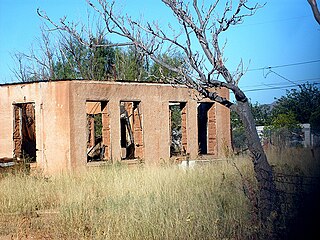
Fort Naco, Camp Naco, or Fort Newell began as a camp in the Southwest United States, on the outskirts of Naco, Arizona as part of the Mexican Border Project. Over time adobe and wooden buildings were constructed to house the garrison along with other permanent structures.
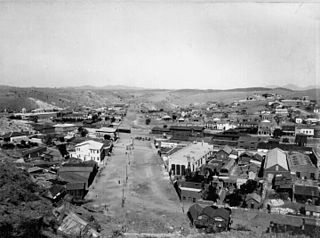
The Battle of Ambos Nogales was an engagement fought on 27 August 1918 between Mexican forces and United States Army elements from the 35th Infantry Regiment and 10th Cavalry Regiment during the Mexican Border War. The American soldiers and militia forces were stationed in Nogales, Arizona, and the Mexican soldiers and armed Mexican militia were in Nogales, Sonora. This battle was notable for being a significant confrontation between U.S. and Mexican forces during the conflict, which took place during the Mexican Revolution and World War I.

The Battle of Columbus, also known as the Burning of Columbus or the Columbus Raid, began on March 9, 1916, as a raid conducted by remnants of Pancho Villa's Division of the North on the small United States border town of Columbus, New Mexico, located 3 miles (4.8 km) north of the border with Mexico. The raid escalated into a full-scale battle between Villistas and the United States Army.

The Mexican Border War, also known as the Border Campaign, refers to a series of military engagements which took place between the United States military and several Mexican factions in the Mexican–American border region of North America during the Mexican Revolution. It was the last major conflict fought on U.S. soil.

The Second Battle of Nogales was a three-sided military engagement of the Mexican Revolution, fought in November 1915 at the border towns of Nogales, Sonora, and Nogales, Arizona. On the morning of November 26, rebel forces of Pancho Villa, who occupied Nogales, Sonora, began firing on United States Army soldiers in Nogales, Arizona. The Americans responded with counter fire for over two hours before a force of Carrancistas arrived to attack the Villistas. Later that day, the Constitutionalistas accidentally opened fire on American soldiers and another short skirmish was fought. The battle resulted in the deaths of several Mexicans and was the first significant engagement fought between Villistas and the United States military.
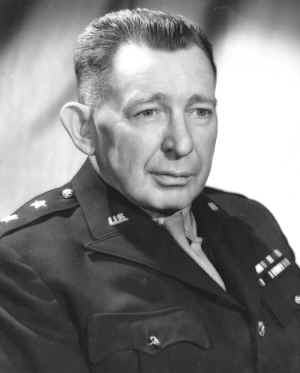
Robert McGowan Littlejohn was a major general in the United States Army who graduated from the United States Military Academy at West Point, New York, in 1912. He served with the Pancho Villa Expedition and on the Western Front during the First World War, and was Chief Quartermaster for the European Theater of Operations during the Second World War. For this service, he received the Distinguished Service Medal. Upon retirement from the Army in 1946, then President of the United States Harry S. Truman appointed him head of the War Assets Administration.

Herbert Ball Crosby was a career officer in the United States Army. A veteran of the Spanish–American War and World War I, he attained the rank of major general as the Army's Chief of Cavalry.

William Payne Jackson was a career officer in the United States Army. A veteran of the American Indian Wars, Spanish–American War, Philippine–American War, Moro Rebellion, Pancho Villa Expedition, and World War I he attained the rank of brigadier general during his career and major general on the army's retired list.
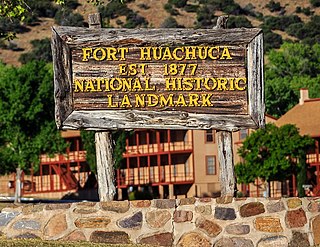
This is a list with images of some of the historic structures and places in the Fort Huachuca National Historic District in Arizona. The district, also known as Old Fort Huachuca, is located within Fort Huachuca an active United States Army installation under the command of the United States Army Installation Management Command. The fort sits at the base of the Huachuca Mountains four miles west of the town of Sierra Vista, on AZ 90 in Cochise County, Arizona.
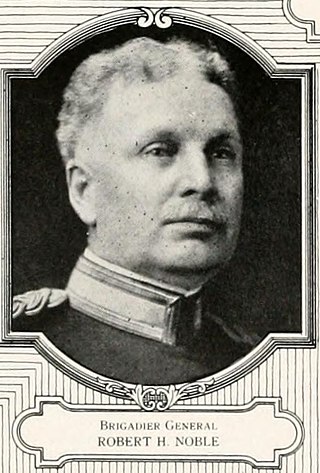
Robert Houston Noble was a career officer in the United States Army. A veteran of the Apache Wars, Spanish–American War, Philippine–American War, Pancho Villa Expedition, and World War I, he attained the rank of brigadier general and was most notable for his World War I command of the 158th Infantry Brigade.

Major General Frank L. Culin Jr. was a career officer in the United States Army. A recipient of the Army Distinguished Service Medal, Silver Star, Bronze Star Medal, and Air Medal, he was a veteran of both World War I and World War II. Culin attained the rank of major general and was most notable for his command of the 87th Infantry Division in the Ardennes Forest during the Battle of the Bulge in the final months of World War II.

Fay Brink Prickett was a career officer in the United States Army. A veteran of the Pancho Villa Expedition, World War I, and World War II, he was most notable for his Second World War command of the 75th Infantry Division, and his post-war command of the 10th Armored Division, 4th Armored Division, and 1st Constabulary Brigade. He attained the rank of major general, and his awards included the Legion of Merit with Oak leaf cluster and Bronze Star Medal.

Henry Rodney Adair (1882–1916) was an American cavalry officer. He is most notable for his participation in the Battle of Carrizal of the Pancho Villa Expedition.

John E. Woodward was a career officer in the United States Army. A veteran of the Spanish–American War, Philippine–American War, Moro Rebellion, Pancho Villa Expedition, and World War I, he served from 1892 to 1934 and attained the rank of brigadier general. Woodward was most notable for his command of the 113th Infantry Regiment, Camp Upton, 152d Depot Brigade, 24th Infantry Brigade, 151st Depot Brigade, and 12th Division.

Mathew Charles Smith was a career officer in the United States Army. An 1893 graduate of the United States Military Academy, he was a veteran of the Spanish–American War, Philippine–American War, the Pancho Villa Expedition, and World War I and served from 1893 to 1932. He attained the rank of brigadier general and his command assignments included the 129th Infantry Regiment, 309th Cavalry Regiment, 56th Field Artillery Regiment, 95th Division, and Panama Pacific General Depot.

John S. Winn, was a career officer in the United States Army. A veteran of the Spanish–American War, Philippine–American War, United States occupation of Veracruz, Pancho Villa Expedition, World War I, and the Occupation of the Rhineland, and he attained the rank of brigadier general. Winn commanded brigades in France during the First World War, and was a recipient of the Silver Star and the French Legion of Honor (Officer).
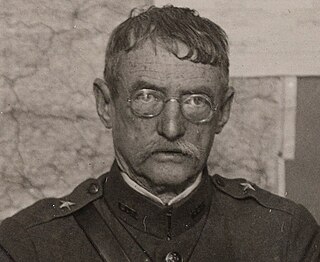
Robert Douglas Walsh was a career officer in the United States Army. An 1883 graduate of the United States Military Academy, he was a veteran of the American Indian Wars, Spanish–American War, Philippine–American War, Pancho Villa Expedition, and World War I. Walsh served until retiring in 1919, and was a recipient of the Army Distinguished Service Medal and French Legion of Honor (Commander).

Perry L. Miles was a career officer in the United States Army. A veteran of the Spanish–American War, Philippine–American War, Pancho Villa Expedition, and World War I, he attained the rank of brigadier general, and his awards and decorations included the Distinguished Service Cross, Army Distinguished Service Medal, Silver Star, and Purple Heart from the United States, as well as the French Legion of Honor (Officer) and Croix de Guerre with Palm.

James Augustine Ryan was a career officer in the United States Army. A veteran of the American Indian Wars, Spanish–American War, Philippine–American War, Pancho Villa Expedition, and World War I, he attained the rank of brigadier general. During the First World War, Ryan commanded 1st Brigade, 15th Cavalry Division at Fort Sam Houston, Texas, and 17th Brigade, 9th Division at Camp Sheridan, Alabama, in addition to acting as the 9th Division commander on several occasions.


