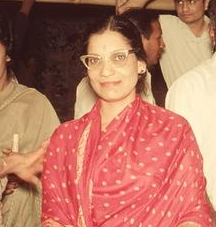
Irene Jai Narayan was an Indian-born teacher and politician,who had a significant influence on politics in Fiji. She came to Fiji in 1959 after marrying Jai Narayan,a well known school Principal in Suva,and began her career as a teacher. She taught in DAV Girls School and MGM High School in Suva before entering politics.
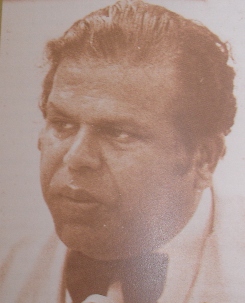
Siddiq Moidin Koya was a Fijian politician,Statesman and Opposition leader. He succeeded to the leadership of the mostly Indo-Fijian National Federation Party (NFP) on the death of the party's founder,A. D. Patel,in October 1969,remaining in this post until 1977. He later served a second term as leader of the NFP,from 1984 to 1987.
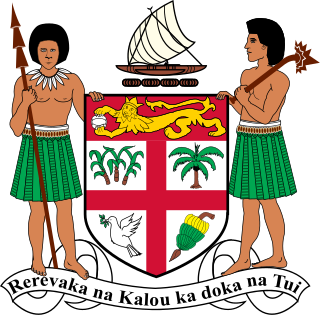
Since becoming independent of the United Kingdom in 1970,Fiji has had four constitutions,and the voting system has changed accordingly.
General elections were held in Fiji between 15 and 29 April 1972,the first since independence from the United Kingdom in 1970. They were characterised by the lack of rancour between racial groups,typical of the 1966 general election and the 1968 by-elections.

The National Federation Party is a Fijian political party founded by A. D. Patel in November 1968,as a merger of the Federation Party and the National Democratic Party. Though it claims to represent all Fiji Islanders,it is supported,in practice,almost exclusively by Indo-Fijians whose ancestors had come to Fiji between 1879 and 1916,mostly as indentured labourers. However,in the 2018 general election,the party recorded a considerable change in its support base due to the inclusion of more indigenous Fijian candidates.
Sir Vijay Raghubar Singh,KBE was an Indo-Fijian lawyer and politician who held Cabinet office in the 1960s and 1970s. Vijay Singh served in Prime Minister Ratu Sir Kamisese Mara's government in a variety of positions,including Attorney-General,and was president of the Indian Alliance,a division of the ruling Alliance Party. He quit the party in 1979 following disagreement with Alliance leadership and later joined the opposition National Federation Party. Vijay Singh was involved in the restructure of the Fiji sugar industry and was a leading member of the Jaycees movement in Fiji.

Ambalal Dahyabhai Patel, better known as A.D. Patel,was an Indo-Fijian politician,farmers' leader and founder and leader of the National Federation Party. Patel was uncompromisingly committed to a vision of an independent Fiji,with full racial integration. He was one of the first to advocate a republic,an ideal not realized in his lifetime. He also advocated a common voters' roll and opposed the communal franchise that characterized Fijian politics.
General elections were held in Fiji between 26 September and 8 October 1966,the last before independence in 1970 and the first held under universal suffrage. The result was a victory for the Alliance Party,which won 23 of the 34 elected seats. Its leader Kamisese Mara became the country's first Chief Minister the following year.
Communal constituencies were the most durable feature of the Fijian electoral system. In communal constituencies,electors enrolled as ethnic Fijians,Indo-Fijians,Rotuman Islanders,or General electors vote for a candidate of their own respective ethnic groups,in constituencies that have been reserved by ethnicity. Other methods of choosing parliamentarians came and went,but this feature was a constant until their final abolition in the 2013 Constitution.
National constituencies were a former feature of the Fijian electoral system. They were created as a compromise between demands for universal suffrage on a common voters' roll,and for a strictly communal franchise,with Parliamentary constituencies allocated on an ethnic basis and elected only by voters enrolled as members of specific ethnic groups.
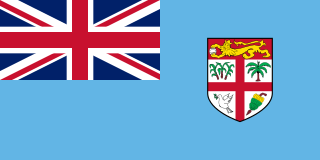
Fiji was an independent state from 1970 to 1987,a Commonwealth realm in which the British monarch,Elizabeth II,remained head of state as Queen of Fiji,represented by the Governor-General. The state was the successor of the British Colony of Fiji which was given independence in October 1970 and it survived until the Republic of Fiji was proclaimed on 6 October 1987 after two military coups,at which time Queen Elizabeth II was removed as head of state,albeit,without any consent from the people of Fiji themselves.
Raojibhai Dahyabhai Patel was an Indo-Fijian lawyer and politician,who was better known as the younger brother of A. D. Patel. To distinguish between the two,he was generally referred to as R.D. A member of parliament from 1966 until 1976,he was Speaker of the House of Representatives between 1972 and 1976.

James Madhavan was an Indo-Fijian politician. He was a member of the Legislative Council and House of Representatives for most of the period between 1947 and 1973 and had two spells in the Executive Council.
The National Congress of Fiji was a Fijian political party that existed from 1965 to 1967. It was created to represent Indo-Fijians as a rival to the Citizens Federation. It soon merged,along with the General Electors Association,which mainly represented Fijians of European descent,to form the Alliance Party.
Andrew Indar Narayan Deoki was an Indo-Fijian statesman who served his community as a social and religious leader,soccer administrator,member of the Legislative Council and Senate in independent Fiji and as Attorney General.
The Federation Party was Fiji's first formal political party. The Citizens Federation,which had won three of the four seats reserved for Indo-Fijians at the 1963 elections,decided to formalize its role as a political party,which was officially founded on 21 June 1964 with A. D. Patel as President and Sidiq Koya as Vice-President. The merger took place in time for the party to participate in the 1965 constitutional conference which was called to map out a path towards independence from the United Kingdom. In 1968,the Federation Party merged with the National Democratic Party to form the National Federation Party,which is now (2021) the oldest political party in Fiji still in existence.
The Citizens Federation was the political expression of a predominantly Indo-Fijian trade union movement,and was a forerunner of the present day National Federation Party.
Chandra Pal Tara Singh Bains was an Indo-Fijian politician. He served in the Legislative Council as a nominated member from 1963 to 1966.
The number of Fiji Indians that could be elected to the Legislative Council was fixed over the years as follows:
