Related Research Articles

The Nord Aviation 3202 is a 1950s French military trainer aircraft designed and built by Nord Aviation to meet a French Army requirement for a two-seat basic trainer, as a replacement for the biplane Stampe SV.4. Altogether, 101 examples were built, with the first flying on 17 April 1957.

The I-11 was a two-seat civil utility aircraft manufactured in Spain in the 1950s. Originally designed by the Spanish aircraft company Iberavia, its first prototype flew on 16 July 1951. It was a low-wing monoplane of conventional configuration with fixed, tricycle undercarriage and a large, bubble canopy over the two side-by-side seats. Flight characteristics were found to be pleasing, but before plans could be made for mass production, Iberavia was acquired by AISA.
The Auster Avis was a four-seat light aircraft developed from the Auster Autocrat. It featured a redesigned fuselage incorporating four doors and a circular cross-section towards the tail, new undercarriage, and new wing flaps. It was planned in two versions, the Mk 1 for civil use, and the Mk 2 for military and air ambulance duties. However, only two prototypes were built, and Auster abandoned the project in favour of the Auster J-5 Autocar.
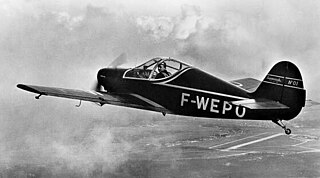
The CAB GY-30 Supercab was a two-seat light aircraft built in France in 1954, as a further development of the CAB Minicab. The design was performed by Yves Gardan, a onetime employee of French aeronautical company SIPA. Changes incorporated in the Supercab included a more powerful engine, greater wingspan, manually retractable undercarriage, and slotted flaps that replaced the split flaps of the Minicab.
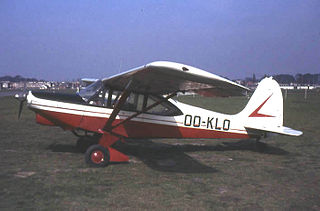
The Boisavia B.60 Mercurey was a series of four-seat light aircraft developed in France shortly after World War II.
The Boisavia B.260 Anjou was a four-seat twin-engine light aircraft developed in France in the 1950s. It was a low-wing cantilever monoplane of conventional configuration with retractable tricycle undercarriage. Intended by Boisavia as a touring aircraft, it did not find a market and only the single prototype was constructed. At this point, the firm sold the design to SIPA, which modified the design and re-engined it with Lycoming O-360 engines, but found that they could not sell it either. At a time when the twin-engine light plane market was already dominated by all-metal American aircraft, the Anjou's fabric-over-tube construction was something of an anachronism, and all development was soon ceased. Plans to develop a stretched version with three extra seats and Potez 4D engines were also abandoned.

The Jodel D.9 Bébé is a French single-seat ultralight monoplane designed by Jean Délémontez for amateur construction.

The Brochet MB.70 was a two-seat light aircraft developed in France in the early 1950s for recreational flying and amateur construction.

The Brochet MB.80 was a two-seat light aircraft developed in France in the early 1950s.

The Call-Air Model A is an American two- to three-seat utility aircraft designed by the Call brothers and built by the Call Aircraft Company, later developed into a successful line of agricultural aircraft.

The Brochet MB.110 was a four-seat light aircraft developed in France in the early 1950s.
The Brochet MB.120 was a two-seat light aircraft developed in France in the 1950s.

The Fouga CM.8 or Castel-Mauboussin CM.8 was a French sailplane of the 1950s, most notable in retrospect due to its place in the development of the Fouga CM.170 Magister jet trainer.
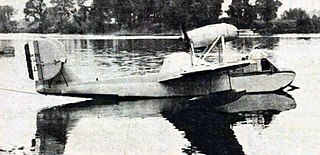
The SCAN 20 was a 1940s French flying-boat training monoplane designed and built by Société de Constructions Aéro-Navales de Port-Neuf (SCAN). The prototype was built in secret in 1941. It was hidden until the liberation of France and first flown in 1945.

The Macchi MB.308, later Aermacchi MB-308, is a light aircraft produced in Italy in the late 1940s.

The Macchi MB.320 was an Italian cabin monoplane designed and built by Macchi. Only a small number were built.
The THK-5 was a twin-engine aircraft designed by Stanisław Rogalski and built in Turkey in 1945 as an air ambulance. It was a conventional, low-wing cantilever monoplane of wooden construction throughout. The main units of the tailwheel undercarriage retracted into the wing-mounted engine nacelles and the THK-5 could carry two stretcher cases plus a medical attendant. This was followed in production by a six-seat utility transport version designated THK-5A and three examples of an improved version of the 5A designated THK-10. A single example of the type was exported, sold to Denmark.

The Ambrosini Rondone is an Italian-designed two/three-seat light touring monoplane of the early 1950s.
The Morane-Saulnier MS.560 was a French civil aerobatic monoplane designed and built by Morane-Saulnier.

The Sud-Est or SNCASE SE-2100, sometimes known as the Satre SE-2100 after its designer, was a tailless, pusher configuration touring monoplane with a single engine and cabin for two. Only one was built.
References
- ↑ de Narbonne 2011, pp. 78–79.
- ↑ Bridgman 1956, pp. 131–132.
- Bridgman, Leonard (1957). Jane's All The World's Aircraft 1956–57. New York: The McGraw Hill Book Company Inc.
- de Narbonne, Roland (January 2011). "Janvier 1951, dans l'aéronautique française: Deux avions réussis dans l'impasse". La Fana de l'Aviation (in French). No. 494. pp. 78–79.
- Simpson, R. W. (1995). Airlife's General Aviation. Shrewsbury: Airlife Publishing. pp. 100–01.
- Taylor, Michael J. H. (1989). Jane's Encyclopedia of Aviation. London: Studio Editions. p. 215.
- World Aircraft Information Files. London: Bright Star Publishing. pp. File 890 Sheet 99.