The Royal Radar Establishment was a research centre in Malvern, Worcestershire in the United Kingdom. It was formed in 1953 as the Radar Research Establishment by the merger of the Air Ministry's Telecommunications Research Establishment (TRE) and the British Army's Radar Research and Development Establishment (RRDE). It was given its new name after a visit by Queen Elizabeth II in 1957. Both names were abbreviated to RRE. In 1976 the Signals Research and Development Establishment (SRDE), involved in communications research, joined the RRE to form the Royal Signals and Radar Establishment (RSRE).
Sajeev John, OC, FRSC is a Professor of Physics at the University of Toronto and Canada Research Chair holder. He is known for his discovery of photonic crystals.

Eli Yablonovitch is an American physicist and engineer who, along with Sajeev John, founded the field of photonic crystals in 1987. He and his team were the first to create a 3-dimensional structure that exhibited a full photonic bandgap, which has been named Yablonovite. In addition to pioneering photonic crystals, he was the first to recognize that a strained quantum-well laser has a significantly reduced threshold current compared to its unstrained counterpart. This is now employed in the majority of semiconductor lasers fabricated throughout the world. His seminal paper reporting inhibited spontaneous emission in photonic crystals is among the most highly cited papers in physics and engineering.
Engineering physics (EP), sometimes engineering science, is the field of study combining pure science disciplines and engineering disciplines.

Electrical impedance tomography (EIT) is a noninvasive type of medical imaging in which the electrical conductivity, permittivity, and impedance of a part of the body is inferred from surface electrode measurements and used to form a tomographic image of that part. Electrical conductivity varies considerably among various types of biological tissues or due to the movement of fluids and gases within tissues. The majority of EIT systems apply small alternating currents at a single frequency, however, some EIT systems use multiple frequencies to better differentiate between normal and suspected abnormal tissue within the same organ.
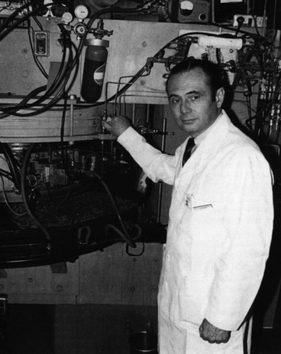
Michel Matthew Ter-Pogossian was an American medical physicist. He was professor of radiology at the Washington University School of Medicine for over 30 years. A pioneer in nuclear medicine, he is best known for his research on the positron emission tomography (PET). He is considered one of its creators and often referred to as the "father of PET."
John G. Webster was an American electrical engineer and a founding pioneer in the field of biomedical engineering. In 2008, Professor Webster was awarded the University of Wisconsin, College of Engineering, Polygon Engineering Council Outstanding Instructor Award. In 2019, the Institute of Electrical and Electronics Engineers awarded him its James H. Mulligan Jr. Educational Medal for his career contributions. Professor Webster died on March 29, 2023.
Ronald Ernest Aitchison was an Australian physicist and electronics engineer who contributed to a range of fields and technologies from solid-state devices to satellite imaging. He was born in Hurstville, New South Wales, Australia on 29 December 1921.
Xi-Cheng Zhang is a Chinese-born American physicist, currently serving as the Parker Givens Chair of Optics at the University of Rochester, and the director of the Institute of Optics. He is also the Chairman of the Board and President of Zomega Terahertz Corporation.
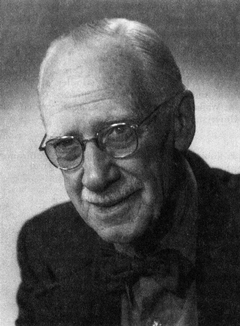
Kenneth Stewart Cole was an American biophysicist described by his peers as "a pioneer in the application of physical science to biology". Cole was awarded the National Medal of Science in 1967.

George Washington Pierce was an American physicist. He was a professor of physics at Harvard University and inventor in the development of electronic telecommunications.
James Ross Macdonald, son of John Elwood Macdonald and Antonina Jones Hansell, was born on 27 February 1923 in Savannah, GA and died at the Carolina Meadows retirement community, Chapel Hill, NC on 30 March 2024. He was an American physicist, who was instrumental in building up the Central Research laboratories of Texas Instruments (TI).
Herman P. Schwan was a biomedical engineer and biophysicist, recognized as the "founding father of biomedical engineering." He was born in Aachen, Germany, and died in his home Radnor, Pennsylvania.

John Milton Miller was a noted American electrical engineer, best known for discovering the Miller effect and inventing fundamental circuits for quartz crystal oscillators.
The IEEE Marie Sklodowska-Curie Award is a Technical Field Award that was established by the IEEE Board of Directors in 2008. This award may be presented for outstanding contributions to the field of nuclear and plasma sciences and engineering. This award may be presented to an individual, individuals on a team, or up to three multiple recipients. Recipients of this award receive a bronze medal, certificate, and honorarium. This award was presented for the first time in 2011.
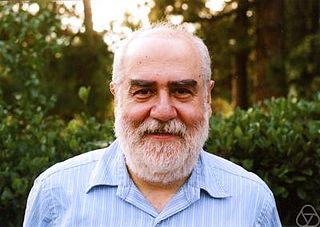
Gunther Alberto Uhlmann Arancibia is a mathematician whose research focuses on inverse problems and imaging, microlocal analysis, partial differential equations and invisibility.
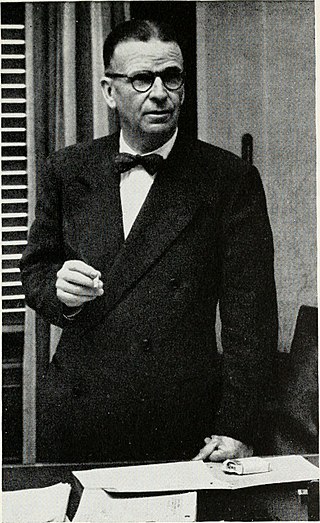
Mervin Joseph Kelly was an American industrial physicist. He worked at Bell Labs from 1925 to 1959, in which time he held positions such as director of research, president, and chairman of the board of directors.

Charles Vernon (Chuck) Shank is an American physicist, best known as the director of the Lawrence Berkeley National Laboratory from 1989 to 2004.

Ge Wang is a medical imaging scientist focusing on computed tomography (CT) and artificial intelligence (AI) especially deep learning. He is the Clark & Crossan Chair Professor of Biomedical Engineering and the Director of the Biomedical Imaging Center at Rensselaer Polytechnic Institute, Troy, New York, USA. He is known for his research and teaching on CT and AI-based imaging. He is Fellow of American Institute for Medical and Biological Engineering (AIMBE), Institute of Electrical and Electronics Engineers (IEEE), International Society for Optics and Photonics (SPIE), Optical Society of America (OSA/Optica), American Association of Physicists in Medicine (AAPM), American Association for the Advancement of Science (AAAS), and National Academy of Inventors (NAI). From Janunary 1, 2025, he serves as the Editor-in-Chief of IEEE Transactions on Medical Imaging.
