
The Handley Page H.P.42 and H.P.45 were four-engine biplane airliners designed and manufactured by British aviation company Handley Page, based in Radlett, Hertfordshire. They held the distinction of being the largest airliners in regular use in the world on the type's introduction in 1931.

The Avro 618 Ten or X was a passenger transport aircraft of the 1930s. It was a licensed version by Avro of the Fokker F.VIIB/3m.

The Junkers A50 Junior is an all-metal sports plane designed and produced by the German aircraft manufacturer Junkers.

The Armstrong Whitworth Argosy was a three-engine biplane airliner designed and produced by the British aircraft manufacturer Armstrong Whitworth Aircraft. It was the company's first airliner.

The Airspeed Consul is a twin-engined light transport aircraft and affordable airliner designed and produced by the British aircraft manufacturer Airspeed Limited. Introduced during the immediate post-war period, it was a straightforward conversion of surplus Airspeed Oxford military trainers that had been extensively used during the Second World War.

The Armstrong Whitworth A.W.27 Ensign was a British four-engine monoplane airliner and the largest airliner built in Britain during the Interwar period.

The Handley Page W.8, W.9 and W.10 were British two- and three-engine medium-range biplane airliners designed and built by Handley Page.

The Short S.26 G-class was a large transport flying boat designed and produced by the British aircraft manufacturer Short Brothers. It was designed to achieve a non-stop transatlantic capability, increasing the viability of long distant services/duties.

The Boulton & Paul P.64 Mailplane also known as the Mail-Carrier was a 1930s British twin-engined all-metal biplane transport aircraft designed for Imperial Airways and built by Boulton & Paul Ltd.

The Airspeed AS.6 Envoy was a twin-engined light transport aircraft designed and produced by the British aircraft manufacturer Airspeed Ltd.

The Westland IV and Westland Wessex were British high wing, three-engined light transport aircraft built by Westland Aircraft.

The de Havilland DH.50 was a 1920s British large single-engined biplane transport built by de Havilland at Stag Lane Aerodrome, Edgware, and licence-built in Australia, Belgium, and Czechoslovakia.

The Avro 652 was a 1930s British light airliner, built by A.V. Roe and Company. It was a twin-engine, low-wing monoplane with a retractable undercarriage, and a tailwheel. Although only two were produced, it formed the basis for the successful Avro Anson.

The Armstrong Whitworth AW.15 Atalanta was a four-engine airliner designed and produced by the British aircraft manufacturer Sir W.G. Armstrong Whitworth Aircraft Limited at Coventry.

The Avro 627 Mailplane was a British biplane developed in 1931 by Avro from the Avro Antelope bomber as a mail plane for use in Canada. Only one was built which ended up being used as a test bed.

The de Havilland DH.75 Hawk Moth was a 1920s British four-seat cabin monoplane built by de Havilland at Stag Lane Aerodrome, Edgware.

The Nieuport Nighthawk was a British fighter aircraft developed by the Nieuport & General Aircraft company for the Royal Air Force towards the end of the First World War. Although ordered into production before the aircraft first flew, it did not enter large scale service with the RAF owing to unreliable engines. Re-engined aircraft did see service in Greece, serving from 1923 to 1938.

The Saro Cloud was a British passenger amphibian flying boat designed and built by Saunders-Roe as the A.19. It was later produced as the A.29 for the Royal Air Force for pilot and navigator training.
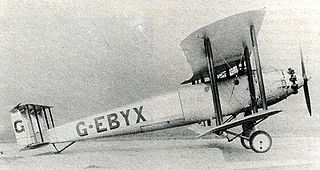
The Vickers Vellore was a large biplane designed as a freight and mail carrier, in single-engined and twin-engined versions, which saw limited use as freighters and long-range experimental aircraft. A final variant with a broader fuselage, the Vellox, was completed as an airliner.

The Avro 642 Eighteen was a 1930s British monoplane airliner. Only two were built — one twin-engined and the other four-engined. The original had a circular partially glazed nose, but this was changed to a more traditional one. It used the wing of the Avro 618 Ten, which was a license produced Fokker V.II.


