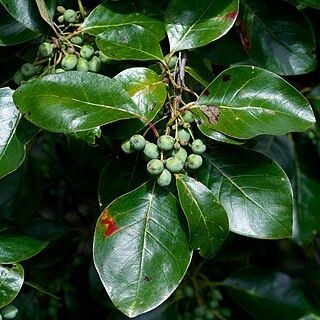
Nyssa sylvatica, commonly known as tupelo, black tupelo, black gum or sour gum, is a medium-sized deciduous tree native to eastern North America from the coastal Northeastern United States and southern Ontario south to central Florida and eastern Texas, as well as Mexico.

Cercis canadensis, the eastern redbud, is a large deciduous shrub or small tree, native to eastern North America from southern Michigan south to central Mexico, west to New Mexico. Species thrive as far west as California and as far north as southern Ontario. It is the state tree of Oklahoma. The prevalence of the so-called "Columbus strain" has seen the residents of Columbus, Wisconsin embrace the plant into their city's identity. Known as the "Redbud City," the town hosts "Redbud Day" annually the Saturday before Mother's Day, organizing a variety of themed events to recognize the tree.

Dasiphora fruticosa is a species of hardy deciduous flowering shrub in the family Rosaceae, native to the cool temperate and subarctic regions of the northern hemisphere, often growing at high altitudes in mountains. Dasiphora fruticosa is still widely referenced in the horticultural literature under its synonym Potentilla fruticosa. Common names include shrubby cinquefoil, golden hardhack, bush cinquefoil, shrubby five-finger, widdy, and kuril tea.

Abies lasiocarpa, the subalpine fir or Rocky Mountain fir, is a western North American fir tree.

Purshia tridentata, with the common name bitterbrush, is a shrub in the genus Purshia of the family Rosaceae. It is native to mountainous areas of western North America.
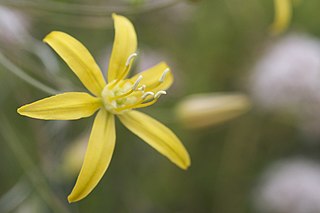
Bloomeria crocea, also known as goldenstar, is a geophyte from southern California and northern Baja California. It is found along hillsides, in grassland and chaparral edges, and in dry flats.
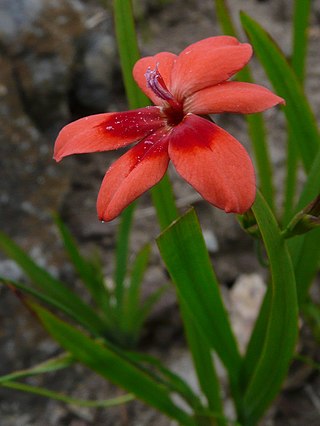
Freesia laxa, commonly known as flowering grass, is a small species of cormous flowering plant in the family Iridaceae, from eastern and southern Africa, from Kenya to northeastern South Africa. It is grown in gardens as an ornamental plant.

Erysimum capitatum is a species of wallflower known commonly as the sanddune wallflower, western wallflower, or prairie rocket.

Triteleia crocea, with the common names yellow triteleia and yellow tripletlily, is a monocot flowering plant in the genus Triteleia.

Calochortus amabilis is a species of the genus Calochortus in the family Liliaceae. It is also known by the common names Diogenes' lantern, yellow globe-tulip, golden globe-tulip, yellow globe lily, golden fairy lantern, golden lily-bell, Chinese lantern, and short lily.

Crocosmia × crocosmiiflora, montbretia, is a garden hybrid of C. aurea and C. pottsii, first bred in 1880 in France by Victor Lemoine. The basionym of the hybrid is Montbretia crocosmiiflora Lemoine. In 1932 it was reclassified as C. × crocosmiiflora (Lemoine) N .E.Br., but the common name "montbretia" is still often found in horticultural literature, and is commonly used in the British Isles for orange-flowered cultivars that have naturalised, while "crocosmia" is reserved for less aggressive red-flowered cultivars.
Bloomeria clevelandii is a rare species of flowering plant that is known by the common name San Diego goldenstar. It is native to a strip of scrub and coastal grassland in San Diego County, California, and adjacent Baja California. Genetic analysis of several morphologically similar genera shows that this species, which was named Muilla clevelandii for several decades, is not very closely related to the other members of Muilla and is moved back to Bloomeria.

Ribes speciosum is a species of flowering plant in the family Grossulariaceae, which includes the edible currants and gooseberries. It is a spiny deciduous shrub with spring-flowering, elongate red flowers that resemble fuchsias, though it is not closely related. Its common name is fuchsia-flowered gooseberry. It is native to central and southern California and Baja California, where it grows in the scrub and chaparral of the coastal mountain ranges.

Crocosmia aurea, common names falling stars, Valentine flower, or montbretia, is a perennial flowering plant belonging to the family Iridaceae.

Crocus angustifolius, the cloth-of-gold crocus, is a species of flowering plant in the genus Crocus of the family Iridaceae, native to southern Ukraine and Armenia. It is a cormous perennial growing to 5 cm (2.0 in) tall and wide. The narrow grass-like leaves with silver central stripe appear in late winter or early spring. They are followed by bright yellow fragrant flowers with maroon blotches on the outer petals.

The flora of the U.S. Sierra Nevada alpine zone is characterized by small, low growing, cushion and mat forming plants that can survive the harsh conditions in the high-altitude alpine zone above the timber line. These flora often occur in alpine fell-fields. The Sierra Nevada alpine zone lacks a dominant plant species that characterizes it, so may or may not be called a vegetation type. But it is found above the subalpine forest, which is the highest in a succession of recognized vegetation types at increasing elevations.

Barberetta is a genus of herbaceous perennial plants in the family Haemodoraceae. It contains only one known species, Barberetta aurea.

Iris series Spuriae are a series of the genus Iris, in Iris subg. Limniris. They are sometimes commonly known as butterfly irises.

Iris crocea is a species in the genus Iris, it is also in the subgenus Limniris and the series Spuriae. It is a rhizomatous perennial plant, found in Kashmir. It is cultivated as an ornamental plant. It is also commonly known as Golden Iris or Golden Flag. It was also known as Iris aurea for a long time, before that was regarded as a synonym of Iris crocea.

Conostylis aurea, commonly known as golden conostylis, is a plant in the bloodwort family Haemodoraceae. It is endemic to the south-west of Western Australia.


