 | This article may need to be rewritten to comply with Wikipedia's quality standards.(February 2011) |
Blackerby Fairfax (fl. 1728) was an English physician.
| | This article may need to be rewritten to comply with Wikipedia's quality standards.(February 2011) |
Blackerby Fairfax (fl. 1728) was an English physician.
Blackerby Fairfax was the son of Nathaniel Fairfax. He was educated at Woodbridge School and Corpus Christi College, Cambridge, where he took the two degrees in arts, B.A. 1689, M.A. 1693, and was created M.D. ‘comitiis regiis’ in 1728. [1] [2] After leaving Cambridge he studied medicine at the university of Leyden, of which he was admitted M.D. on 18 April 1696. [3] He was appointed a physician in the navy, but had retired by 1717.
He wrote a number of philosophical works reflecting his wide range of scientific and political interests:
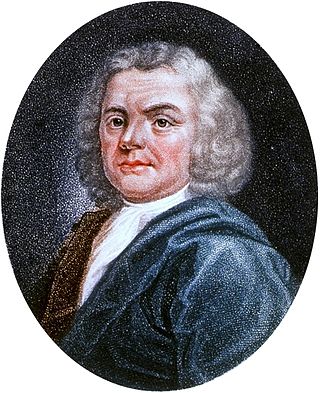
Herman Boerhaave was a Dutch botanist, chemist, Christian humanist, and physician of European fame. He is regarded as the founder of clinical teaching and of the modern academic hospital and is sometimes referred to as "the father of physiology," along with Venetian physician Santorio Santorio (1561–1636). Boerhaave introduced the quantitative approach into medicine, along with his pupil Albrecht von Haller (1708–1777) and is best known for demonstrating the relation of symptoms to lesions. He was the first to isolate the chemical urea from urine. He was the first physician to put thermometer measurements to clinical practice. His motto was Simplex sigillum veri: 'Simplicity is the sign of the truth'. He is often hailed as the "Dutch Hippocrates".

John Ray FRS was a Christian English naturalist widely regarded as one of the earliest of the English parson-naturalists. Until 1670, he wrote his name as John Wray. From then on, he used 'Ray', after "having ascertained that such had been the practice of his family before him". He published important works on botany, zoology, and natural theology. His classification of plants in his Historia Plantarum, was an important step towards modern taxonomy. Ray rejected the system of dichotomous division by which species were classified according to a pre-conceived, either/or type system, and instead classified plants according to similarities and differences that emerged from observation. He was among the first to attempt a biological definition for the concept of species, as "a group of morphologically similar organisms arising from a common ancestor". Another significant contribution to taxonomy was his division of plants into those with two seedling leaves (dicotyledons) or only one (monocotyledons), a division used in taxonomy today.
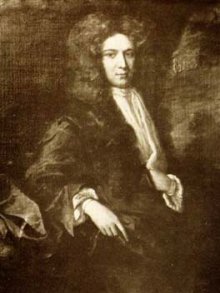
Anthony Collins was an English philosopher and essayist, notable for being one of the early proponents of Deism in Great Britain.
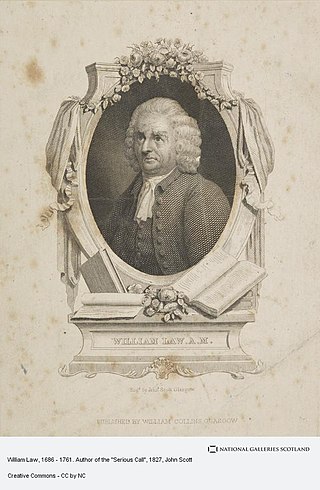
William Law was a Church of England priest who lost his position at Emmanuel College, Cambridge when his conscience would not allow him to take the required oath of allegiance to the first Hanoverian monarch, King George I. Previously, William Law had given his allegiance to the House of Stuart and is sometimes considered a second-generation non-juror. Thereafter, Law continued as a simple priest (curate) and when that too became impossible without the required oath, Law taught privately, as well as wrote extensively. His personal integrity, as well as his mystic and theological writing greatly influenced the evangelical movement of his day, as well as Enlightenment thinkers such as the writer Dr. Samuel Johnson and the historian Edward Gibbon. In 1784, William Wilberforce (1759–1833), the politician, philanthropist, and leader of the movement to stop the slave trade, was deeply touched by reading William Law's book A Serious Call to a Devout and Holy Life (1729). Law's spiritual writings remain in print today.

John Freind was an English physician.

John Woodward was an English naturalist, antiquarian and geologist, and founder by bequest of the Woodwardian Professorship of Geology at the University of Cambridge. Though a leading supporter of observation and experiment in what we now call science, few of his theories have survived.

Benjamin Waterhouse was a physician, co-founder and professor of Harvard Medical School. He is most well known for being the first doctor to test the smallpox vaccine in the United States, which he carried out on his own family.

Robert Beale was an English diplomat, administrator, and antiquary in the reign of Elizabeth I. As Clerk of the Privy Council, Beale wrote the official record of the execution of Mary, Queen of Scots, to which he was an eyewitness.
Willem Sewel was a Dutch Quaker historian, of English background.
Archibald Campbell was a Church of Scotland minister and moral philosopher.
Henry Pemberton was an English physician and man of letters. He became Gresham Professor of Physic, and edited the third edition of Principia Mathematica.
Joseph Boyse was an English presbyterian minister in Ireland, and controversialist.
Thomas Bennet (1673–1728) was an English clergyman, known for controversial and polemical writings, and as a Hebraist.
James Keill was a Scottish physician, philosopher, medical writer and translator. He was an early proponent of mathematical methods in physiology.
Nathaniel Fairfax (1637–1690) was an English divine and physician.
William Douglass was a physician in 18th-century Boston, Massachusetts, who wrote pamphlets on medicine, economics and politics that were often polemical. He was a central figure, along with Cotton Mather during the controversy surrounding the 1721 smallpox epidemic in Boston.
Nathaniel Johnston M.D. was an English physician, political theorist and antiquary.
Sir Richard Manningham M.D. (1690–1759) was an English physician and man-midwife, now remembered for his involvement in the Mary Toft hoax.
Sir Tancred Robinson was an English physician, known also as a naturalist.

Richard Hale M.D. (1670–1728) was an English physician, elected a Fellow of the Royal Society in 1721.
 This article incorporates text from a publication now in the public domain : "Fairfax, Nathaniel". Dictionary of National Biography . London: Smith, Elder & Co. 1885–1900.
 Media related to Blackerby Fairfax at Wikimedia Commons