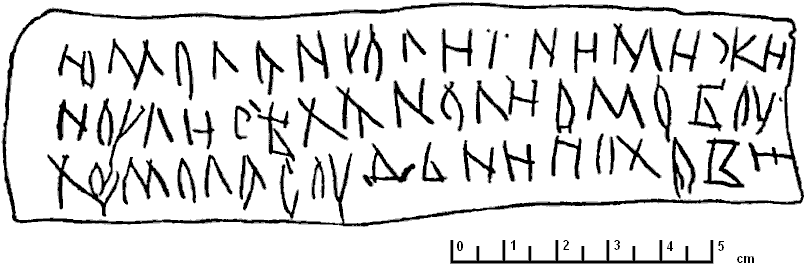
Birch bark letter no. 292 is a birch bark letter that is the oldest known document in any Finnic language.[1][2] The document is dated to the beginning of the 13th century and is written in the Cyrillic script.[3] It was found in 1957 by a Soviet expedition led by Artemiy Artsikhovsky in the Nerevsky excavation on the left coast side of Novgorod.[4] It is currently held at the Novgorod City Museum.
The language used in the document is thought to be an archaic form of Livvi-Karelian, the language spoken in Olonets Karelia,[5] although the exact form is difficult to determine, as Finnic dialects were still developing during that period.
Transcription
The text is written in Cyrillic in a Finnic language variety that is closer to modern Karelian or Veps.[3] A transcription of the text is as follows:[6]
Yeliseyev believes, that this is an invocation against lightning, as evidenced by "ten your names" construction. According to superstitious notions, knowledge of the name gives a human the magic power over an object or phenomenon.[8]
By Martti Haavio
As the orthography used does not utilize spaces between words, the source text can be transcribed into words in different ways. Martti Haavio gives a different interpretation of the text in his 1964 article, suggesting, that this is a sort of an oath:
jumolan nuoli inimizi
nouli sekä n[u]oli omo bou
jumola soud'nii okovy
In modern Finnish, this means roughly the following:
Jumalan nuoli, ihmisen
nuoli sekä nuoli oma.
Tuomion jumalan kahlittavaksi.
In modern Estonian, this means roughly the following:
Jumala nool, inimese
nool ja nool omaenda.
Kohtujumala aheldatuks.
In English, this means roughly the following:
God's arrow, man's arrow, and (his) own arrow. [
To be chained by the Doom-God.]
By Yevgeny Khelimsky
Professor Yevgeny Khelimsky in his 1986 work[9] criticizes Haavio's interpretation and gives the third known scientific interpretation, believing the letter to be an invocation, like Yeliseyev:[8]
Jumalan nuoli 10 nimezi
Nuoli säihä nuoli ambu
Jumala suduni ohjavi (johavi?)
A translation into Finnish of this interpretation would look something like this:
Jumalan nuoli 10 nimesi
Nuoli säihkyvä nuoli ampuu
Suuto-Jumala (Syyttö-Jumala)† ohjaa (johtaa?)
In English, it means roughly the following:
God's arrow, ten your name(s) Arrow sparkling, arrow shoots
The Doom-God guides/directs (leads/rules?)
†Syyttö-Jumala could also mean "Blaming God" or "God that blames"; modern Finnish syyttää = to blame or prosecute.
↑ Bakró-Nagy, Laakso & Skribnik 2022, p.59, The Novgorod birch-bark letter No. 292 from the early thirteenth century... written in Cyrillic... is not Finnish, but rather represents a Finnic language variety closer to today's Karelian or Veps.
↑ Елисеев Ю. С. Древнейший письменный памятник одного из прибалтийско-финских языков.— Изв. АН СССР. Отд-ние лит. и языка, 1959, т. 18, Вып. 1, с. 65—72.
↑ Хелимский Е. А. О прибалтийско-финском языковом материале в новгородских берестяных грамотах. In the book Янин В. Л., Зализняк А. А. Новгородские грамоты на бересте (из раскопок 1977—1983 гг.): Комментарии и словоуказатель к берестяным грамотам (из раскопок 1951—1983 гг.) / АН СССР. Отд-ние истории. — М.: Наука, 1986. — С. 254—255.)
This page is based on this Wikipedia article Text is available under the CC BY-SA 4.0 license; additional terms may apply. Images, videos and audio are available under their respective licenses.