
A synagogue, sometimes referred to by the Yiddish term shul and often used interchangeably with the word temple, is a Jewish house of worship. Synagogues have a place for prayer, where Jews attend religious Services or special ceremonies, have rooms for study, social hall(s), administrative and charitable offices, classrooms for religious school and Hebrew school, sometimes Jewish preschools, and often have many places to sit and congregate; display commemorative, historic, or modern artwork throughout; and sometimes have items of some Jewish historical significance or history about the Synagogue itself, on display.

Łask is a town in central Poland with 16,925 inhabitants (2020). It is the capital of Łask County, and is situated in Łódź Voivodeship. The Polish Air Force's 32nd Air Base is located nearby.
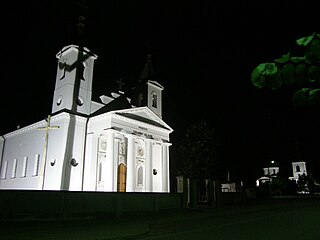
Zabłudów is a town in Białystok County, Podlaskie Voivodeship, in north-eastern Poland. Prior to 1999 it was part of the Białystok Voivodeship (1975–1998).
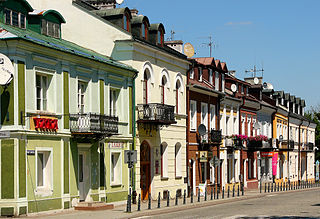
Krasnystaw is a town in southeastern Poland with 18 630 inhabitants. Situated in the Lublin Voivodeship, previously in Chełm Voivodeship (1975–1998). It is the capital of Krasnystaw County.

Opole Lubelskie is a town in eastern Poland. As of 2004, it had 8,879 inhabitants. The town is situated in Lublin Voivodeship, some 10 kilometers east of the Vistula River, and is the capital of Opole Lubelskie County. It was founded in the 14th century, and historically belongs to Lublin Land, which is part of Lesser Poland.

Kurów is a village in south-eastern Poland, located in the historic province of Lesser Poland, between Puławy and Lublin, on the Kurówka River. It is capital of a separate gmina (municipality) called Gmina Kurów, within Lublin Voivodeship. The village has 2,725 inhabitants.

Biecz is a town and municipality in southeastern Poland, in Lesser Poland Voivodeship, Gorlice County. It is in the Carpathian Mountains, in the Doły Jasielsko-Sanockie, by the Ropa River. Due to its rich history, it is often referred to as "little Kraków" or the "pearl of the Carpathians". The many preserved medieval city walls and buildings have also given rise to the nickname "Polish Carcassonne" for both Biecz and the town of Szydłów.

Zhovkva is a city in Lviv Raion, Lviv Oblast (region) of western Ukraine. Zhovkva hosts the administration of Zhovkva urban hromada, one of the hromadas of Ukraine. Its population is approximately 13,852 .

The First Roumanian-American Congregation, also known as Congregation Shaarey Shomayim, or the Roumanishe Shul, was an Orthodox Jewish congregation that, for over 100 years, occupied a historic building at 89–93 Rivington Street on the Lower East Side of Manhattan, New York.
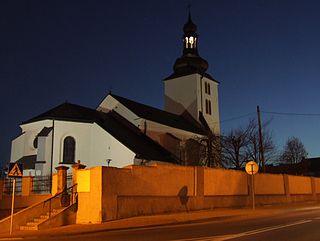
Lipsko is a town in eastern Poland, in northern Lesser Poland, Masovian Voivodeship. It is the capital of Lipsko County. The population is 5,895 (2004). Lipsko’s coat of arms is the Dębno, which was used by previous owners of the town.
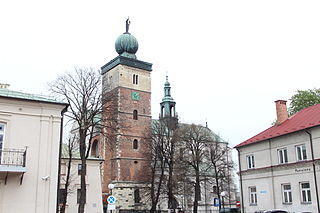
Miechów is a town in Poland, in Lesser Poland Voivodeship, about 40 kilometres north of Kraków. It is the capital of Miechów County. Population is 11,852 (2004). Miechów lies on the Miechówka river, along European route E77. The area of the town is 15 square kilometres (6 sq mi), and it has a rail station, located on the main railroad which connects Kraków with Warsaw.
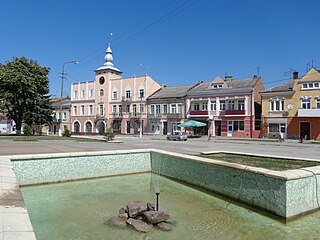
Pidhaitsi is a small city in Ternopil Raion, Ternopil Oblast (province) of western Ukraine. It is located ca. 15.5 mi south of Berezhany, 43.5 mi from Ternopil and ca. 62 mi south-east of Lviv. In 1939 Pidhaitsi obtained the formal status of a city. It hosts the administration of Pidhaitsi urban hromada, one of the hromadas of Ukraine. Population: 2,609.

Kupiškis is a city in northeastern Lithuania. It is the capital of the Kupiškis district municipality, mainly known for its sculptures and fourth biggest water reservoir in Lithuania. Kupiškis is located on the Lėvuo and Kupa rivers. The name of the city comes from the Kupa River. The Gediminas Bridge crosses the Kupa River. There are six parts of the city, which are named:

Horodok is a city in Lviv Raion, Lviv Oblast (region) of Ukraine. It hosts the administration of Horodok urban hromada, one of the hromadas of Ukraine. Population: 16,085 .

Zamość Synagogue is a UNESCO-protected Renaissance synagogue built between 1610 and 1618 in Zamość, southeastern Poland. Erected during the times of the Polish–Lithuanian Commonwealth, it functioned as a place of worship for Polish Jews until World War II, when the Nazis turned the interior into a carpenters' workshop. The structure was spared from destruction and in 1992 it became a UNESCO World Heritage Site alongside the Old City of Zamość.

The Synagogue in Chachmei Lublin Yeshiva is a synagogue located in Lublin, Poland, in the building of Chachmei Lublin Yeshiva, on Lubartowska 85 Street.

The Włodawa Synagogue in Włodawa, Poland is an architectural complex consisting of two historic synagogues and a Jewish administrative building, now preserved as a museum. The complex includes the Włodawa Great Synagogue of 1764–74, the late 18th century Small Synagogue, and the 1928 community building. It is "one of the best-preserved" synagogues in Poland.
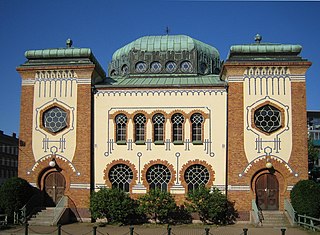
Malmö Synagogue is the only synagogue in Malmö, Sweden. It was built in 1903 and designed by the architect John Smedberg. It has an Art Nouveau and Moorish Revival design, which is one of the few synagogues in Europe when most of them were destroyed during Kristallnacht 1938. The services of worship are Orthodox. At the inauguration of Malmö Synagogue, it was Malmö's first non-Christian place of worship. Malmö has two Jewish cemeteries: one section in the northern part of Sankt Pauli kyrkogård and another, newer section in Östra kyrkogården.

The New Synagogue in Ostrów Wielkopolski, Poland, is located in the city's center on 21 Raszkowska Street, which was the northern edge of the former Jewish district. Currently, this is the only preserved metropolitan synagogue. It is built in the once very popular Moorish Revival style. It is the most precious monument of religious architecture in Ostrów Wielkopolski. Long neglected, the synagogue has been fully restored in 2010. See the municipal website for updates:
Wieluń, Poland is a small town situated in the south of central Poland, between the large cities of Łódź and Kraków. A Jewish presence in Wieluń was recorded from the early part of the 16th century (1537). Before World War II (1939–1945), Wielun had a large Jewish community, which was completely destroyed by the Nazis between 1940 and 1944.


