| Berck-Plage - Paris-Plage line | |
|---|---|
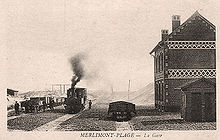
| Arrival of a train at Berck-Plage station | |
| Overview | |
| Locale | France |
| Termini | |
| Service | |
| Operator(s) | CF Berck-Plage to Paris-Plage (from 1906) |
| History | |
| Closed | 1929 |
| Technical | |
| Number of tracks | 1 |
| Track gauge | Metre-gauge railway (1,000 m) |
| Electrification | Non-electrified |
The Berck-Plage - Paris-Plage line [1] (subsequently designated Le Touquet-Paris-Plage) constituted a narrow-gauge local railway that connected two coastal resorts on the Opal Coast of the English Channel in France. This line served the administrative Pas-de-Calais department and was operational from the early 20th century. The route opened in stages between 1909 and 1912 and operated until it ceased in 1929.
Spanning approximately 17 kilometers, the line was owned by a company independent of the major railway networks serving Berck-Plage and Le Touquet-Paris-Plage. It faced significant challenges due to irregular seasonal traffic and the inexperience of its operator in railway management. Nevertheless, this railway is illustrative of the communication modes utilized from the late 19th century until World War II, with the specific intention of serving vacation spots on the northern coasts of France.
By the conclusion of the 19th century, a multitude of seaside resorts had been established along the shores of the English Channel and the North Sea, in response to the growing practice of sea bathing and the expansion of summer and weekend tourism. [2] The coastline between the estuaries of the Authie and the Canche rivers, situated on the southern part of the Opal Coast, is characterized by a series of sandy beaches and vacation spots of varying importance, extending from south to north. [N 1] [3] The coastal resorts of Berck-Plage, Merlimont, and Le Touquet-Paris-Plage are located in the region between the estuaries of the Authie and the Canche rivers, on the southern part of the Opal Coast. [4] [N 2] In this context, in 1891, Mr. Lambert, an entrepreneur and founder of the Société des Dunes, sought to develop this coastal area by establishing a railway line connecting Berck-Plage to Paris-Plage, following the coastline. [5] The route was designed to connect with the Aire-sur-la-Lys - Berck-Plage line in the south and the Étaples to Paris-Plage tramway in the north, both of which were planned for implementation shortly. [N 3] [6] The request was denied, but the company was granted permission to construct a short narrow-gauge railway between Berck-Plage and the Dunes beach, to transport construction materials for real estate developments that were already underway. [5] This line, which was 2.15 kilometers in length, was rapidly completed and likely opened in 1893. [7] However, it only operated for freight transport, and no detailed information is available regarding its operations.
A new request was made in the early 20th century by Paul Berger and Charles Roy, who were responsible for establishing the Société du Chemin de Fer de Berck-Plage à Paris-Plage (B.P.). [8] The declaration of public utility was signed on 27 April 1906, and work commenced. The existing line was reinforced, and the remainder of the route was opened in successive sections: [9]
The line, with a total length of 17.2 kilometers, originated at Berck-Plage, sharing facilities with the Aire-sur-la-Lys to Berck-Plage line. It then turned north and closely followed the coastline until reaching Merlimont, where it crossed the dunes along the Channel. Subsequently, the line moved slightly inland, serving Cucq, before reaching Paris-Plage, where it skirted the golf course. After the freight facilities and the provisional terminus at Daloz, the railway terminated at Rue de Paris , where it shared infrastructure with the Étaples to Paris-Plage tramway . [10] The topography was relatively flat, with only gentle gradients (a maximum of 16%). The narrow-gauge track was predominantly situated on its right-of-way and utilized "Vignole" rails weighing 20 kg/m, except for Paris-Plage, where the tracks were embedded in the road and employed heavier rails of 25 to 30 kg/m. Curves had a minimum radius of 100 meters. [5]
In addition to the two terminal stations that are shared with other networks, the sole intermediate station on the route was Merlimont-Plage. This station was notably expansive and aesthetically pleasing for a local railway, with the passenger facility situated separately from the goods shed. [5] Other structures included a depot workshop at Bellevue-les-Dunes, situated a few hundred meters north of Berck, and a goods shed located just before Paris-Plage station. The stops, situated from south to north at Bellevue-les-Dunes, Merlimont-Village, Cucq, Golf, Daloz, and Sémaphore, were relatively simple in design, comprising only a platform and a post displaying the train schedule. [11]
Upon the commencement of railway operations in 1909 on the Berck-Plage to Merlimont-Plage section, seven shuttles were in operation on weekdays and eleven on Sundays and holidays. This represented a significantly higher frequency than that of the majority of local railways. Following the inauguration of the Paris-Plage extension (terminating at Daloz) in 1910, the number of daily trips was reduced to eight during the summer, four during the fall, and one during the winter. [12] A mixed train, included in the aforementioned services, was used for transporting freight wagons. The number of shuttles was significantly reduced due to a lack of traction power, which resulted in a considerable increase in operational issues. [9] In the years preceding the First World War, the number of passengers increased steadily, yet freight traffic failed to reach the anticipated levels, despite the installation of dedicated facilities near the Paris-Plage terminus. [11] The railway line completion in 1912 resulted in a lengthy journey between the two terminal stations due to the numerous intermediate stops. Trains required a minimum of one hour and ten minutes to traverse the 17.2-kilometer distance, with an average speed of fewer than 15 kilometers per hour. In 1914, the fare structure was as follows: first class, 1.80 fr; second class, 1.35 fr; and third class, 1 fr.
As with other railways, operations ceased on 3 August 1914, with the outbreak of war. They did not resume immediately afterward. The army proceeded to dismantle the tracks to supply military lines that were serving the Somme front. [11] The line was rebuilt in 1919, and passenger services were reinstated on 25 July that year. [13] However, the service was now limited to two or three round trips per day along the entire route, with an additional shuttle between Berck-Plage and Merlimont-Plage, and only operated during the summer season from 1 July to 30 September. [12] The reduction in intermediate stops resulted in a one-hour journey, with trains serving only Bellevue-les-Dunes and Merlimont-Plage. Freight service was reinstated on 1 August 1925, at the request of local authorities, but it was unsuccessful due to the railway's inability to attract customers. [13]
In the mid-1920s, bus lines were introduced to serve the communities of Merlimont-Plage and Stella-Plage, which had been designated a "climatic resort" since 1925. [3] These buses ran from the Nord Railway Company's stations on the Amiens-Calais line. The introduction of buses resulted in a loss of passengers for the local railway, as they offered a more direct and faster mode of transportation. [14] This decline in ridership, in conjunction with the progressive encroachment of sand, resulted in the cessation of operations on 30 September 1927. On 26 December 1928 an agreement was reached whereby the railway was purchased by the department. The line was utilized for a brief period of two months in the spring of 1929, facilitating the transportation of materials for the construction of a golf course between Stella-Plage and Paris-Plage. However, it was ultimately deemed unnecessary and permanently abandoned. [5] The line was formally decommissioned by decree on 25 December 1929, and the tracks were subsequently removed in the following months. [13] The passenger buildings at Berck-Plage and Merlimont were preserved; the former now houses a casino, and the latter the local tourist office. In contrast, the Touquet-Paris-Plage station was demolished and replaced with an apartment building. [15] Currently, the Le Touquet-Berck-Plage connection is served by line 42 (Boulogne-Berck) of the Colvert transport system. [16]
The relatively brief operational lifespan of the line (less than 20 years) and its subsequent closure cannot be attributed to the general factors that contributed to the decline of local railways. These include competition from road transport, chronic deficits that emerged following the First World War or the 1929 crisis, a lack of modernisation, and a waning interest from local authorities in providing subsidies. [17] Additionally, the line was subject to particular constraints, which were further compounded by the inexperience of the Société du Chemin de Fer de Berck-Plage à Paris-Plage in railway operations:
The locomotive fleet of the line was notable for its considerable heterogeneity, which presented a significant challenge concerning maintenance.
At the inception of operations, two steam locomotives were designated for the purpose of handling heavy traffic: a 0-6-0T [N 4] locomotive constructed by Decauville in 1908 and a 0-4-0T locomotive manufactured by Corpet-Louvet. As was the case with the remainder of the rolling stock, these locomotives were equipped with a central buffer and lower coupling, as well as vacuum brakes. [12] The inauguration of the railway and the insufficient number of engines resulted in the acquisition of three additional locomotives: in 1910, a 0-6-0T Borsig of German origin, and in 1912, two 2-6-0T La Meuse locomotives of Belgian origin. These latter two were requisitioned by the military during wartime and were destroyed by an aerial bombing near Albert in 1918. [12]
Following the cessation of operations in 1919, the three oldest locomotives were utilized once more. To compensate for the loss of the two machines, the line received in 1924 two 2-6-0T locomotives, constructed by the Société Alsacienne de Constructions Mécaniques. [N 5] [19] However, the size of the fleet was no longer justified by the level of traffic, and thus one locomotive was sold to a cement factory in Cher and the other was leased to a brickyard in the vicinity of Berck. The latter was returned to the network for a brief period before being sold with the rest of the equipment when the line ceased operations. [20]
One of the two machines, the 2-6-0T number 3 from 1924, is on display at the Museum of Steam Trams and French Secondary Railways in Butry-sur-Oise. It has been classified as a historical monument.
The towed fleet consisted of two-axle equipment built by Decauville in 1908–1909: [20]
The Société nationale des chemins de fer français is France's national state-owned railway company. Founded in 1938, it operates the country's national rail traffic along with that of Monaco, including the TGV, on France's high-speed rail network. Its functions include operation of railway services for passengers and freight, as well as maintenance and signalling of rail infrastructure. The railway network consists of about 35,000 km (22,000 mi) of route, of which 2,600 km (1,600 mi) are high-speed lines and 14,500 km (9,000 mi) electrified. About 14,000 trains are operated daily.
The Opal Coast is a coastal region in northern France on the English Channel, popular with tourists.
Le Touquet-Paris-Plage, commonly referred to as Le Touquet, is a commune near Étaples, in the Pas-de-Calais department, northern France. It has a permanent population of 4,213 (2021), but it welcomes up to 250,000 people during the summer, so the population at any given time during high season in summer swells to about 30,000. Located on the Opal Coast of the English Channel at the estuary of the river Canche, the commune is one of the most renowned seaside resorts in France, with a wide range of sports and leisure activities.
Berck, sometimes referred to as Berck-sur-Mer in French or Berck-su-Mér in Picard, is a commune in the northern French department of Pas-de-Calais.
The Compagnie des chemins de fer de l'Ouest, often referred to simply as L'Ouest or Ouest, was an early French railway company which operated from the years 1855 through 1909.
The Compagnie du Chemin de Fer d'Orléans à Rouen was a French railway company. The company was created in 1872 by M. Ridder, and subsequently absorbed by the Chemins de fer de l'Ouest in 1891.
The Chemin de Fer de la Baie de Somme, is a preserved railway in northern France. The railway is managed by a non-profit organization, which runs from March to December between the towns of the Baie de Somme area: Le Crotoy and Cayeux-sur-Mer via Noyelles-sur-Mer and Saint-Valery-sur-Somme, on metre gauge tracks. The association was founded in 1970 and over the years it has become a major player in tourism development in the Picardy coast and is also responsible for the preservation, safeguarding and enhancement of the fleet full of cars, wagons, steam locomotives and diesel locomotives. A part of the line has dual gauge track, and although forming part of a group of five lines, at least a part of it has always been open to traffic.
The Réseau des Bains de Mer was a group of five metre gauge railways centred on Noyelles-sur-Mer, with a total route length of some 68 kilometres (42 mi). It was a part of the Chemins de fer départementaux de la Somme. Three of the lines are still open as the Chemin de Fer de la Baie de Somme heritage line, and are dealt with under that article. This article covers the other two lines, now closed. All the lines were in the Somme department.
The Chemin de fer du Cambrésis was a 120-kilometre (75 mi) long metre gauge railway in the Nord and Aisne departments of France. There were four lines with Caudry at the centre.
The Chemin de fer des Côtes-du-Nord, the Côtes-d'Armor today, was a 1,000 mm, metre gauge, railway in Côtes-du-Nord, France, although there were a few kilometres of line in Finistère and Ille-et-Vilaine. The first lines opened in 1905 and final closure was in 1956. The lines were a voie ferrée d'intérêt local system with a total extent of 457 kilometres (284 mi).
The Chemins de fer du Morbihan (CM) was a metre gauge railway in Morbihan, France, with some track in Loire-Inférieure. The first lines opened in 1902 and the system had a total extent of 433 kilometres (269 mi).
The Chemin de Fer du Blanc-Argent is a 1,000 mm gauge railway in the region of Centre-Val de Loire, France, part of which is still open to traffic, whilst another section is now operated as a heritage railway.
The Musée des tramways à vapeur et des chemins de fer secondaires français is located alongside Valmondois railway station, in the small town of Butry-sur-Oise in the departement of Val-d'Oise, 30 kilometres (19 mi) north of Paris.
The museum houses a collection of railway vehicles from the former French departmental railways, preserved, restored and rebuilt by the members of an association. During the season, short trips can be made on some of the exhibits, at a separate location in the town of Crèvecoeur le Grand, along a metre gauge line, three kilometers in length, nicknamed the "Impressionists' railway".
In France, a voie ferrée d'intérêt local, abbreviated VFIL, is a secondary railway constructed by a local administrative division, serving sparsely populated rural areas. These areas were beyond the economic reach of the networks of the intérêt général, which were concessions of the grandes compagnies who ran their lines for profit.
The French National Railways used to run a considerable number of 1,000 mmmetre gauge lines, a few of which still operate mostly in tourist areas, such as the St Gervais-Vallorcine (Alps) and the "Petit Train Jaune" in the Pyrenees. The original French scheme was that every sous-prefecture should be rail connected. Extensive 600 mm gauge lines were also built for the sugar-beet industry in the north often using ex-military equipment after the First World War. Decauville was a famous French manufacturer of industrial narrow-gauge railway equipment and equipped one of the most extensive regional 600 mm narrow-gauge railway, the Chemins de fer du Calvados. Corsica has a narrow-gauge network of two lines following the coast line, that are connected by one line crossing the island through highly mountainous terrain. The petit train d'Artouste, a tourist line in the Pyrenees, uses 500 mm gauge.
The Chemin de fer d'Anvin à Calais was a 1,000 mmmetre gauge railway from Calais to Anvin, in the Pas-de-Calais department of France. It opened in 1881 and closed in 1955.
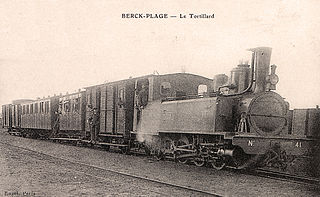
The Aire–Fruges and Rimeux-Gournay–Berck railway was a 1,000 mmmetre gauge railway from Aire-sur-la-Lys to Berck, in the Pas-de-Calais department of France. It opened in 1891 and closed in 1955.
The Chemin de fer du Val de Passey is a 0.8 km (0.5 mi) long heritage railway with 600 mm gauge near Choloy-Ménillot southwest of Toul in France.
The Isle of Oléron railway was a metre gauge secondary railway which was in service from 1904 to 1935, running north to south on the Isle of Oléron, in Charente-Maritime, France. It was operated by the local railway 'la compagnie des chemins de fer économiques des Charentes'.