Related Research Articles

Ferdinand Joseph LaMothe, known professionally as Jelly Roll Morton, was an American ragtime and jazz pianist, bandleader, and composer of Louisiana Creole descent. Morton was jazz's first arranger, proving that a genre rooted in improvisation could retain its essential characteristics when notated. His composition "Jelly Roll Blues", published in 1915, was one of the first published jazz compositions. He also claimed to have invented the genre.
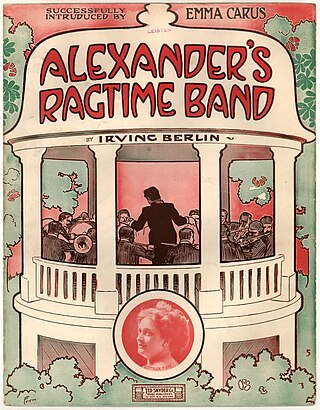
"Alexander's Ragtime Band" is a Tin Pan Alley song by American composer Irving Berlin released in 1911; it is often inaccurately cited as his first global hit. Despite its title, the song is a march as opposed to a rag and contains little syncopation. The song is a narrative sequel to Berlin's earlier 1910 composition "Alexander and His Clarinet". This earlier composition recounts the reconciliation between an African-American musician named Alexander Adams and his flame Eliza Johnson as well as highlights Alexander's innovative musical style. Berlin's friend Jack Alexander, a cornet-playing African-American bandleader, inspired the title character.

A big band or jazz orchestra is a type of musical ensemble of jazz music that usually consists of ten or more musicians with four sections: saxophones, trumpets, trombones, and a rhythm section. Big bands originated during the early 1910s and dominated jazz in the early 1940s when swing was most popular. The term "big band" is also used to describe a genre of music, although this was not the only style of music played by big bands.
This is a list of notable events in music that took place in the year 1909.
Spirituals is a genre of Christian music that is associated with African Americans, which merged varied African cultural influences with the experiences of being held in bondage in slavery, at first during the transatlantic slave trade and for centuries afterwards, through the domestic slave trade. Spirituals encompass the "sing songs", work songs, and plantation songs that evolved into the blues and gospel songs in church. In the nineteenth century, the word "spirituals" referred to all these subcategories of folk songs. While they were often rooted in biblical stories, they also described the extreme hardships endured by African Americans who were enslaved from the 17th century until the 1860s, the emancipation altering mainly the nature of slavery for many. Many new derivative music genres such as the blues emerged from the spirituals songcraft.

The Jazz Age was a period in the 1920s and 1930s in which jazz music and dance styles gained worldwide popularity. The Jazz Age's cultural repercussions were primarily felt in the United States, the birthplace of jazz. Originating in New Orleans as mainly sourced from the culture of African Americans, jazz played a significant part in wider cultural changes in this period, and its influence on popular culture continued long afterwards.
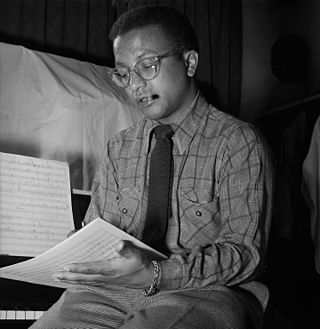
William Thomas Strayhorn was an American jazz composer, pianist, lyricist, and arranger who collaborated with bandleader and composer Duke Ellington for nearly three decades. His compositions include "Take the 'A' Train," "Chelsea Bridge," "A Flower Is a Lovesome Thing," and "Lush Life".
John Wesley Work III was an American composer, educator, choral director, musicologist and scholar of African-American folklore and music.
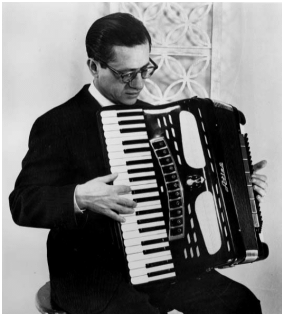
John Serry Sr. was an American concert accordionist, arranger, composer, organist, and educator. He performed on the CBS Radio and Television networks and contributed to Voice of America's cultural diplomacy initiatives during the Golden Age of Radio. He also concertized on the accordion as a member of several orchestras and jazz ensembles for nearly forty years between the 1930s and 1960s.

RCA Thesaurus, a brand owned by RCA Victor, was a supplier of electrical transcriptions. It enjoyed a long history of producing electrical transcriptions of music for radio broadcasting which dated back to NBC's Radio Recording Division.
Ross Lee Finney Junior was an American composer who taught for many years at the University of Michigan.
Rhythm in a Riff is a 1947 medium length musical film produced by William D. Alexander and directed by Leonard Anderson. The film stars Billy Eckstine and his band performing as well as Ann Baker, Hortense Allen Jordan, Sarah Harris, and Emmett "Babe" Wallace. The film is extant. The film was.made in New York City. It was released by Astor Pictures. The film was targeted to am African American audience, features and African American cast, and was produced and directed by African Americans. The film is also known as Flicker Up.
William Benjamin Olds (1874–1948) was an American musician, professor, composer, and scholar. His book Bird songs for children was published in 1914. The Musical Quarterly published an article he wrote about bird songs in 1922. Arrangements he made of bird songs were performed.
Nicholas Laucella was an American concert flautist and composer. During the course of a professional musical career which spanned over three decades, he performed as the principal flute with several leading orchestral ensembles including the New York Philharmonic and the Metropolitan Opera Orchestra in New York City.

Anton Lada was a ragtime, jazz and dance musician. He was a drummer. He played with and was the manager of the Louisiana Five. He recorded on Columbia Records and toured. Lada performed for dancing and vaudeville shows and made a series of recordings for Emerson Records, Edison Records, and Columbia Records.
Carman Newsome was an African-American actor, musician and band conductor in the United States. His work includes leading roles in five Oscar Micheaux films.
Nathaniel Cleophas "N.C." Davis (1888-1972) was an African American musician, composer, educator, bandleader, and owner/publisher of N.C. Davis Music Company of Nashville, Tennessee.
Leonard Anderson was an American film editor and film director, and he co-owned a film production company. Anderson's short films of African-American musical acts include footage of Anna Mae Winburn with the International Sweethearts of Rhythm, Lucky Millinder and his orchestra, and Henri Woode.
Joseph Erskine Agnew was a musician, arranger, music store proprietor, and music publisher in Des Moines, Iowa and later Newton, Iowa briefly. He played the mandolin. He became a nationally prominent band music publisher. Sheet music published by his Agnew Music Publishing Company is in the collections of the Library of Congress, the University of Missouri-Kansas City, and the University of Rochester.
Frederick Jerome Work was a collector, arranger ("harmonizer"), and composer of songs in the United States. He was part of a family of musicians and published a collection of "Negro spirituals" with his brother John Wesley Work.
References
- 1 2 "Benjamin Shook". Library of Congress, Washington, D.C. 20540 USA.
- 1 2 Abbott, Lynn; Seroff, Doug (September 18, 2009). Out of Sight: The Rise of African American Popular Music, 1889-1895. Univ. Press of Mississippi. ISBN 978-1-60473-039-5 – via Google Books.
- ↑ University, Fisk (March 3, 1893). "Catalogue of the ..." The University – via Google Books.
- ↑ Shook, Benjamin (composer) (January 1, 1903). "Dat gal of mine - African American sheet music 1883-1923". Library of Congress.