The conflict between Brunei and Spain began with the sending of a letter by Francisco de Sande to the Sultan of Brunei. In the letter, de Sande urged the Sultan of Brunei to stop sending missionaries to the islands of Borneo and the Philippines, which were already under Spanish control.[7] As an alternative, de Sande offered the entry of Catholic priests to spread Christianity in Bruneian territory. Sultan Saiful Rijal considered the letter an insult to Islam and flatly denied the request. This action angered de Sande, considering the refusal an insult to Spain.[8]
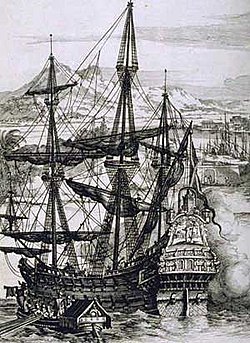
A Spanish galleon
In March 1578, de Sande sailed from Manila to Kota Batu with 40 warships and 2,200 soldiers.[9][10] Upon arriving in the waters of Kota Batu, de Sande sent a second letter to the Sultan of Brunei with the aim of allowing Christian priests to enter Brunei, but this letter was also rejected. On 14 April 1578, de Sande launched an attack on Kota Batu, where the Spanish fleet bombarded and destroyed 50 Brunei ships in the harbor. This attack was intended to overthrow Sultan Saiful Rijal. As a result of the attack, the Sultan's palace and property fell into Spanish hands, while the population of Brunei was massacred and the Brunei Grand Mosque was burned. However, Sultan Saiful Rijal and his followers managed to escape and retreat to Jerudong.[11]
Aftermath
In spite of the Spanish victory in Kota Batu, cholera or dysentery plagued them, fleeing from the capital after 72 days,[12][13] after a counterattack by Bendahara Sakam which expelled them with 1,000 men,[14] returning to Manila in 26 June 1578.[15] Having a minimal effect on the sultanate however lead to the independence of the Sultanate of Sulu and the loss of Luzon to the Spanish.
↑Jabatan Pusat Sejarah (1999). Masa silam sarana masa depan: kumpulan kertas kerja Seminar Sejarah Brunei II. Jabatan Pusat Sejarah, Kementerian Kebudayaan, Belia dan Sukan. p.216. ISBN9789991734163.
↑Letter from Fajardo to Felipe III From Manila, August 15 1620 (From the Spanish Archives of the Indies): "The infantry does not amount to 200 men, in three companies. If these men were that number, and Spaniards, it wouldn’t be so bad; but, although I haven’t seen them, because they haven’t yet arrived here, I’m told that they are, as at other times, for the most part boys, mestizos, and mulattoes, with some Indians (Native Americans). There is no little cause for regret in the great sums that reinforcements of such men waste for, and cost, your Majesty. I cannot see what betterment there will be until your Majesty shall provide it, since I do not think, that more can be done in Nueva Spaña, although the viceroy must be endeavoring to do so, as he is ordered."
↑Haji Awg Asbol bin Haji Mail (2024). Traditional Malay Monarchy. Taylor & Francis. p.228. ISBN9781040102473.
↑Frankham 2008, p.278 harvnb error: no target: CITEREFFrankham2008 (help)
↑Atiyah 2002, p.71 harvnb error: no target: CITEREFAtiyah2002 (help)
McAmis, Robert Day (2002). Malay Muslims: The History and Challenge of Resurgent Islam in Southeast Asia. Eerdmans. ISBN978-0-8028-4945-8.
This page is based on this Wikipedia article Text is available under the CC BY-SA 4.0 license; additional terms may apply. Images, videos and audio are available under their respective licenses.

 Bruneian Sultanate