
A brain is an organ that serves as the center of the nervous system in all vertebrate and most invertebrate animals. It is located in the head, usually close to the sensory organs for senses such as vision. It is the most complex organ in a vertebrate's body. In a human, the cerebral cortex contains approximately 14–16 billion neurons, and the estimated number of neurons in the cerebellum is 55–70 billion. Each neuron is connected by synapses to several thousand other neurons. These neurons typically communicate with one another by means of long fibers called axons, which carry trains of signal pulses called action potentials to distant parts of the brain or body targeting specific recipient cells.

The central nervous system (CNS) is the part of the nervous system consisting primarily of the brain and spinal cord. The CNS is so named because the brain integrates the received information and coordinates and influences the activity of all parts of the bodies of bilaterally symmetric and triploblastic animals—that is, all multicellular animals except sponges and diploblasts. It is a structure composed of nervous tissue positioned along the rostral to caudal axis of the body and may have an enlarged section at the rostral end which is a brain. Only arthropods, cephalopods and vertebrates have a true brain.
Nociception is the sensory nervous system's process of encoding noxious stimuli. It deals with a series of events and processes required for an organism to receive a painful stimulus, convert it to a molecular signal, and recognize and characterize the signal in order to trigger an appropriate defense response.

The brainstem is the posterior stalk-like part of the brain that connects the cerebrum with the spinal cord. In the human brain the brainstem is composed of the midbrain, the pons, and the medulla oblongata. The midbrain is continuous with the thalamus of the diencephalon through the tentorial notch, and sometimes the diencephalon is included in the brainstem.
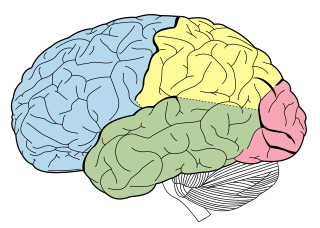
The parietal lobe is one of the four major lobes of the cerebral cortex in the brain of mammals. The parietal lobe is positioned above the temporal lobe and behind the frontal lobe and central sulcus.

The midbrain or mesencephalon is the forward-most portion of the brainstem and is associated with vision, hearing, motor control, sleep and wakefulness, arousal (alertness), and temperature regulation. The name comes from the Greek mesos, "middle", and enkephalos, "brain".

The auditory system is the sensory system for the sense of hearing. It includes both the sensory organs and the auditory parts of the sensory system.

In neuroanatomy, the superior colliculus is a structure lying on the roof of the mammalian midbrain. In non-mammalian vertebrates, the homologous structure is known as the optic tectum, or optic lobe. The adjective form tectal is commonly used for both structures.

The inferior colliculus (IC) is the principal midbrain nucleus of the auditory pathway and receives input from several peripheral brainstem nuclei in the auditory pathway, as well as inputs from the auditory cortex. The inferior colliculus has three subdivisions: the central nucleus, a dorsal cortex by which it is surrounded, and an external cortex which is located laterally. Its bimodal neurons are implicated in auditory-somatosensory interaction, receiving projections from somatosensory nuclei. This multisensory integration may underlie a filtering of self-effected sounds from vocalization, chewing, or respiration activities.
In neuroanatomy, the pretectal area, or pretectum, is a midbrain structure composed of seven nuclei and comprises part of the subcortical visual system. Through reciprocal bilateral projections from the retina, it is involved primarily in mediating behavioral responses to acute changes in ambient light such as the pupillary light reflex, the optokinetic reflex, and temporary changes to the circadian rhythm. In addition to the pretectum's role in the visual system, the anterior pretectal nucleus has been found to mediate somatosensory and nociceptive information.
Multisensory integration, also known as multimodal integration, is the study of how information from the different sensory modalities may be integrated by the nervous system. A coherent representation of objects combining modalities enables animals to have meaningful perceptual experiences. Indeed, multisensory integration is central to adaptive behavior because it allows animals to perceive a world of coherent perceptual entities. Multisensory integration also deals with how different sensory modalities interact with one another and alter each other's processing.
Sensory processing is the process that organizes sensation from one's own body and the environment, thus making it possible to use the body effectively within the environment. Specifically, it deals with how the brain processes multiple sensory modality inputs, such as proprioception, vision, auditory system, tactile, olfactory, vestibular system, interoception, and taste into usable functional outputs.

Hemianopsia, or hemianopia, is a loss of vision or blindness (anopsia) in half the visual field, usually on one side of the vertical midline. The most common causes of this damage are stroke, brain tumor, and trauma.
Eric Knudsen is a professor of neurobiology at Stanford University. He is best known for his discovery, along with Masakazu Konishi, of a brain map of sound location in two dimensions in the barn owl, tyto alba. His work has contributed to the understanding of information processing in the auditory system of the barn owl, the plasticity of the auditory space map in developing and adult barn owls, the influence of auditory and visual experience on the space map, and more recently, mechanisms of attention and learning. He is a recipient of the Lashley Award, the Gruber Prize in Neuroscience, and the Newcomb Cleveland prize and is a member of the National Academy of Sciences.
Sensory integration therapy (SIT) was originally developed by occupational therapist A. Jean Ayres in the 1970s to help children with sensory-processing difficulties. It was specifically designed to treat Sensory Processing Disorder. Sensory Integration Therapy is based on A. Jean Ayres's Sensory Integration Theory, which proposes that sensory-processing is linked to emotional regulation, learning, behavior, and participation in daily life. Sensory integration is the process of organizing sensations from the body and from environmental stimuli.

Ann Martin Graybiel is an Institute Professor and a faculty member in the Department of Brain and Cognitive Sciences at the Massachusetts Institute of Technology. She is also an investigator at the McGovern Institute for Brain Research. She is an expert on the basal ganglia and the neurophysiology of habit formation, implicit learning, and her work is relevant to Parkinson's disease, Huntington's disease, obsessive–compulsive disorder, substance abuse and other disorders that affect the basal ganglia.

Sensory processing disorder is a condition in which multisensory input is not adequately processed in order to provide appropriate responses to the demands of the environment. Sensory processing disorder is present in many people with autism spectrum disorder and attention deficit hyperactivity disorder. Individuals with SPD may inadequately process visual, auditory, olfactory (smell), gustatory (taste), tactile (touch), vestibular (balance), proprioception, and interoception sensory stimuli.

Medial pulvinar nucleus is one of four traditionally anatomically distinguished nuclei of the pulvinar of the thalamus. The other three nuclei of the pulvinar are called lateral, inferior and anterior pulvinar nuclei.
Multisensory learning is the assumption that individuals learn better if they are taught using more than one sense (modality). The senses usually employed in multisensory learning are visual, auditory, kinesthetic, and tactile – VAKT. Other senses might include smell, taste and balance.
Nadine Gogolla is a Research Group Leader at the Max Planck Institute of Neurobiology in Martinsried, Germany as well as an Associate Faculty of the Graduate School for Systemic Neuroscience. Gogolla investigates the neural circuits underlying emotion to understand how the brain integrates external cues, feeling states, and emotions to make calculated behavioral decisions. Gogolla is known for her discovery using machine learning and two-photon microscopy to classify mouse facial expressions into emotion-like categories and correlate these facial expressions with neural activity in the insular cortex.

