英文互译镜像站

Atwood machine

Last updated
Illustration of the Atwood machine, 1905. Atwoods machine.png
Illustration of the Atwood machine, 1905.

The Atwood machine (or Atwood's machine) was invented in 1784 by the English mathematician George Atwood as a laboratory experiment to verify the mechanical laws of motion with constant acceleration. Atwood's machine is a common classroom demonstration used to illustrate principles of classical mechanics.

Contents

The ideal Atwood machine consists of two objects of mass m1 and m2, connected by an inextensible massless string over an ideal massless pulley. [1]

Both masses experience uniform acceleration. When m1 = m2, the machine is in neutral equilibrium regardless of the position of the weights.
Equation for constant acceleration

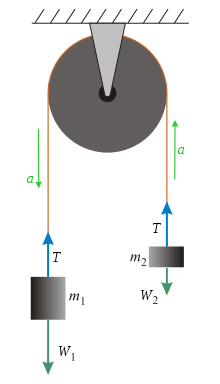
The free body diagrams of the two hanging masses of the Atwood machine. Our sign convention, depicted by the acceleration vectors is that m1 accelerates downward and that m2 accelerates upward, as would be the case if m1 > m2 Atwood.svg
The free body diagrams of the two hanging masses of the Atwood machine. Our sign convention, depicted by the acceleration vectors is that m1 accelerates downward and that m2 accelerates upward, as would be the case if m1 > m2

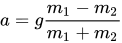
An equation for the acceleration can be derived by analyzing forces. Assuming a massless, inextensible string and an ideal massless pulley, the only forces to consider are: tension force (T), and the weight of the two masses (W1 and W2). To find an acceleration, consider the forces affecting each individual mass. Using Newton's second law (with a sign convention of ) derive a system of equations for the acceleration (a).

As a sign convention, assume that a is positive when downward for and upward for . Weight of and is simply and respectively.

Forces affecting m1: Forces affecting m2: and adding the two previous equations yields and the concluding formula for acceleration

The Atwood machine is sometimes used to illustrate the Lagrangian method of deriving equations of motion. [2]

See also

Notes

  1. Tipler, Paul A. (1991). Physics For Scientists and Engineers (3rd, extended ed.). New York: Worth Publishers. p.  161. ISBN   0-87901-432-6. Chapter 6, example 6-13
  2. Goldstein, Herbert (1980). Classical Mechanics (2nd ed.). New Delhi: Addison-Wesley/Narosa Indian Student Edition. pp. 26–27. ISBN   81-85015-53-8. Section 1-6, example 2
蚪侠镜像站群 蚪侠镜像站群 批量镜像网站 泛镜像站群 关键词转码站群