Astragalus neglectus is a perennial, herbaceous plant growing 30 to 90 cm tall.[2] The alternate, compound leaves have 11 to 25 leaflets.[3] The 10 to 20 white or creamy flowers form a cluster arising from the upper leaf axils.[3] The fruit is in the form of an inflated pod.[3]
Etymology
The first published description of the species (as Phaca neglecta) was in A Flora of North America by John Torrey and Asa Gray in 1838.[4] The species is called Cooper's milkvetch after a William Cooper who discovered the plant described by Gray in 1856 as Astragalus cooperi (which ultimately was considered to be the same entity as A. neglectus).[5]
Distribution and habitat
The range of Astragalus neglectus is centred around the Great Lakes,[3] but it also occurs from Manitoba and South Dakota east to Massachusetts and Virginia.[6] It is rare throughout most of its range.[3] It is found in wet to dry, open, often rocky habitats, especially those that are calcareous.[7] Natural disturbance is required to maintain these open habitats.[2]
Conservation
Although ranked globally as apparently secure (G4), this species is considered to be a rare and potentially vulnerable species within most of the states and provinces where it occurs.[1] It is classified as endangered in Wisconsin.[8] It was formerly considered to be at risk in Minnesota but was delisted after the discovery of numerous new populations in the 1990s.[3]
↑ Reznicek, A. A.; Voss, E. G.; Walters, B. S., eds. (February 2011). "Astragalusneglectus". Michigan Flora Online. University of Michigan Herbarium. Retrieved 11 February 2020.
↑ "Cooper's Milkvetch". Wisconsin's Endangered Resources. Wisconsin Department of Natural Resources. Retrieved 11 February 2020.
This page is based on this Wikipedia article Text is available under the CC BY-SA 4.0 license; additional terms may apply. Images, videos and audio are available under their respective licenses.

 seedpods
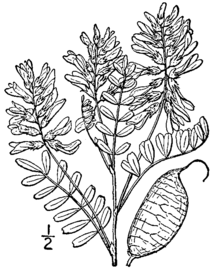 botanical illustration


