英文互译镜像站

Armstrong Whitworth F.K.3

Last updated

F.K.3
Armstrong-Whitworth FK3 captured.jpg
General information
TypeGeneral purpose / Trainer aircraft
Manufacturer Armstrong Whitworth Aircraft
Designer
Primary user Royal Flying Corps
Number builtc.500 [1]
History
Manufactured1915–1917
First flight1915
Developed from Royal Aircraft Factory BE.2
A British pilot, possibly 2nd Lt. A.C. Stopher from No. 47 Squadron RAF, Thessalonika with FK.3 Armstrong-Whitworth FK3.jpg
A British pilot, possibly 2nd Lt. A.C. Stopher from No. 47 Squadron RAF, Thessalonika with FK.3
Bulgarian Aviation Corps Officers and soldiers gathered around a captured FK.3 in 1917. Armstrong-Whitworth-bulgarian.jpg
Bulgarian Aviation Corps Officers and soldiers gathered around a captured FK.3 in 1917.
Armstrong Whitworth F.K.3 in 1915 Armstrong Whitworth F.K.3 5519.jpg
Armstrong Whitworth F.K.3 in 1915

The Armstrong Whitworth F.K.3 was a British two-seat general-purpose biplane built by Armstrong Whitworth Aircraft during the First World War. By the end of the war it was considered obsolete for combat.

Contents

History

The Dutch aircraft designer Frederick Koolhoven joined Armstrong Whitworth in 1914. He designed a series of aircraft that had his initials in their designation. The F.K.3 followed the basic layout of the Royal Aircraft Factory B.E.2c, which Armstrong Whitworth were building for the Royal Flying Corps. It was designed as an improvement, with a simplified structure that was easier to build. The prototype, first flown by Norman Spratt was powered by a 70 hp (52 kW) air-cooled Renault 70 hp V-8. [2] This aircraft differed from the B.E.2 in eliminating welded joints and complex metal components in the structure, and having greater dihedral on the upper wing. It retained the seating layout of the B.E.2, with separate cockpits for the pilot and observer, with the latter in front. An initial batch of seven aircraft to this standard, [3] sometimes referred to as the F.K.2 were built. [4] [5] [6]

This initial batch offered little improvement over the BE.2, and was rejected for service in France. [7] Aircraft following this initial batch were completed to a revised design, with a new fin and rudder, its leading edge straight and lacking the earlier comma shaped horn balance, and powered by the Renault-related but more powerful 90 hp (67 kW) RAF 1a engine. [2] Both crew were placed in a single, extended cockpit with the pilot forward, [2] allowing the observer a more effective field of fire, although in the event few F.K.3s were flown with armament. Trials at Upavon in May 1916 proved that the F.K.3 had a better performance in some respects than the B.E.2c, although it had a smaller useful load. Armstrong Whitworth were given a contract to build 150 aircraft with another 350 being built by Hewlett & Blondeau Limited at Luton. Some of the early batch had twin high exhaust pipes that exited above the upper wing in B.E.2 style, but these were later replaced with rams' horns forward stubs. [8]

At one time during production of the F.K.3 there was a shortage of the RAF engines, and twelve aircraft were fitted with longer and heavier 120 hp (90 kW) six-cylinder inline water cooled Beardmore 120 hp. To carry the extra weight, span was increased by 2 ft (610 mm), but though the extra power enhanced the climb rate, top speed was little changed and these machines were converted back to RAF engines when they became available. [2]

Operational Service

The F.K.3 was not adopted for use by operational squadrons of the RFC in France, as the more capable F.K.8 and R.E.8 were both already in prospect. Only one overseas unit received the F.K.3 (which was 47 Squadron at Salonika), all the other aircraft were based in the United Kingdom. Most of the aircraft were used for training until replaced by the Avro 504.

Military operators

Flag of Australia (converted).svg  Australia
Flag of Bulgaria.svg  Bulgaria
Flag of the United Kingdom.svg  United Kingdom

Specifications (F.K.3)

Data from The British Bomber since 1914 [4]

General characteristics

Performance

Armament

See also

Related development

Related Research Articles

<span class="mw-page-title-main">Royal Aircraft Factory B.E.2</span> 1912 military aircraft family by the Royal Aircraft Factory

The Royal Aircraft Factory B.E.2 is a British single-engine tractor two-seat biplane, designed and developed at the Royal Aircraft Factory. Most of the roughly 3,500 built were constructed under contract by private companies, including established aircraft manufacturers and firms new to aircraft construction.
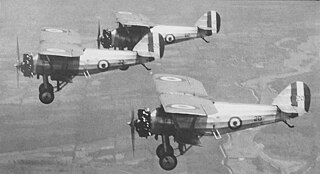
<span class="mw-page-title-main">Armstrong Whitworth Siskin</span>

The Armstrong Whitworth Siskin was a sesquiplane single-seat fighter aircraft developed and produced by the British aircraft manufacturer Armstrong Whitworth Aircraft. It was also the first all-metal fighter to be operated by the Royal Air Force (RAF), as well as being one of the first new fighters to enter service following the end of the First World War.

<span class="mw-page-title-main">Royal Aircraft Factory R.E.8</span> Royal Aircraft Factory First World War reconnaissance biplane

The Royal Aircraft Factory R.E.8 is a British two-seat biplane reconnaissance and bomber aircraft of the First World War that was designed and produced at the Royal Aircraft Factory. It was also built under contract by Austin Motors, Daimler, Standard Motors, Siddeley-Deasy and the Coventry Ordnance Works.
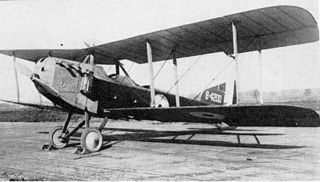
<span class="mw-page-title-main">Armstrong Whitworth F.K.8</span> 1916 utility aircraft by Armstrong Whitworth

The Armstrong Whitworth F.K.8 was a British two-seat general-purpose biplane built by Armstrong Whitworth during the First World War. The type served alongside the better known R.E.8 until the end of the war, at which point 694 F.K.8s remained on RAF charge.

<span class="mw-page-title-main">Westland Walrus</span>

The Westland Walrus was a British spotter/reconnaissance aircraft built by Westland Aircraft.
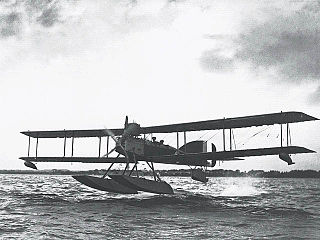
<span class="mw-page-title-main">Short Type 184</span>

The Short Admiralty Type 184, often called the Short 225 after the power rating of the engine first fitted, was a British two-seat reconnaissance, bombing and torpedo carrying folding-wing seaplane designed by Horace Short of Short Brothers. It was first flown in 1915 and remained in service until after the armistice in 1918. A Short 184 was the first aircraft to sink a ship using a torpedo, and another was the only British aircraft to take part in the Battle of Jutland.

<span class="mw-page-title-main">Airco DH.1</span>

The Airco DH.1 was an early military biplane of typical "Farman" pattern flown by Britain's Royal Flying Corps during World War I. By the time the powerplant for which it was designed was sufficiently plentiful it was obsolete as an operational aircraft, and apart from a few examples sent to the Middle East it served as a trainer and Home Defence fighter.

<span class="mw-page-title-main">Airco DH.6</span>

The Airco DH.6 was a British military trainer biplane used by the Royal Flying Corps during the First World War. Known by various nicknames, including the "Clutching hand" and "Skyhook", many survived to be used as a civil light aircraft in the postwar era.

<span class="mw-page-title-main">Royal Aircraft Factory B.E.12</span>

The Royal Aircraft Factory B.E.12 was a British single-seat aeroplane of The First World War designed at the Royal Aircraft Factory. It was essentially a single-seat version of the B.E.2.

<span class="mw-page-title-main">Armstrong Whitworth Atlas</span>

The Armstrong Whitworth Atlas was a British single-engine biplane designed and built by Armstrong Whitworth Aircraft. It served as an army co-operation aircraft for the Royal Air Force (RAF) in the 1920s and 1930s. It was the first purpose-designed aircraft of the army co-operation type to serve with the RAF.

<span class="mw-page-title-main">Armstrong Whitworth F.K.10</span> British WWI quadruplane fighter aircraft

The Armstrong Whitworth F.K.10 was a British two-seat quadruplane fighter aircraft built by Armstrong Whitworth during the First World War. While it was ordered in small numbers for the Royal Flying Corps and Royal Naval Air Service, it was not used operationally. It is one of the few quadruplane aircraft to reach production.

<span class="mw-page-title-main">Bristol M.1</span>

The Bristol M.1 Monoplane Scout was a British monoplane fighter of the First World War. It holds the distinction of being the only British monoplane fighter to reach production during the conflict.

<span class="mw-page-title-main">Flanders F.4</span> Type of aircraft

The Flanders F.4 was a 1910s British experimental military two-seat monoplane aircraft that was designed and built by Howard Flanders as a development of the Flanders F.3.
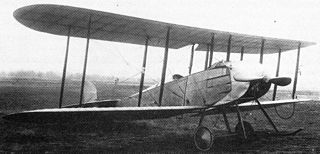
<span class="mw-page-title-main">Royal Aircraft Factory B.E.8</span> Type of aircraft

The Royal Aircraft Factory B.E.8 was a British two-seat single-engined general purpose biplane of the First World War, designed by John Kenworthy at the Royal Aircraft Factory in 1913. Small numbers were used by the Royal Flying Corps over the Western Front in the first year of the war, with the type being used as a trainer until 1916.

<span class="mw-page-title-main">Nieuport Nighthawk</span> Type of aircraft

The Nieuport Nighthawk was a British fighter aircraft developed by the Nieuport & General Aircraft company for the Royal Air Force towards the end of the First World War. Although ordered into production before the aircraft first flew, it did not enter large scale service with the RAF owing to unreliable engines. Re-engined aircraft did see service in Greece, serving from 1923 to 1938.

<span class="mw-page-title-main">Royal Aircraft Factory R.E.5</span> Type of aircraft

The Royal Aircraft Factory R.E.5 was a British two-seat reconnaissance and artillery observation biplane designed and built by the Royal Aircraft Factory for the Royal Flying Corps.

<span class="mw-page-title-main">BAT Basilisk</span> Type of aircraft

The BAT F.K.25 Basilisk was a prototype British fighter aircraft of the First World War. A single engined biplane intended to meet a requirement to replace the Sopwith Snipe, the Basilisk was unsuccessful, only three being built.

The Armstrong Whitworth Sissit, also known as the Armstrong Whitworth F.K.1, was a prototype single-engined biplane fighter aircraft of the First World War. The first aircraft designed by Armstrong Whitworth, the Sissit was underpowered and only a single example was built.

The Armstrong Whitworth F.K.5 and F.K.6 were experimental triplanes built as escort fighters by Armstrong Whitworth during the First World War. They carried two gunners in nacelles mounted on the centre wing. One example of each type was built, with no further development or production following.

<span class="mw-page-title-main">Sopwith Three-seater</span> Type of aircraft

The Sopwith Three-seater was a British aircraft designed and built prior to the start of the First World War. One of the first aircraft built by the Sopwith Aviation Company, it was operated by both the Royal Naval Air Service (RNAS) and the Royal Flying Corps (RFC), being used briefly over Belgium by the RNAS following the start of the War.

References

Notes

  1. Tapper 1973, p. 367
  2. 1 2 3 4 Tapper 1973 , pp. 52–8
  3. According to Tapper, only the prototype had the Renault engine
  4. 1 2 Mason 1994, p. 41
  5. Bruce 1982 , pp. 90–93
  6. Koolhoven site
  7. Bruce 1982 , pp. 92–93
  8. "Collection of F.K.3 images. One of these (image 4817) shows aircraft no. 5334, the last of the initial batch with a handwritten note saying Renault engine". Archived from the original on 22 February 2012. Retrieved 17 September 2009.
  9. Bruce 1998 , pp. 6, 10
  10. 1 2 Bruce 1957, p. 14

Bibliography

  • Bruce, J. M. (1982). The Aeroplanes of the Royal Flying Corps (Military Wing). London: Putnam. ISBN   0-370-30084-X.
  • Bruce, J. M. (1998). AW FK.3 (Little Ack) – Windsock Mini Datafile 13. Hertfordshire, UK: Albatros Productions. ISBN   1-902207-08-4.
  • Bruce, J. M. (1957). British Aeroplanes 1914-18. London: Putnam.
  • Mason, Francis K. (1994). The British Bomber since 1914. London: Putnam Aeronautical Books. ISBN   0-85177-861-5.
  • Tapper, Oliver (1973). Armstrong Whitworth Aircraft since 1913. London: Putnam Publishing. ISBN   0-370-10004-2.
一键镜像站群 关键词转码站群 蚪侠镜像站群 站点核心词加权 镜像精灵