英文互译镜像站

Architecture of Tirumala Venkateswara Temple

Last updated

Venkateswara Temple is a Vaishnavite temple situated in the town of Tirumala in Tirupati of Andhra Pradesh, India. The Temple is dedicated to Venkateswara, an incarnation of Vishnu, who is believed to have appeared here to save mankind from the trials and troubles of Kali Yuga. The temple is situated at a height of 853 m (2,799 ft) on Tirumala Hills which are part of the Seshachalam Hills and is constructed in Dravidian architectural style.

Contents

Gopurams

Gopurams refer to the tower-like structures sitting on top of temple entrances. They are a recognisable characteristic of Dravidian temple architecture. The Venkateshwara Temple has 3 entrances that have gopurams.

Mahadvaram

Maha Dwaram of Sri Venkateswara Temple with Five storied Gopuram over it encircled by Mahaprakaram Tirumala Venkateswara temple entrance 09062015.JPG
Maha Dwaram of Sri Venkateswara Temple with Five storied Gopuram over it encircled by Mahaprakaram

The Maha Dwaram is the main entrance to the temple and is also known as 'Padikavali', 'Simhadvaram,' [1] or 'Outer Gopuram'. [2] It provides access from outside the temple to the Sampangi Pradakshinam, and is separated from it by an outer compound wall (Maha Prakaram). The tower stands at the height of 50 ft (15 m). [1] On either side of the entrance stand two panchaloha (metal) statues of Sankanidhi and Padmanidhi, who are traditionally regarded as the guardians of the Navanidhi, the nine treasures of Venkateswara. [1]

Venḍi Vākili

Venḍi Vākili, which means "silver entrance" in Telugu, is the second entrance of the temple. It leads to the VimanaPradakshinam and is also known as 'Nadimipadikavali'. [3] The name of this entrance comes from the silver plating on the doors. An inner compound wall separates the Sampangi Pradakshinam and Vimana Pradakshinam. A three storied gopuram was built over this entrance with seven kalisams during the twelfth and thirteenth centuries.

Baṁgāru Vākili

From the Tirumamani Mandapam in front, one can enter the Baṁgāru Vākili (translates to Golden Entrance) to reach the inner sanctum sanctorum. There are two tall copper images of the dwarapalakas Jaya and Vijaya on either side of the door. The thick wooden door is covered with gilt plates depicting the dasavataram of Sri Maha Vishnu. The doorway is directly in line with the Padi Kavali and the Vendi Vakili (Meaning Silver Corridor in Telugu). It admits pilgrims to the Snapana Mandapam. Suprabhatam is sung in front of this door. [4]

Pradakshinas

The temple is surrounded by 3 concentric compound walls (or prakaram). Pradakshinas refer to the spaces enclosed between them. They are the circumambulation walkways that lay in between them. Circumambulations are a holy ritual act in Hinduism. Multiple mandapas are also standing in these spaces.

SampangiPradakshina

The Sampangi Pradakshina is the primary circumambulation walkway within the temple complex. It is named after Magnolia champaca flowers, called Sampangi in Telugu, which were grown in the area. [1] [5] The mandapas situated in the Pradakshina are:

Additionally, various ugrams (storerooms) are located across the corridor. [5]

VimanaPradakshina

The Venḍi Vākili leads to the VimanaPradakshina. [1] It is the pathway that circumambulates the Sanctum Sanctorum. The AngapradakshinaSeva is performed in this area; hence, this path is also referred to as the AngapradakshinaMargam.

Just after entering the VimanaPradakshinam, opposite Vendivakili and behind the GarudaMandapam, there are small idols of Sri Varadaraja Swamy, Sri Ranganatha Swamy (in a sleeping posture over Adisesha), and Sri Venkateswara Swamy, plated in gold.

The Vimana Pradakshinam also includes small shrines: the Varadaraja Swamy Temple, located to the right of Vendivakili and facing west, and the Yoga Narasimha Swamy Temple, located to the left of Vendivakili, also facing west.

Other rooms along the path include:

Devotees also have darshan of Vimana Venkateswara Swamy, who resides on Ananda Nilayam, from the Sampangi Pradakshinam.

All the small temples along this pathway are collectively known as ‘Chuttu Gullu’—the sub-shrines that encircle the main shrine.

MukkotiPradakshina

This is the pathway that encircles, and is a part of, the main shrine. This pradakshina is open only one day a year on Vaikunta Ekadashi. The pradakshina is open only at the north, south and western portions. This is a pillared verandah in three sections — a six-pillared southern section, a four-pillared western section and a fourteen-pillared northern section. All the pillars are round and have Chola capitols with the broad faces fluted and with a circle in the centre.

There is a shrine of Vishvaksena (Senai Mudaliyar) on the northern side. The walls on the northern side have some sculptures and ornamental niches.

Main Shrine

TirumamaniMandapam

The first mandapam of the main shrine. It is an open 16-pillared hall whose left and right walls are in three sections, the central section being wider than the other two. At the south-west corner are located two huge bells of the temple which are inscribed, and which give the name Tirumamani to the mandapa. It is here that Koluvu Srinivasa holds daily audience after TomalaSeva (offering of garlands and tulsi leaves to the deity), and Malayappa Swami is seated here on the afternoon of the Brahmotsavam's commencement. It was built by Mallanna alias Madhavadasa, a chief of Chandragiri near Tirupati, in 1417 A.D. [6] [5] [7]

At the back of the mandapa, right of the entrance is a shrine for Garuda, directly facing the Bamgaru Vakili. Supposedly built at around 1417 after the construction of tirumamani mandapam, it houses a 150m tall standing statue of Garuda. [5]

SnapanaMandapam

Also called tiruvilankovil, it is the mandapa encountered right after passing the Bangaru Vakili. It has four central pillars with bas reliefs carved in the Vijayanagar style. The front part of the mandapa was converted into two rooms, one on either side. [6]

RamarMedai

It seems to have originally been a part of the mukkoti pradakshina before the passage was closed at about 1262-1265 A.D. and the Ramar Medai was converted into a closed room. Here, two small platform are situated, upon which bronze statues of Hanuman, Angada, Sugriva and others, dated at around the early Chola period, are placed.

SayanaMandapam

Also called the antarala mandapam or the ardha mandapam. It is the last mandapa, after which the next room is the garbhagriha. During the Ekantaseva at night, the Lord's Bhoga Srinivasa idol is put to sleep in this mandapa on an installed swing with a bed.

Garbhagriha

The Garbhagriha or sanctum sanctorum, which used to be called the 'Koyil Alwar' in old times, is where the Mula Beram (Main Idol) of Lord Venkateswara is placed. This 8-ft idol is believed to be self-manifested. Tradition holds that no known sculptors were capable of producing such an idol, and no person was known to have installed the idol in the temple. [8]

The stone step between the sayanamandapa and the garbhagriha is called the kulasekharapadi in honor of Kulasekhara Alvar, who is said to have wished to be reborn as the threshold of the Lord's shrine. Devotees are not allowed to step on this or enter the Garbhagriha of the Lord beyond it.

The garbhagriha is almost a square shaped structure 12 ft2 in area. Its walls as well as the Sayana mandapa's walls are double walls built one behind another. The walls of the garbhagriha as they exist at present are made of cut stones and may belong to the 8th or 9th century A.D. The temple type consisting of a garbhagriha with a mukhamandapa and pradakshina got established in South India by about 8th century A.D. [6] The outer face of the outer wall has some inscriptions dating from 966–1013 A.D.

Ananda Nilayam

The Ananda Nilayam is a gold-plated three-storey vimanam (a structure constructed over the garbhagriha), under which the deity stands directly beneath. According to the temple's inscriptions, the gold plating was installed during renovations of the temple in c.13th century C.E., and a gold-plated kalasha was installed on the vimana by Pandya king Jatavarman Sundara I in c. 1262. [6] It was later renovated in the 1950s and 60s.

Pushkarni

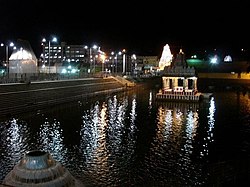
Swami Pushkarni during night with Mandapam at its centre and Venkateswara Temple in the background SwamiPushkarni.JPG
Swami Pushkarni during night with Mandapam at its centre and Venkateswara Temple in the background

Swami Pushkarni is the temple pond located on the northern side of the main temple. The pond is spread over 1.5 acres, and is considered sacred as it is believed to have been brought by Garuda from Vaikuntham to Tirumala Hills. The tank had a mandapam at its centre, which was constructed by Saluva King Narasimha Raya in 1468. A harathi is given to the Pushkarni daily in the evening by temple priests. Every year the Sri Venkateswara Annual Theppotsavam (Float festival) is conducted in this pond, where the processional deities of the temple are taken to float over the water. Chakrasnanam, a celestial bath to Chakrathalwar, Malayappa and his concerts, is conducted at this pond during the last day of Srivari Brahmotsavams. [9]

Akhilandam

Akhilandam, also known as Akhandam, is the area in front of main temple where huge lamps are installed. Devotees will offer karpuram (camphor) and coconuts to Venkateswara at this place after darshan. From the Akhilandam one can have a complete view of the temple. It has huge lamps, two iron rails to break coconuts and two huge coconut hundis where devotees can offer the coconuts. [10]

See also

References

  1. 1 2 3 4 5 "Tirumala Tirupati Devasthanams-Temple History". Tirumala Tirupati Devasthanams. Archived from the original on 21 July 2015. Retrieved 29 July 2015.
  2. "Dwarams of Srivari Temple as Tirumala" . Retrieved 18 August 2024.
  3. "Tirumala Tirupati Devasthanams (Official Website)". www.tirumala.org. Archived from the original on 29 November 2024. Retrieved 31 January 2025.
  4. "Bangaru Vakili". Tirumala.org. 15 June 2010. Archived from the original on 5 July 2013. Retrieved 17 June 2013.
  5. 1 2 3 4 5 6 7 Nair, Shantha (7 January 2014). Sri Venkateshwara. Jaico Publishing House. ISBN   978-81-8495-445-6.
  6. 1 2 3 4 5 6 7 8 9 10 11 Ramesan, N. (1981). The Tirumala Temple. Tirupati: Tirumala Tirupati Devasthanams.
  7. Kameswara Rao, V. (1986). Temples in and Around Tirupati.
  8. "Garba Gruha". Tirumala Tirupati Devasthanams. Archived from the original on 24 December 2012. Retrieved 10 February 2013.
  9. "SRIVARI PUSHKARNI HARATHI". Tirumala Tirupati Devasthanams. Retrieved 25 January 2016.
  10. "AKHILANDAM-THE UNENDING "DIVYA JYOTHI"". Tirumala Tirupati Devasthanams. Retrieved 25 January 2016.
泛目录+镜像 MirrorElf 超级站群助手 网站镜像克隆 站点核心词加权