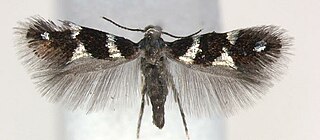
The Heliozelidae, commonly known as shield-bearer moths, are a family of small, day flying monotrysian moths distributed worldwide. The larvae of most heliozelid species are leaf miners who cut distinctive shield-shaped cases from the surface of the host leaf, hence the common name. Some species are considered pests of commercial crops such as grapevines, cranberries, and walnuts. The taxonomy of this family is poorly understood.

Antispila isabella is a species of moth of the family Heliozelidae. It is found in Ontario, Connecticut, Georgia, Kentucky, New York, Pennsylvania and Vermont. However, research concludes that a complex of species is involved under this name.

Holocacista rivillei is a species of moth of the family Heliozelidae. It is found in southern Europe and western and Central Asia. Records include Spain, France, Italy, Malta, Slovenia, Croatia, Bulgaria, Greece, Sicily, Turkey, south-eastern Russia, Georgia, Kazakhstan, Uzbekistan and Turkmenistan.

Antispila argostoma is a moth of the family Heliozelidae. It was described by Edward Meyrick in 1916. It is found in India.
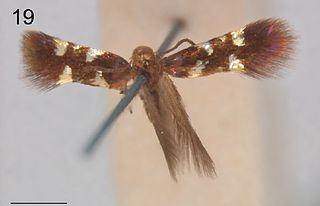
Antispila aristarcha is a moth of the family Heliozelidae. It was described by Edward Meyrick in 1916. It is found in India.
Antispila cleyerella is a moth of the family Heliozelidae that is endemic to Japan.
Antispila inouei is a moth of the family Heliozelidae. It was described by Kuroko in 1987. It is found in Japan.
Antispila isorrhythma is a moth of the family Heliozelidae. It was described by Edward Meyrick in 1926. It is found in India.

Holocacista micrarcha is a moth of the family Heliozelidae. It was described by Edward Meyrick in 1926. It is found in India.
Holocacista pariodelta is a moth of the family Heliozelidae. It was described by Edward Meyrick in 1929. It is found in India.

Holocacista salutans is a moth of the family Heliozelidae. It was described by Edward Meyrick in 1921. It is found in Zimbabwe and the South African provinces of KwaZulu-Natal and Limpopo.

Holocacista selastis is a moth of the family Heliozelidae. It was described by Edward Meyrick in 1926. It is found in India.
Antispila tateshinensis is a moth of the family Heliozelidae. It was described by Kuroko in 1987. It is found in Japan.

Antispila uenoi is a moth of the family Heliozelidae. It was described by Kuroko in 1987. It is found in Japan. In 2018, the species was found from China.

Holocacista is a genus of moths of the family Heliozelidae. It was described by Walsingham and Durrant in 1909.

Aspilanta ampelopsifoliella is a species of moth in the family Heliozelidae. It is found in eastern North America. The larvae are leaf miners that feed on Virginia creeper and false Virginia creeper.
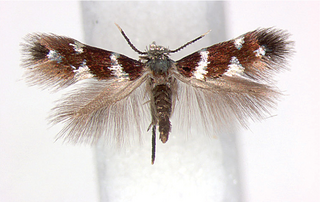
Aspilanta hydrangaeella is a species of moth in the family Heliozelidae. It is found in the United States. The larvae are leaf miners that feed on hydrangea plants.
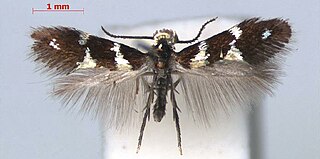
Aspilanta oinophylla is a species of moth in the family Heliozelidae. It is native to North America and is an introduced species in Italy. The larvae are leaf miners that feed on several species of Vitaceae, including commercially important species of grapevine.

Aspilanta viticordifoliella is a species of moth in the family Heliozelidae. It is found in eastern North America. The larvae are leaf miners that feed on Virginia creeper, false Virginia creeper, and frost grape.

Aspilanta voraginella is a species of moth in the family Heliozelidae, first described by Annette Frances Braun in 1927. It is found in the United States. The larvae are leaf miners that feed on Vitis arizonica.


