Related Research Articles

A rotary dial is a component of a telephone or a telephone switchboard that implements a signaling technology in telecommunications known as pulse dialing. It is used when initiating a telephone call to transmit the destination telephone number to a telephone exchange.

A telephone is a telecommunications device that permits two or more users to conduct a conversation when they are too far apart to be easily heard directly. A telephone converts sound, typically and most efficiently the human voice, into electronic signals that are transmitted via cables and other communication channels to another telephone which reproduces the sound to the receiving user. The term is derived from Greek: τῆλε and φωνή, together meaning distant voice. A common short form of the term is phone, which came into use early in the telephone's history.

A hybrid transformer is a type of directional coupler which is designed to be configured as a circuit having four ports that are conjugate in pairs, implemented using one or more transformers. It is a particular case of the more general concept of a hybrid coupler.

A microphone, colloquially called a mic, is a transducer that converts sound into an electrical signal. Microphones are used in many applications such as telephones, hearing aids, public address systems for concert halls and public events, motion picture production, live and recorded audio engineering, sound recording, two-way radios, megaphones, and radio and television broadcasting. They are also used in computers for recording voice, speech recognition, VoIP, and for other purposes such as ultrasonic sensors or knock sensors.

Elisha Gray was an American electrical engineer who co-founded the Western Electric Manufacturing Company. Gray is best known for his development of a telephone prototype in 1876 in Highland Park, Illinois. Some recent authors have argued that Gray should be considered the true inventor of the telephone because Alexander Graham Bell allegedly stole the idea of the liquid transmitter from him. Although Gray had been using liquid transmitters in his telephone experiments for more than two years previously, Bell's telephone patent was upheld in numerous court decisions.
This timeline of the telephone covers landline, radio, and cellular telephony technologies and provides many important dates in the history of the telephone.

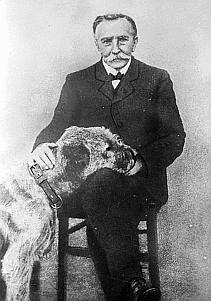
David Edward Hughes, was a British-American inventor, practical experimenter, and professor of music known for his work on the printing telegraph and the microphone. He is generally considered to have been born in London but his family moved around that time so he may have been born in Corwen, Wales. His family moved to the U.S. while he was a child and he became a professor of music in Kentucky. In 1855 he patented a printing telegraph. He moved back to London in 1857 and further pursued experimentation and invention, coming up with an improved carbon microphone in 1878. In 1879 he identified what seemed to be a new phenomenon during his experiments: sparking in one device could be heard in a separate portable microphone apparatus he had set up. It was most probably radio transmissions but this was nine years before electromagnetic radiation was a proven concept and Hughes was convinced by others that his discovery was simply electromagnetic induction.

The Western Electric model 500 telephone series was the standard domestic desk telephone set issued by the Bell System in North America from 1950 through the 1984 Bell System divestiture. Millions of model 500-series phones were produced and were present in most homes in North America. Many are still in use today because of their durability and ample availability. Its modular construction compared to previous types simplified manufacture and repair, and facilitated a large number of variants with added features.

A handset is a component of a telephone that a user holds to the ear and mouth to receive audio through the receiver and speak to the remote party using the built-in transmitter. In earlier telephones, the transmitter was mounted directly on the telephone itself, which was attached to a wall at a convenient height or placed on a desk or table. Until the advent of the cordless telephone, the handset was usually wired to the base unit, typically by a flexible tinsel wire cord.
A duplex communication system is a point-to-point system composed of two or more connected parties or devices that can communicate with one another in both directions. Duplex systems are employed in many communications networks, either to allow for simultaneous communication in both directions between two connected parties or to provide a reverse path for the monitoring and remote adjustment of equipment in the field. There are two types of duplex communication systems: full-duplex (FDX) and half-duplex (HDX).

The invention of the telephone was the culmination of work done by more than one individual, and led to an array of lawsuits relating to the patent claims of several individuals and numerous companies.

Design Line, also known as Deco-Tel, is a brand name that AT&T has used for several of its specialty telephone designs to fulfill the demand by customers for more variety in telephone models.

The Princess telephone was introduced by the Bell System in 1959. It was a compact telephone designed for convenient use in the bedroom, and contained a light-up dial for use as a night-light. It was commonly advertised with the slogan "It's little...It's lovely...It lights", which was suggested by Robert Karl Lethin, an AT&T employee.

The arc converter, sometimes called the arc transmitter, or Poulsen arc after Danish engineer Valdemar Poulsen who invented it in 1903, was a variety of spark transmitter used in early wireless telegraphy. The arc converter used an electric arc to convert direct current electricity into radio frequency alternating current. It was used as a radio transmitter from 1903 until the 1920s when it was replaced by vacuum tube transmitters. One of the first transmitters that could generate continuous sinusoidal waves, it was one of the first technologies used to transmit sound by radio. It is on the list of IEEE Milestones as a historic achievement in electrical engineering.

The carbon microphone, also known as carbon button microphone, button microphone, or carbon transmitter, is a type of microphone, a transducer that converts sound to an electrical audio signal. It consists of two metal plates separated by granules of carbon. One plate is very thin and faces toward the speaking person, acting as a diaphragm. Sound waves striking the diaphragm cause it to vibrate, exerting a varying pressure on the granules, which in turn changes the electrical resistance between the plates. Higher pressure lowers the resistance as the granules are pushed closer together. A steady direct current is passed between the plates through the granules. The varying resistance results in a modulation of the current, creating a varying electric current that reproduces the varying pressure of the sound wave. In telephony, this undulating current is directly passed through the telephone wires to the central office. In public address systems it is amplified by an audio amplifier. The frequency response of most carbon microphones, however, is limited to a narrow range, and the device produces significant electrical noise.

An acoustic-electric guitar is an acoustic guitar fitted with a microphone or a magnetic or piezoelectric pickup. They are used in a variety of music genres where the sound of an acoustic guitar is desired but more volume is required, especially during live performances. The design is distinct from a semi-acoustic guitar, which is an electric guitar with the addition of sound chambers within the guitar body.

This history of the telephone chronicles the development of the electrical telephone, and includes a brief overview of its predecessors. The first telephone patent was granted to Alexander Graham Bell in 1869.

Mobile radio or mobiles refer to wireless communications systems and devices which are based on radio frequencies, and where the path of communications is movable on either end. There are a variety of views about what constitutes mobile equipment. For US licensing purposes, mobiles may include hand-carried,, equipment. An obsolete term is radiophone.
The General Post Office (GPO) of the United Kingdom carried the sole responsibility for providing telecommunication services across the country with the exception of Hull. The GPO issued a range of telephone instruments to telephone service subscribers that were matched in function and performance to its telephone exchanges.

Francis Blake Jr. was an American inventor.
References
- Lewis Coe, The Telephone and its Several Inventors, McFarland Publishers, 1995.
- ↑ Coe, pages 37, 78
 | This article about an American inventor is a stub. You can help Wikipedia by expanding it. |