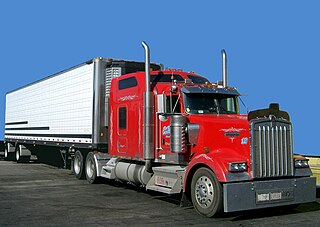
A commercial driver's license (CDL) is a driver's license required in the United States to operate large and heavy vehicles or a vehicle of any size that transports hazardous materials or more than 15 passengers.

A truck driver is a person who earns a living as the driver of a truck,which is commonly defined as a large goods vehicle (LGV) or heavy goods vehicle (HGV).

Freight companies are companies that specialize in the moving of freight,or cargo,from one place to another. These companies are divided into several variant sections. For example,international freight forwarders ship goods internationally from country to country,and domestic freight forwarders,ship goods within a single country.
A moving scam is a scam by a moving company in which the company provides an estimate,loads the goods,then states a much higher price to deliver the goods,effectively holding the goods as lien.
The Federal Motor Carrier Safety Administration (FMCSA) is an agency in the United States Department of Transportation that regulates the trucking industry in the United States. The primary mission of the FMCSA is to reduce crashes,injuries,and fatalities involving large trucks and buses.

In the United States,driver's licenses are issued by each individual state,territory,and the District of Columbia rather than by the federal government due to federalism. Drivers are normally required to obtain a license from their state of residence. All states of the United States and provinces and territories of Canada recognize each other's licenses for non-resident age requirements. There are also licenses for motorcycle use. Generally,a minimum age of 15 is required to apply for a non-commercial driver license,and 25 for commercial licenses which drivers must have to operate vehicles that are too heavy for a non-commercial licensed driver or vehicles with at least 16 passengers or containing hazardous materials that require placards. A state may also suspend an individual's driving privilege within its borders for traffic violations. Many states share a common system of license classes,with some exceptions,e.g. commercial license classes are standardized by federal regulation at 49 CFR 383. Many driving permits and ID cards display small digits next to each data field. This is required by the American Association of Motor Vehicle Administrators' design standard and has been adopted by many US states. The AAMVA provides a standard for the design of driving permits and identification cards issued by its member jurisdictions,which include all 50 US states,the District of Columbia,and Canadian territories and provinces. The newest card design standard released is the 2020 AAMVA DL/ID Card Design Standard (CDS). The AAMVA standard generally follows part 1 and part 2 of ISO/IEC 18013-1. The ISO standard in turn specifies requirements for a card that is aligned with the UN Conventions on Road Traffic,namely the Geneva Convention on Road Traffic and the Vienna Convention on Road Traffic.

Hours of service (HOS) regulations are issued by the Federal Motor Carrier Safety Administration (FMCSA) and govern the working hours of anyone operating a commercial motor vehicle (CMV) in the United States. These regulations apply to truck drivers,commercial and intercity bus drivers,and school bus drivers who operate CMVs. These rules limit the number of daily and weekly hours spent driving and working,and regulate the minimum amount of time drivers must spend resting between driving shifts. For intrastate commerce,the respective state's regulations apply.

The Federal Bridge Gross Weight Formula,also known as Bridge Formula B or the Federal Bridge Formula,is a mathematical formula in use in the United States by truck drivers and Department of Transportation (DOT) officials to determine the appropriate maximum gross weight for a commercial motor vehicle (CMV) based on axle number and spacing. The formula is part of federal weight and size regulations regarding interstate commercial traffic. The formula is necessary to prevent heavy vehicles from damaging roads and bridges. CMVs are most often tractor-trailers or buses,but the formula is of most interest to truck drivers due to the heavy loads their vehicles often carry.
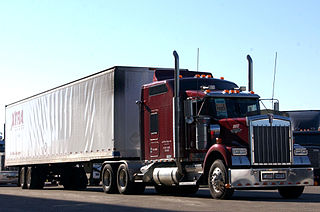
The trucking industry serves the American economy by transporting large quantities of raw materials,works in process,and finished goods over land—typically from manufacturing plants to retail distribution centers. Trucks are also used in the construction industry,two of which require dump trucks and portable concrete mixers to move the large amounts of rocks,dirt,concrete,and other building materials used in construction. Trucks in America are responsible for the majority of freight movement over land and are tools in the manufacturing,transportation,and warehousing industries.
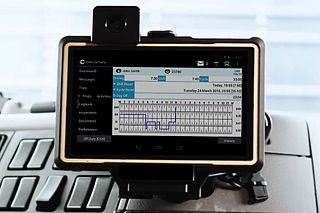
An electronic on-board recorder (EOBR) is an electronic device attached to a commercial motor vehicle,which is used to record the amount of time a vehicle is being driven. This is similar to the tachograph,and is the American equivalent of the digital tachograph used in Europe. Trucks in the European Union are required to have digital tachographs installed,and are securely monitored by government agencies. However,in Europe,the new digital tachograph which is considered secure,can be tricked with a round magnet placed by drivers over the connection to the transmission box. Usually they tie a rope to that magnet,and with a simple pull,the magnet will disengage and will show that the driver started moving about half an hour ago . The majority of carriers and drivers in the United States currently use paper-based log books. On January 31,2011,the U.S. Federal Motor Carrier Safety Administration (FMCSA) proposed a rule requiring Electronic On-Board Recorders for interstate commercial truck and bus companies. The proposed rule covers interstate carriers that currently use log books to record driver's hours of service. The proposal would affect more than 500,000 carriers in the United States and carriers that currently use time cards would be exempt.
The motor carrier safety rating is an evaluation given to an interstate commercial motor carrier by the Federal Motor Carrier Safety Administration (FMCSA).
The American Trucking Associations (ATA),founded in 1933,is the largest national trade association for the trucking industry. ATA represents more than 37,000 members covering every type of motor carrier in the United States through a federation of other trucking groups,industry-related conferences,and its 50 affiliated state trucking associations. Former Governor of Kansas Bill Graves was replaced by Chris Spear as the ATA's president and CEO in July 2016.
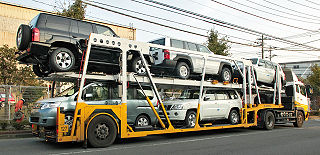
An auto transport broker is a type of cargo broker that specializes in the shipping and transportation of vehicles. Most vehicles shipped in the U.S. are cars and trucks,but many brokers handle boats,RVs,motorcycles and other types of vehicles as well. Auto transport is classified as "specialized freight trucking" under NAICS code 484230.

People who are driving as part of their work duties are an important road user category. First,workers themselves are at risk of road traffic injury. Contributing factors include fatigue and long work hours,delivery pressures,distractions from mobile phones and other devices,lack of training to operate the assigned vehicle,vehicle defects,use of prescription and non-prescription medications,medical conditions,and poor journey planning. Death,disability,or injury of a family wage earner due to road traffic injury,in addition to causing emotional pain and suffering,creates economic hardship for the injured worker and family members that may persist well beyond the event itself.

Public Law 113-45 is a U.S. federal law that requires that the Federal Motor Carrier Safety Administration go through the standard rulemaking proceeding,allowing comment from the public and the trucking industry,before it sets any requirements for truck drivers related to sleep apnea. It was introduced in the United States House of Representatives during the 113th United States Congress and was signed into law by President Barack Obama in October 2013.
The Home Heating Emergency Assistance Through Transportation Act of 2014 or HHEATT Act of 2014 is an act that created an emergency exception to existing Federal Motor Carrier Safety Administration (FMCSA) regulations. The exceptions allow truckers to drive for long hours if they are delivering home heating fuels,such as propane,to places where there is a shortage. The exemption lasts until May 31,2014. An existing suspension was scheduled to expire on March 15,2014.
The Reliable Home Heating Act is a U.S. public law that loosens some transportation regulations in order to try to deal with a home heating fuel shortage in some states. The law requires the Federal Motor Carrier Safety Administration (FMCSA) to exempt motor carriers that transport home heating oil from certain federal regulations if the Governor of a state declares a state of emergency caused by a shortage of residential heating fuel. It would also require the Energy Information Administration (EIA) to notify states if certain petroleum reserves fall below historical averages.
A freight broker bond must be obtained by freight brokers and freight forwarders in the United States in order to obtain or renew their license.
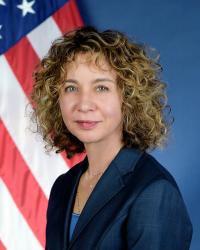
Meera Joshi is an American attorney and government official who has been serving as deputy mayor for operations for New York City since January 2022. She previously served as the deputy and acting administrator of the Federal Motor Carrier Safety Administration and New York City Taxi and Limousine Commissioner.
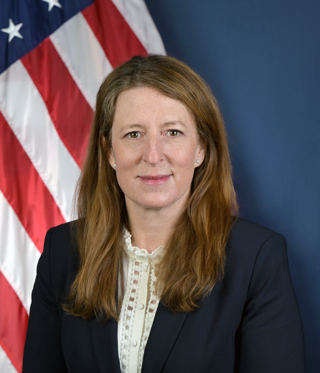
Robin Meredith Cohn Hutcheson is an American transportation official who served as administrator of the Federal Motor Carrier Safety Administration.
