Related Research Articles

The Congolese Party of Labour is the ruling party of the Republic of the Congo. Founded in 1969 by Marien Ngouabi, it was originally a pro-Soviet, Marxist–Leninist vanguard party which founded the People's Republic of the Congo, but moved towards a moderate left-wing stance in the early 1990s after the fall of the Soviet Union. The party later adopted social democracy as its ideological basis during its Fixth Extraordinary Congress in 2006. Denis Sassou Nguesso is President of the PCT Central Committee, and Pierre Ngolo is the PCT's Secretary-General.

Isidore Mvouba is a Congolese politician who was Prime Minister of Congo-Brazzaville from 2005 to 2009. He is a member of the Congolese Labour Party and held key positions under President Denis Sassou Nguesso beginning in 1997.
Gabriel Oba-Apounou is a Congolese politician. During the single-party rule of the Congolese Labour Party (PCT), he was First Secretary of the Congolese Socialist Youth Union; he also served in the government of Congo-Brazzaville as Minister of Youth from 1979 to 1985, Minister of Agriculture from 1985 to 1989, and as Minister of State for Youth and Rural Development from 1989 to 1991. Later, he was First Vice-President of the National Assembly from 2002 to 2007, and he has been a member of the Senate since 2008.
François Ibovi is a Congolese politician who held a succession of key posts in the government of Congo-Brazzaville beginning in 1997. Closely associated with President Denis Sassou Nguesso, he was Minister of Communication from 1997 to 2002, Minister of Territorial Administration from 2002 to 2007, First Vice-President of the National Assembly from 2007 to 2012, and Minister of Health from 2012 to 2016.
Pierre-Damien Boussoukou-Boumba is a Congolese politician. During the single-party rule of the Congolese Labour Party (PCT), he served in the government of Congo-Brazzaville as Minister of Health from 1979 to 1984, as Minister of Scientific Research from 1984 to 1989, and as Minister of Basic Education from 1989 to 1991. He was Ambassador to the United States in the 1990s and Minister of Small and Medium-Sized Enterprises from 1997 to 2002; subsequently he was a Deputy in the National Assembly of Congo-Brazzaville from 2002 to 2007. Boussoukou-Boumba was also President of the Union for the Defence of Democracy (UDD), a political party, from 1996 to 2011.
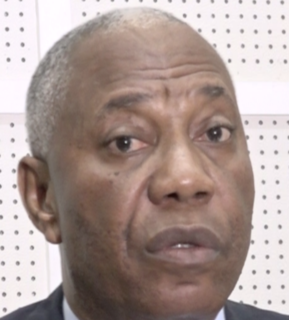
Firmin Ayessa is a Congolese politician who has served in the government of Congo-Brazzaville as Deputy Prime Minister for Civil Service, State Reform, Labour, and Social Security since 2017. As a long-time associate of President Denis Sassou Nguesso, Ayessa has held a series of key posts at the Presidency of Congo-Brazzaville; he was Director of the Civil Cabinet of the President from 1999 to 2002, Deputy Director of the Presidential Cabinet from 2002 to 2007, and he was Director of the Presidential Cabinet from 2007 to 2017.
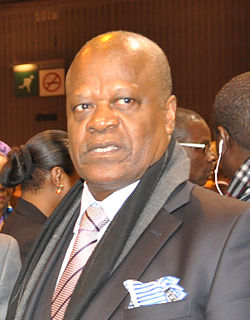
Henri Djombo is a Congolese politician who has served in the government of Congo-Brazzaville as Minister of State for Agriculture since 2016. Previously he was Minister of Water and Forests from 1980 to 1985 and Minister of the Forest Economy from 1997 to 2016. He is a member of the ruling Congolese Labour Party (PCT).

André Okombi Salissa is a Congolese politician. As a member of the ruling Congolese Labour Party (PCT), he served in the government of Congo-Brazzaville from 1997 to 2012. He was also the President-Coordinator of the Action Committee for the Defense of Democracy - Youth Movement (CADD-MJ). After his dismissal from the government, he moved into opposition, becoming the President of the Initiative for Democracy in Congo and standing as a candidate in the 2016 presidential election.
Mamadou Kamara Dékamo is a Congolese political figure and diplomat. He has been Congo-Brazzaville's Ambassador to Italy since 2000 and was previously Minister of Health in the government of Congo-Brazzaville from 1997 to 1999. He's the father of Hilley Bandhiougou Kamara, substitute MP of Impfondo's second constituency (Congo) and comrade member of Congolese Labor Party's central committee (PCT).
Jean-Marie Tassoua is a Congolese politician. Tassoua was a militia commander during the 1997 civil war and served in the government of Congo-Brazzaville as Minister of Energy and Hydraulics from 1997 to 2002. He has been the President of the Economic and Social Council, a state institution, since 2009 and he was Co-President of the New Democratic Forces (FDN), a political party, from 2007 to 2010.
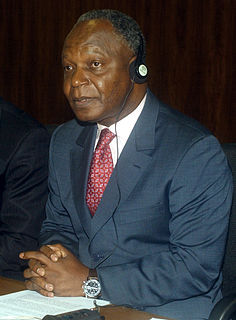
Henri Ossébi is a Congolese sociologist and politician who served in the government of Congo-Brazzaville as Minister of Energy from 2011 to 2016. Previously he was Minister of Higher Education from 2002 to 2009 and Minister of Scientific Research from 2009 to 2011.
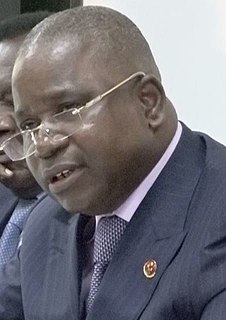
Pierre Ngolo is a Congolese politician who has been Secretary-General of the Congolese Labour Party (PCT) since August 2011. He was First Secretary of the National Assembly of Congo-Brazzaville from 2002 to 2012. He has served as the President of the Senate of Congo-Brazzaville since 2017.
Léon-Alfred Opimbat is a Congolese politician. He served in the government of Congo-Brazzaville as Minister of Health from 1992 to 1993 and as Minister of National Solidarity and Humanitarian Action from 1997 to 2002, with additional responsibility for the health portfolio beginning in 1999. Subsequently he was a Deputy in the National Assembly from 2002 to 2007 and again from 2007 to 2011. He was also President of the New Democratic Forces (FDN), a political party, from 2007 to 2011; when the FDN merged itself into the ruling Congolese Labour Party (PCT) in July 2011, Opimbat became a member of the PCT Political Bureau. He was Minister of Sports from 2011 to 2017, and he has been First Vice-President of the National Assembly since 2017.

Serge Michel Odzoki is a Congolese politician. A member of the Congolese Labour Party (PCT), he is a journalist by profession and worked for years as a diplomat before serving in the government of Congo-Brazzaville as Minister of Sports and Youth from December 2007 to September 2009. He has been a Deputy in the National Assembly since 2009 and Spokesman of the PCT since 2011.

Pascal Tsaty Mabiala is a Congolese politician who has been the Secretary-General of the Pan-African Union for Social Democracy (UPADS) since 2006, as well as President of the UPADS Parliamentary Group since 2007. He stood as the UPADS candidate in the 2016 presidential election.
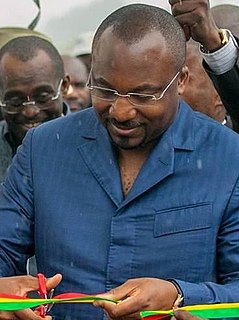
Denis-Christel Sassou Nguesso is a Congolese politician. He is the son of President of Congo-Brazzaville Denis Sassou Nguesso. Denis Christel was administrator-general of Cotrade and was subsequently appointed deputy director-general of the National Petroleum Company of the Congo in December 2010. He was elected to the National Assembly of Congo-Brazzaville in 2012.
Justin Mikolo-Kinzonzi is a Congolese politician. He was Second Vice-President of the National People's Assembly of Congo-Brazzaville during the 1970s. From 2002 to 2011, he served in the Senate of Congo-Brazzaville, and during that time he was President of the Parliamentary Group of the Congolese Labour Party (PCT) in the Senate.
Gabriel Valère Eteka Yemet is a Congolese politician who was First Secretary of the National Assembly of Congo-Brazzaville from 2012 to 2017. Previously he was President of the Departmental Council of Likouala Department.
René-Dambert Ndouane is a Congolese politician who served in the government of Congo-Brazzaville as Minister of Tourism from 1997 to 1999 and as Minister of Labour from 1999 to 2002. He was Second Vice-President of the National Assembly from 2002 to 2007 and First Vice-President of the National Assembly from 2012 to 2017.
Fernand Sabaye is a Congolese politician who has served as a Deputy in the National Assembly of Congo-Brazzaville since 2002.
References
- 1 2 "Who's Who", Congo Brazzaville: Les Hommes de Pouvoir, number 1, Africa Intelligence, 29 October 2002 (in French).
- ↑ Calixte Baniafouna, La bataille de Brazzaville, 5 juin–15 octobre 1997 (2008), L'Harmattan, page 196 (in French).
- ↑ "Elections législatives : les 51 élus du premier tour". Les Dépêches de Brazzaville (in French). 5 June 2002. Archived from the original on 9 February 2012. Retrieved 9 February 2012.
- ↑ "La composition du nouveau gouvernement congolais". Les Dépêches de Brazzaville (in French). 19 August 2002. Archived from the original on 28 May 2012. Retrieved 28 May 2012.
- ↑ "Le Dr Alain Moka s'installe officiellement dans ses fonctions de ministre de la Santé". Les Dépêches de Brazzaville (in French). 23 August 2002. Archived from the original on 11 March 2012. Retrieved 11 March 2012.
- ↑ "Republic of Congo declares end to latest Ebola outbreak, 29 dead", Associated Press, 20 January 2004.
- ↑ "Coming cleaner", Africa Confidential, volume 45, number 15, 21 July 2004.
- ↑ "Le président Denis Sassou Nguesso remanie le gouvernement congolais", Les Dépêches de Brazzaville, 8 January 2005 (in French). "Archived copy". Archived from the original on 2012-03-11. Retrieved 2011-09-07.CS1 maint: archived copy as title (link) CS1 maint: bot: original URL status unknown (link)
- 1 2 "Alain Moka contribue à la lutte contre le VIH/sida dans les écoles de la Likouala", Les Dépêches de Brazzaville, 18 February 2006 (in French). "Archived copy". Archived from the original on 2012-06-10. Retrieved 2011-01-18.CS1 maint: archived copy as title (link) CS1 maint: bot: original URL status unknown (link)
- ↑ "Impfondo : "Radio Moka", une chaîne locale, réduite au silence", Congopage website, 5 September 2005 (in French).
- 1 2 3 Tshitenge Lubabu, "Un boulevard pour 2009", Jeune Afrique, 13 August 2007 (in French).
- ↑ Pascal Azad Doko, "Alain Moka, président de la Fondation Jean-Pierre Moka : «La Fondation Jean-Pierre Moka s’est, surtout, investie dans l’appui au développement de la Likouala»", La Semaine Africaine, 27 November 2012 (in French).
- ↑ Gerry-Gérard Mangondo, "Elections législatives. Le PCT choisit ses candidats dans la Likouala", Les Dépêches de Brazzaville, 3 April 2007 (in French). "Archived copy". Archived from the original on 2012-06-10. Retrieved 2011-01-19.CS1 maint: archived copy as title (link) CS1 maint: bot: original URL status unknown (link)
- 1 2 "Les résultats des élections législatives, avant l'examen des contentieux électoraux", La Semaine Africaine, number 2,720, 21 August 2007, page 7 (in French).
- ↑ "La liste complète des députés". Les Dépêches de Brazzaville (in French). 11 August 2007. Archived from the original on 26 February 2012. Retrieved 26 February 2012.
- ↑ Joël Nsoni, "Denis Sassou Nguesso aux congressistes du P.c.t : «Les élections ne se gagnent pas dans les bureaux. Elles se gagnent sur le terrain»", La Semaine Africaine, 30 July 2011 (in French).
- ↑ "Résultats du premier tour des élections législatives 2012", La Semaine Africaine, 24 July 2012 (in French).
- ↑ Cyr Armel Yabbat-Ngo, "Assemblée nationale : Après moult tractations, les commissions permanentes ont été mises en place", La Semaine Africaine, 21 September 2012 (in French).
- ↑ Pascal Azad Doko, "P.c.t (Parti congolais du travail) : Les parlementaires ont adopté le principe de non cumul de mandats", La Semaine Africaine, 4 April 2014 (in French).
- ↑ "Les résultats tels que publiés par le ministre de l’intérieur et de la décentralisation", La Semaine Africaine, number 3,711, 25 July 2017, page 15 (in French).